




- One kind of cake requires 300 gm of flour and 15 gm of fat and another kind of cake requires 150 gm of flour and 30 gm of fat. Find the maximum number of cakes that can be made from 7.5 kg of flour and 600 gm of fat. Form a linear programming problem and solve it graphically.
Answer
 Verified
625.2k+ views
Hint- Here, we will proceed by making the linear inequalities according to the problem statement and then obtaining the feasible solution which will satisfy all the linear inequalities and then finding the value of the function (which needs to be maximized) corresponding to all the corner points of the feasible point.
Complete step-by-step answer:
Let x and y be the number of cakes made of first kind and second kind respectively.
Given, the first kind of cake requires 300 gm of flour per cake and 15 gm of fat per cake whereas the second kind of cake requires 150 gm of flour per cake and 30 gm of fat per cake.
Maximum amount of flour available = 7.5 kg = 7500 gm
Maximum amount of fat available = 600 gm
According to the problem statement,
$
300x + 150y \leqslant 7500 \\
\Rightarrow 150\left( {2x + y} \right) \leqslant 7500 \\
\Rightarrow 2x + y \leqslant \dfrac{{7500}}{{150}} \\
\Rightarrow 2x + y \leqslant 50{\text{ }} \to {\text{(1)}} \\
$
Also, \[
15x + 30y \leqslant 600 \\
\Rightarrow 15\left( {x + 2y} \right) \leqslant 600 \\
\Rightarrow x + 2y \leqslant \dfrac{{600}}{{15}} \\
\Rightarrow x + 2y \leqslant 40{\text{ }} \to {\text{(2)}} \\
\]
Since, the number of cakes made can never be negative.
$
x \geqslant 0{\text{ }} \to {\text{(3)}} \\
y \geqslant 0{\text{ }} \to {\text{(4)}} \\
$
Here, we have to maximize the total number of cakes made.
Total number of cakes made = Number of cakes made of first kind + Number of cakes made of second kind
$ \Rightarrow $Total number of cakes made, $z = x + y{\text{ }} \to {\text{(5)}}$ (this function needs to be maximized)
Consider $2x + y = 50{\text{ }} \to {\text{(6)}}$
Put x = 0 in equation (6), we get
$
\Rightarrow \left( {2 \times 0} \right) + y = 50 \\
\Rightarrow y = 50 \\
$
Put y = 0 in equation (6), we get
$
\Rightarrow 2x + 0 = 50 \\
\Rightarrow x = \dfrac{{50}}{2} = 25 \\
$
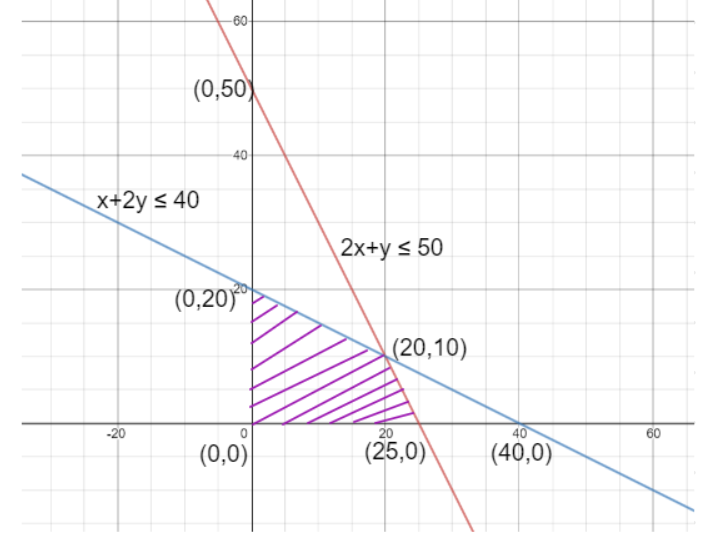
So, the line $2x + y = 50$ passes through the points (0,50) and (25,0)
Consider $x + 2y = 40{\text{ }} \to {\text{(7)}}$
Put x = 0 in equation (6), we get
$
\Rightarrow 0 + 2y = 40 \\
\Rightarrow y = 20 \\
$
Put y = 0 in equation (6), we get
$
\Rightarrow x + \left( {2 \times 0} \right) = 40 \\
\Rightarrow x = 40 \\
$
So, the line $x + 2y = 40$ passes through the points (0,20) and (40,0)
Since, both the linear inequalities given by (1) and (2) satisfy the origin (0,0) and the linear inequalities given by (3) and (4) together represents the first quadrant. So, the feasible region is coloured violet in the figure shown.
Equation (7) can be rewritten as
$ \Rightarrow x = 40 - 2y$
Put the value of x from the above equation in equation (6), we get
$
\Rightarrow 2\left( {40 - 2y} \right) + y = 50 \\
\Rightarrow 80 - 4y + y = 50 \\
\Rightarrow 3y = 30 \\
\Rightarrow y = 10 \\
$
Put y = 10 in the equation $x = 40 - 2y$, we have
$
\Rightarrow x = 40 - \left( {2 \times 10} \right) \\
\Rightarrow x = 40 - 20 \\
\Rightarrow x = 20 \\
$
The point where both the straight lines given by equations (6) and (7) will meet is (20,10)
Corner points of the feasible region (coloured at violet) are (0,0), (25,0), (20,10) and (0,20).
For point (0,0), \[
z = x + y \\
\Rightarrow z = 0 + 0 \\
\Rightarrow z = 0 \\
\]
For point (25,0), \[
z = x + y \\
\Rightarrow z = 25 + 0 \\
\Rightarrow z = 25 \\
\]
For point (20,10), \[
z = x + y \\
\Rightarrow z = 20 + 10 \\
\Rightarrow z = 30 \\
\]
For point (0,20), \[
z = x + y \\
\Rightarrow z = 0 + 20 \\
\Rightarrow z = 20 \\
\]
Clearly, the maximum value of the function z is 30 cakes.
The number of cakes made of first kind are 20 and the number of cakes made of second kind are 10.
Therefore, the maximum number of cakes that can be made from 7.5 kg of flour and 600 gm of fat are 30 cakes.
Note- In this particular problem, if we will put x = 0 and y = 0 in the linear inequalities $2x + y \leqslant 50$ and\[x + 2y \leqslant 40\], we will get $0 \leqslant 50$ and $0 \leqslant 40$ respectively which are true. This means that origin (0,0) satisfies both these linear inequalities. In order to find the point corresponding to which the maximum or minimum value of the function occurs, we will find all the extremes points (i.e., corner points) of the feasible region.
Complete step-by-step answer:
Let x and y be the number of cakes made of first kind and second kind respectively.
Given, the first kind of cake requires 300 gm of flour per cake and 15 gm of fat per cake whereas the second kind of cake requires 150 gm of flour per cake and 30 gm of fat per cake.
Maximum amount of flour available = 7.5 kg = 7500 gm
Maximum amount of fat available = 600 gm
According to the problem statement,
$
300x + 150y \leqslant 7500 \\
\Rightarrow 150\left( {2x + y} \right) \leqslant 7500 \\
\Rightarrow 2x + y \leqslant \dfrac{{7500}}{{150}} \\
\Rightarrow 2x + y \leqslant 50{\text{ }} \to {\text{(1)}} \\
$
Also, \[
15x + 30y \leqslant 600 \\
\Rightarrow 15\left( {x + 2y} \right) \leqslant 600 \\
\Rightarrow x + 2y \leqslant \dfrac{{600}}{{15}} \\
\Rightarrow x + 2y \leqslant 40{\text{ }} \to {\text{(2)}} \\
\]
Since, the number of cakes made can never be negative.
$
x \geqslant 0{\text{ }} \to {\text{(3)}} \\
y \geqslant 0{\text{ }} \to {\text{(4)}} \\
$
Here, we have to maximize the total number of cakes made.
Total number of cakes made = Number of cakes made of first kind + Number of cakes made of second kind
$ \Rightarrow $Total number of cakes made, $z = x + y{\text{ }} \to {\text{(5)}}$ (this function needs to be maximized)
Consider $2x + y = 50{\text{ }} \to {\text{(6)}}$
Put x = 0 in equation (6), we get
$
\Rightarrow \left( {2 \times 0} \right) + y = 50 \\
\Rightarrow y = 50 \\
$
Put y = 0 in equation (6), we get
$
\Rightarrow 2x + 0 = 50 \\
\Rightarrow x = \dfrac{{50}}{2} = 25 \\
$
So, the line $2x + y = 50$ passes through the points (0,50) and (25,0)
Consider $x + 2y = 40{\text{ }} \to {\text{(7)}}$
Put x = 0 in equation (6), we get
$
\Rightarrow 0 + 2y = 40 \\
\Rightarrow y = 20 \\
$
Put y = 0 in equation (6), we get
$
\Rightarrow x + \left( {2 \times 0} \right) = 40 \\
\Rightarrow x = 40 \\
$
So, the line $x + 2y = 40$ passes through the points (0,20) and (40,0)
Since, both the linear inequalities given by (1) and (2) satisfy the origin (0,0) and the linear inequalities given by (3) and (4) together represents the first quadrant. So, the feasible region is coloured violet in the figure shown.
Equation (7) can be rewritten as
$ \Rightarrow x = 40 - 2y$
Put the value of x from the above equation in equation (6), we get
$
\Rightarrow 2\left( {40 - 2y} \right) + y = 50 \\
\Rightarrow 80 - 4y + y = 50 \\
\Rightarrow 3y = 30 \\
\Rightarrow y = 10 \\
$
Put y = 10 in the equation $x = 40 - 2y$, we have
$
\Rightarrow x = 40 - \left( {2 \times 10} \right) \\
\Rightarrow x = 40 - 20 \\
\Rightarrow x = 20 \\
$
The point where both the straight lines given by equations (6) and (7) will meet is (20,10)
Corner points of the feasible region (coloured at violet) are (0,0), (25,0), (20,10) and (0,20).
For point (0,0), \[
z = x + y \\
\Rightarrow z = 0 + 0 \\
\Rightarrow z = 0 \\
\]
For point (25,0), \[
z = x + y \\
\Rightarrow z = 25 + 0 \\
\Rightarrow z = 25 \\
\]
For point (20,10), \[
z = x + y \\
\Rightarrow z = 20 + 10 \\
\Rightarrow z = 30 \\
\]
For point (0,20), \[
z = x + y \\
\Rightarrow z = 0 + 20 \\
\Rightarrow z = 20 \\
\]
Clearly, the maximum value of the function z is 30 cakes.
The number of cakes made of first kind are 20 and the number of cakes made of second kind are 10.
Therefore, the maximum number of cakes that can be made from 7.5 kg of flour and 600 gm of fat are 30 cakes.
Note- In this particular problem, if we will put x = 0 and y = 0 in the linear inequalities $2x + y \leqslant 50$ and\[x + 2y \leqslant 40\], we will get $0 \leqslant 50$ and $0 \leqslant 40$ respectively which are true. This means that origin (0,0) satisfies both these linear inequalities. In order to find the point corresponding to which the maximum or minimum value of the function occurs, we will find all the extremes points (i.e., corner points) of the feasible region.
Recently Updated Pages
Basicity of sulphurous acid and sulphuric acid are

Master Class 10 English: Engaging Questions & Answers for Success
Master Class 10 Social Science: Engaging Questions & Answers for Success
Master Class 10 Computer Science: Engaging Questions & Answers for Success
Class 10 Question and Answer - Your Ultimate Solutions Guide
Master Class 10 General Knowledge: Engaging Questions & Answers for Success
Trending doubts
Which country won the ICC Men's ODI World Cup in 2023?
In cricket, how many legal balls are there in a standard over?
Explain the Treaty of Vienna of 1815 class 10 social science CBSE
A boat goes 24 km upstream and 28 km downstream in class 10 maths CBSE
What does "powerplay" mean in limited-overs cricket?
What is the "Powerplay" in T20 cricket?