




On which of the following do action reaction forces act upon?
A. Same body
B. Different bodies
C. Along different lines
D. In the same direction
Answer
 Verified
622.8k+ views
Hint: According to Newton’s third law of motion, each body in the universe exerts a force on every other body in the universe. The pair of forces which are a result of interaction or contact between two bodies are called action reaction forces.
Complete step by step answer:
A force is a push or a pull that acts upon a body as a result of its interaction with another body. Forces result from interactions. Some forces are a result of contact interactions such as normal force, frictional force, tensional force, and applied forces, and other forces are the result of action-at-a-distance interactions such as gravitational force, electrical force, and magnetic force. According to Newton’s law, whenever body A interacts with body B, they both exert forces upon each other.
For example, when we sit in a chair, our body exerts a downward force on the chair and the chair exerts an upward force on our body. There are two forces which are the results of this interaction - a force on the chair and a force exerted on our body. These two forces are known as action and reaction forces and are the subject to Newton's third law of motion.
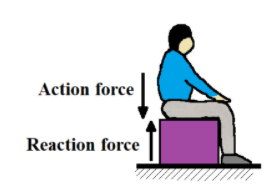
Newton's Third law states that the equal and opposite action-reaction pair acts on different bodies.
Hence, the correct option is B.
Note:
Whenever two bodies interact, they exert equal and opposite forces on each other. This can be observed anywhere and everywhere in the surroundings. Newton’s Third Law of Motion states that when an object exerts a force on another object, the second object exerts a force on the first object that is equal in magnitude and opposite in direction of the force exerted by the first object on the second object. This law is sometimes called the Law of Action and Reaction. Even though the forces are equal in magnitude, or strength, and opposite in direction, they do not cancel each other. This law actually addresses two objects, each with only one force exerted on it.
Complete step by step answer:
A force is a push or a pull that acts upon a body as a result of its interaction with another body. Forces result from interactions. Some forces are a result of contact interactions such as normal force, frictional force, tensional force, and applied forces, and other forces are the result of action-at-a-distance interactions such as gravitational force, electrical force, and magnetic force. According to Newton’s law, whenever body A interacts with body B, they both exert forces upon each other.
For example, when we sit in a chair, our body exerts a downward force on the chair and the chair exerts an upward force on our body. There are two forces which are the results of this interaction - a force on the chair and a force exerted on our body. These two forces are known as action and reaction forces and are the subject to Newton's third law of motion.
Newton's Third law states that the equal and opposite action-reaction pair acts on different bodies.
Hence, the correct option is B.
Note:
Whenever two bodies interact, they exert equal and opposite forces on each other. This can be observed anywhere and everywhere in the surroundings. Newton’s Third Law of Motion states that when an object exerts a force on another object, the second object exerts a force on the first object that is equal in magnitude and opposite in direction of the force exerted by the first object on the second object. This law is sometimes called the Law of Action and Reaction. Even though the forces are equal in magnitude, or strength, and opposite in direction, they do not cancel each other. This law actually addresses two objects, each with only one force exerted on it.
Recently Updated Pages
Master Class 12 Economics: Engaging Questions & Answers for Success

Master Class 12 English: Engaging Questions & Answers for Success
Master Class 12 Social Science: Engaging Questions & Answers for Success
Master Class 12 Maths: Engaging Questions & Answers for Success
Master Class 12 Physics: Engaging Questions & Answers for Success
Master Class 9 General Knowledge: Engaging Questions & Answers for Success
Trending doubts
One Metric ton is equal to kg A 10000 B 1000 C 100 class 11 physics CBSE
Difference Between Prokaryotic Cells and Eukaryotic Cells
Two of the body parts which do not appear in MRI are class 11 biology CBSE
Find the value of the expression given below sin 30circ class 11 maths CBSE
1 ton equals to A 100 kg B 1000 kg C 10 kg D 10000 class 11 physics CBSE
Draw a diagram of nephron and explain its structur class 11 biology CBSE