




On what principle electric motor works?
A. Principle of force experienced by current carrying conductor in magnetic field
B. Principle of current experienced by current carrying conductor in magnetic field
C. Principle of force experienced by current carrying conductor in electric field
D. None of the above
Answer
 Verified
632.7k+ views
Hint: The electric motor is an electrical device which is capable of converting electrical energy into mechanical energy by using the magnetic effect of electric current. In an electric motor, we place a current-carrying-conductor in a magnetic field which experiences a force.
Complete step by step answer:
An electric motor is an electrical device which is used for converting electrical energy into mechanical energy (usually a torque). This conversion is obtained through the generation of a magnetic field.
When a current-carrying conductor is placed in a magnetic field, it experiences a force.
The experiment shows that the magnitude of the force depends directly on the current in the wire, and the strength of the magnetic field. The force is greatest when the magnetic field is perpendicular to the conductor.
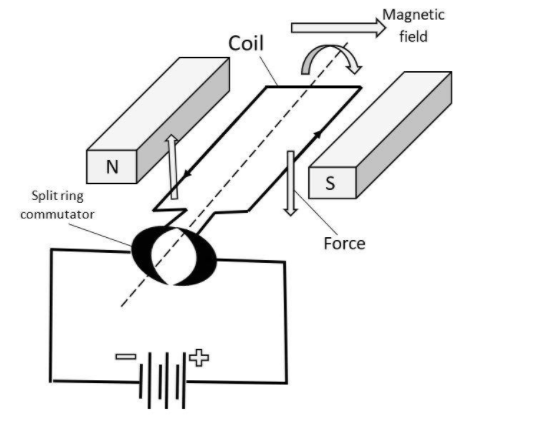
So, an electric motor is based on the principle of ‘force experienced by a current carrying conductor in a magnetic field’.
Hence, the correct option is A, i.e., Principle of force experienced by the current carrying conductor in the magnetic field.
Additional Information:
When an electric current is passed through a rectangular coil, this current produces a magnetic field around the coil. Thereafter the magnetic field of the magnet interacts with the magnetic field of the coil and causes the coil to rotate continuously.
Note: The students should understand that the working of the electric motor is purely based on the Faraday’s law of electromagnetic induction where the magnetic effect of electric current is involved. The law states that the changing fields produce electromotive force or emf.
Complete step by step answer:
An electric motor is an electrical device which is used for converting electrical energy into mechanical energy (usually a torque). This conversion is obtained through the generation of a magnetic field.
When a current-carrying conductor is placed in a magnetic field, it experiences a force.
The experiment shows that the magnitude of the force depends directly on the current in the wire, and the strength of the magnetic field. The force is greatest when the magnetic field is perpendicular to the conductor.
So, an electric motor is based on the principle of ‘force experienced by a current carrying conductor in a magnetic field’.
Hence, the correct option is A, i.e., Principle of force experienced by the current carrying conductor in the magnetic field.
Additional Information:
When an electric current is passed through a rectangular coil, this current produces a magnetic field around the coil. Thereafter the magnetic field of the magnet interacts with the magnetic field of the coil and causes the coil to rotate continuously.
Note: The students should understand that the working of the electric motor is purely based on the Faraday’s law of electromagnetic induction where the magnetic effect of electric current is involved. The law states that the changing fields produce electromotive force or emf.
Recently Updated Pages
Master Class 12 Business Studies: Engaging Questions & Answers for Success

Master Class 12 Chemistry: Engaging Questions & Answers for Success
Master Class 12 Biology: Engaging Questions & Answers for Success
Class 12 Question and Answer - Your Ultimate Solutions Guide
Master Class 11 English: Engaging Questions & Answers for Success
Master Class 11 Social Science: Engaging Questions & Answers for Success
Trending doubts
Which are the Top 10 Largest Countries of the World?
Draw a labelled sketch of the human eye class 12 physics CBSE
Differentiate between homogeneous and heterogeneous class 12 chemistry CBSE
Why is the cell called the structural and functional class 12 biology CBSE
Draw ray diagrams each showing i myopic eye and ii class 12 physics CBSE
Which is the correct genotypic ratio of mendel dihybrid class 12 biology CBSE