




On open ground, a motorist follows a track that turns to his left by an angle of 60 degrees after every 500m. Starting from a given turn, specify the displacement of the motorist at the third, sixth and eighth turn. Compare the magnitude of the displacement with the total path length covered by the motorist in each case.
Answer
 Verified
581.4k+ views
Hint: Find out the shape of the path followed by the motorist by using the information given in the question. To find out the angle between two consecutive tracks, subtract the turn angle from${{180}^{{}^\circ }}$. To find the displacement use the law of vector addition.
Complete step-by-step answer:
Since the motorist takes a ${{60}^{{}^\circ }}$turn, the angle between two consecutive tracks is ${{180}^{{}^\circ }}={{60}^{{}^\circ }}={{120}^{{}^\circ }}$.
Thus, the motorist follows a hexagonal path with track length 500m
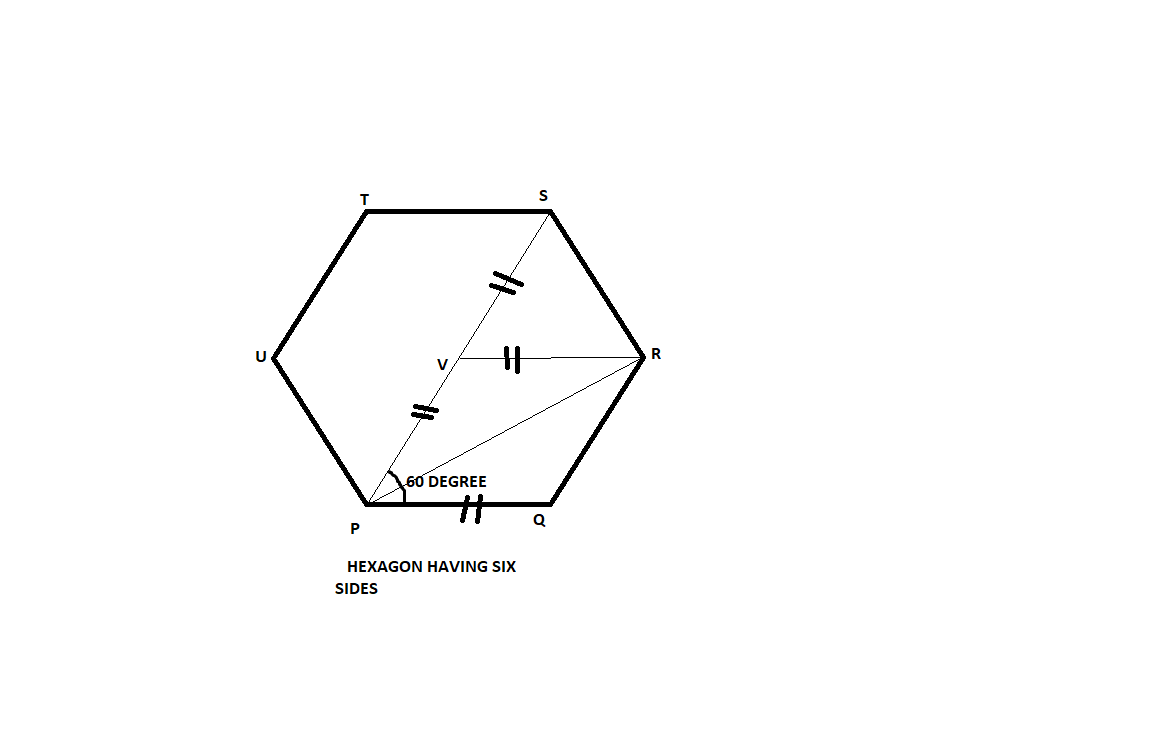
Let’s say the motorist starts from point P. So at the third turn, he will be at S, at the sixth turn, he will return to its original position and at the eight turn, he will be at R.
Since displacement is a vector quantity, to find out displacement we will do vector addition of each displacement at each turn.
We can calculate the displacement at the third turn as
PS=PV+VS
Since $\square PQRV$is a Rhombus, we have,
PQ=QR=RV=VP=500m
Therefore, PS=500+500=1000m
Total path length covered by motorist at third turn=PQ+QR+RS=500+500+500=1500m
When the motorist takes the sixth turn, he will return to its original position, therefore, his displacement is zero at sixth turn.
Total path length at the sixth turn= PQ+QR+RS+ST+TU+UP=500+500+500+500+500+500=3000m
When the motorist takes the eighth turn at S:
Magnitude of displacement of the motorist at the sixth turn = PS=PV+VS=500+500=1000m
But total path length= PQ+QR+RS+ST+TU+UP+PQ+QR+RS=500+500+500+500+500+500+500+500+500=4500m
Note: The displacement is the shortest distance between the starting and the endpoint of the body. If a body returns to its original position then the displacement of a body is zero. If a body travels in a straight line then the displacement of the body is equal to the total path length covered by it.
Complete step-by-step answer:
Since the motorist takes a ${{60}^{{}^\circ }}$turn, the angle between two consecutive tracks is ${{180}^{{}^\circ }}={{60}^{{}^\circ }}={{120}^{{}^\circ }}$.
Thus, the motorist follows a hexagonal path with track length 500m
Let’s say the motorist starts from point P. So at the third turn, he will be at S, at the sixth turn, he will return to its original position and at the eight turn, he will be at R.
Since displacement is a vector quantity, to find out displacement we will do vector addition of each displacement at each turn.
We can calculate the displacement at the third turn as
PS=PV+VS
Since $\square PQRV$is a Rhombus, we have,
PQ=QR=RV=VP=500m
Therefore, PS=500+500=1000m
Total path length covered by motorist at third turn=PQ+QR+RS=500+500+500=1500m
When the motorist takes the sixth turn, he will return to its original position, therefore, his displacement is zero at sixth turn.
Total path length at the sixth turn= PQ+QR+RS+ST+TU+UP=500+500+500+500+500+500=3000m
When the motorist takes the eighth turn at S:
Magnitude of displacement of the motorist at the sixth turn = PS=PV+VS=500+500=1000m
But total path length= PQ+QR+RS+ST+TU+UP+PQ+QR+RS=500+500+500+500+500+500+500+500+500=4500m
Note: The displacement is the shortest distance between the starting and the endpoint of the body. If a body returns to its original position then the displacement of a body is zero. If a body travels in a straight line then the displacement of the body is equal to the total path length covered by it.
Recently Updated Pages
Basicity of sulphurous acid and sulphuric acid are

Master Class 11 English: Engaging Questions & Answers for Success
Master Class 11 Physics: Engaging Questions & Answers for Success
Master Class 11 Computer Science: Engaging Questions & Answers for Success
Master Class 11 Chemistry: Engaging Questions & Answers for Success
Master Class 11 Social Science: Engaging Questions & Answers for Success
Trending doubts
Difference Between Prokaryotic Cells and Eukaryotic Cells
Two of the body parts which do not appear in MRI are class 11 biology CBSE
One Metric ton is equal to kg A 10000 B 1000 C 100 class 11 physics CBSE
10 examples of friction in our daily life
Draw a diagram of nephron and explain its structur class 11 biology CBSE
What will happen if the mucus is not secreted by the class 11 biology CBSE