




How many obtuse angles does a parallelogram have?
Answer
 Verified
594.3k+ views
Hint: Here in this question, we need to find the number of obtuse angles formed in a parallelogram. Obtuse Angles are the angles that are more than ${{90}^{\circ }}$. Parallelogram is basically a quadrilateral having four sides and four angles.
Complete step by step answer:
Now, let’s have a look at the question:
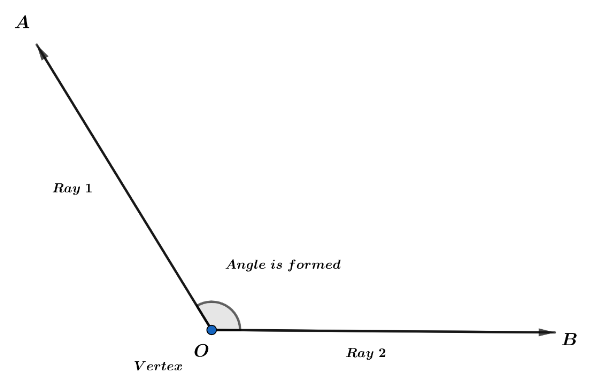
As we know that when the two rays meet at a vertex, an angle is formed and it is represented by the symbol $\angle $ and is measured in degrees.
We also know what an obtuse angle is!
The angle whose measure is greater than ${{90}^{\circ }}$ and lesser than ${{180}^{\circ }}$ is called an obtuse angle.
Let’s see some of the examples of obtuse angle:
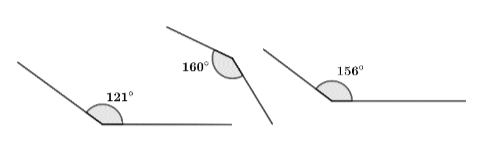
So, the angles ${{121}^{\circ }},{{160}^{\circ }},{{156}^{\circ }}$ can be called as Obtuse Angles.
Real-life example: In real life, when the minute hand of the clock is at 10 and the hour hand is at 3, then the angle formed between 10-3 clockwise will be an obtuse angle.
Now, let’s come to parallelogram:
The parallelogram is basically a simple quadrilateral having two pairs of parallel sides, opposite sides equal lengths and equal opposite angles.
You should know that the sum of the interior angles of any quadrilateral is ${{180}^{\circ }}$.
Thus, consecutive angles are supplementary and the opposite angles are equal.
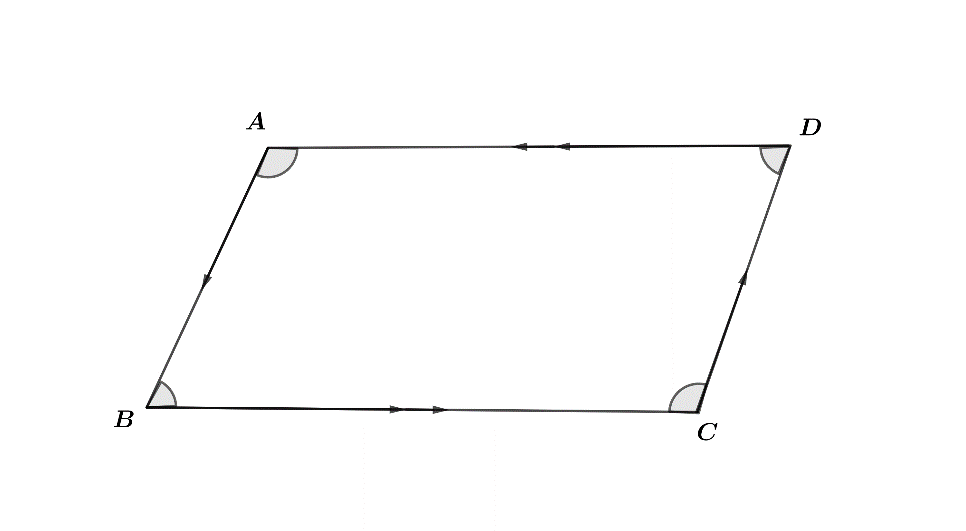
So, from the figure, we can see that there are only two obtuse angles (i.e. $\angle $ A & $\angle $ C) of a parallelogram which are equal and the other two angles are acute angles. Hence, we can say that a parallelogram has two Obtuse Angles.
Note:
You can use a protractor to check that the measure of the obtuse angles of a parallelogram. Note that the obtuse angle is greater than 90° and the acute angle is less than 90°. You must draw the figure to represent the obtuse angles in the answer.
Complete step by step answer:
Now, let’s have a look at the question:
As we know that when the two rays meet at a vertex, an angle is formed and it is represented by the symbol $\angle $ and is measured in degrees.
We also know what an obtuse angle is!
The angle whose measure is greater than ${{90}^{\circ }}$ and lesser than ${{180}^{\circ }}$ is called an obtuse angle.
Let’s see some of the examples of obtuse angle:
So, the angles ${{121}^{\circ }},{{160}^{\circ }},{{156}^{\circ }}$ can be called as Obtuse Angles.
Real-life example: In real life, when the minute hand of the clock is at 10 and the hour hand is at 3, then the angle formed between 10-3 clockwise will be an obtuse angle.
Now, let’s come to parallelogram:
The parallelogram is basically a simple quadrilateral having two pairs of parallel sides, opposite sides equal lengths and equal opposite angles.
You should know that the sum of the interior angles of any quadrilateral is ${{180}^{\circ }}$.
Thus, consecutive angles are supplementary and the opposite angles are equal.
So, from the figure, we can see that there are only two obtuse angles (i.e. $\angle $ A & $\angle $ C) of a parallelogram which are equal and the other two angles are acute angles. Hence, we can say that a parallelogram has two Obtuse Angles.
Note:
You can use a protractor to check that the measure of the obtuse angles of a parallelogram. Note that the obtuse angle is greater than 90° and the acute angle is less than 90°. You must draw the figure to represent the obtuse angles in the answer.
Recently Updated Pages
Master Class 12 Economics: Engaging Questions & Answers for Success

Master Class 12 English: Engaging Questions & Answers for Success
Master Class 12 Social Science: Engaging Questions & Answers for Success
Master Class 12 Maths: Engaging Questions & Answers for Success
Master Class 12 Physics: Engaging Questions & Answers for Success
Master Class 9 General Knowledge: Engaging Questions & Answers for Success
Trending doubts
Explain the Treaty of Vienna of 1815 class 10 social science CBSE
Who Won 36 Oscar Awards? Record Holder Revealed
What is the median of the first 10 natural numbers class 10 maths CBSE
Why is it 530 pm in india when it is 1200 afternoon class 10 social science CBSE
Make a sketch of the human nerve cell What function class 10 biology CBSE
What is the full form of POSCO class 10 social science CBSE