




Obtain the expression for the deflecting torque acting on the current-carrying rectangular coil of a galvanometer in a uniform magnetic field. Why is a radial magnetic field employed in the moving coil galvanometer?
Answer
 Verified
585.3k+ views
Hint: A moving coil galvanometer is a device used to detect or measure very small currents. It works on the principle that when current flows through a rectangular coil kept in a magnetic field, it is deflected. The angle of deflection is proportional to the current through the coil.
Complete step by step solution:
Let us consider a rectangular coil $ABCD\;$. A current $I$ is flowing through the coil. Let $N$ be the number of turns of the coil and a uniform magnetic $B$ is along the x-axis.
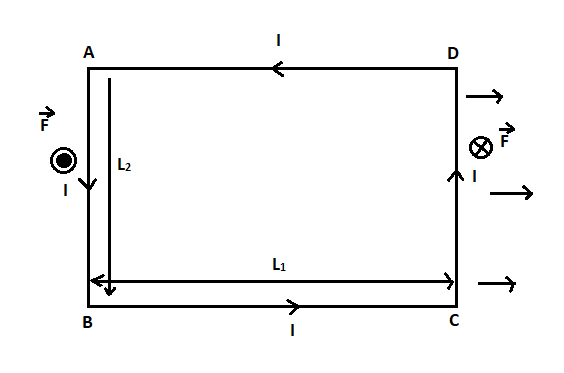
There will be a force acting on $AB\;$ and $CD\;$ since they are perpendicular to the direction of the magnetic field. Since $AD\;$ and $BC\;$ is along the direction of the magnetic field the force on these sides will be zero. Since the magnetic field $B\;$ is uniform and the same current is flowing through the coil, the force on $AB\;$ and $CD\;$ will be equal in magnitude and opposite in direction.
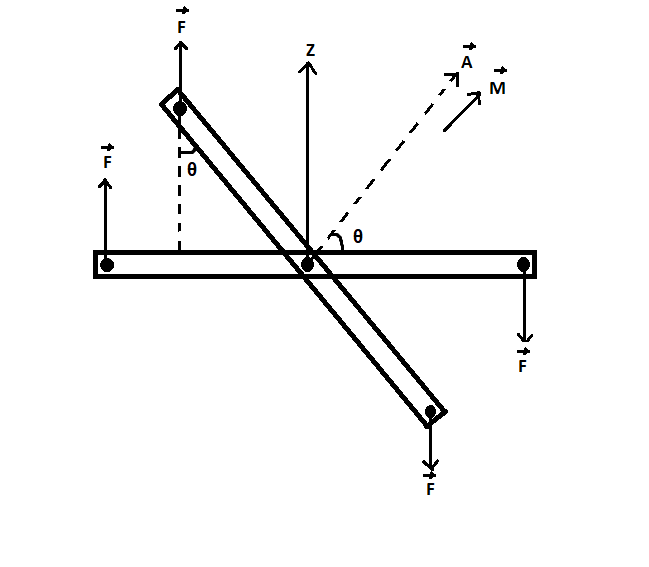
Let $\theta $ be the angle turned by the coil.
The force can be written as,
$F = \left( {I{l_2}B} \right)N\hat k$
Where $I$ stands for the current, ${l_2}$ is the breadth of the rectangle, $B$ is the magnetic field, $N$ is the number of turns, and $\hat k$ shows that the direction of force is in the $Z$ direction.
The torque can be written as,
$\tau = \dfrac{{F \times {l_1}}}{2}\sin \theta + \dfrac{{F \times {l_1}}}{2}\sin \theta $
This can be written as,
$\tau = \left( {\dfrac{{F{l_1}\sin \theta }}{2}} \right) \times 2$
Substituting the value of force in this equation, we get
$\tau = \left( {\dfrac{{BI{l_1}{l_2}\sin \theta }}{2}} \right) \times 2N$
This equation can be rearranged as,
$\tau = NIB{l_1}{l_2}\sin \theta $
Let $A$ be the area of the rectangular coil,
$A$ can be written as
$A = {l_1}{l_2}$
Now we can write the above equation as,
$\tau = NIAB\sin \theta $
Let $NIA = \vec M$
Where $\vec M$ is the magnetic moment of the coil.
Substituting, we get
$\tau = \vec M\vec B\sin \theta $
This is the cross product of $\vec M$ and $\vec B$.
$\tau = \vec M \times \vec B$.
Note:
The current-carrying coil rotates due to the torque. The suspension wire is twisted. A restoring couple is developed in the suspension wire. A steady deflection $\theta $ is produced when the restoring couple balances the torque produced. At equilibrium, the torque is proportional to the restoring couple.
Complete step by step solution:
Let us consider a rectangular coil $ABCD\;$. A current $I$ is flowing through the coil. Let $N$ be the number of turns of the coil and a uniform magnetic $B$ is along the x-axis.
There will be a force acting on $AB\;$ and $CD\;$ since they are perpendicular to the direction of the magnetic field. Since $AD\;$ and $BC\;$ is along the direction of the magnetic field the force on these sides will be zero. Since the magnetic field $B\;$ is uniform and the same current is flowing through the coil, the force on $AB\;$ and $CD\;$ will be equal in magnitude and opposite in direction.
Let $\theta $ be the angle turned by the coil.
The force can be written as,
$F = \left( {I{l_2}B} \right)N\hat k$
Where $I$ stands for the current, ${l_2}$ is the breadth of the rectangle, $B$ is the magnetic field, $N$ is the number of turns, and $\hat k$ shows that the direction of force is in the $Z$ direction.
The torque can be written as,
$\tau = \dfrac{{F \times {l_1}}}{2}\sin \theta + \dfrac{{F \times {l_1}}}{2}\sin \theta $
This can be written as,
$\tau = \left( {\dfrac{{F{l_1}\sin \theta }}{2}} \right) \times 2$
Substituting the value of force in this equation, we get
$\tau = \left( {\dfrac{{BI{l_1}{l_2}\sin \theta }}{2}} \right) \times 2N$
This equation can be rearranged as,
$\tau = NIB{l_1}{l_2}\sin \theta $
Let $A$ be the area of the rectangular coil,
$A$ can be written as
$A = {l_1}{l_2}$
Now we can write the above equation as,
$\tau = NIAB\sin \theta $
Let $NIA = \vec M$
Where $\vec M$ is the magnetic moment of the coil.
Substituting, we get
$\tau = \vec M\vec B\sin \theta $
This is the cross product of $\vec M$ and $\vec B$.
$\tau = \vec M \times \vec B$.
Note:
The current-carrying coil rotates due to the torque. The suspension wire is twisted. A restoring couple is developed in the suspension wire. A steady deflection $\theta $ is produced when the restoring couple balances the torque produced. At equilibrium, the torque is proportional to the restoring couple.
Recently Updated Pages
Master Class 10 Computer Science: Engaging Questions & Answers for Success

Master Class 10 General Knowledge: Engaging Questions & Answers for Success
Master Class 10 English: Engaging Questions & Answers for Success
Master Class 10 Social Science: Engaging Questions & Answers for Success
Master Class 10 Maths: Engaging Questions & Answers for Success
Master Class 10 Science: Engaging Questions & Answers for Success
Trending doubts
Which is more stable and why class 12 chemistry CBSE
Which are the Top 10 Largest Countries of the World?
Draw a labelled sketch of the human eye class 12 physics CBSE
Differentiate between homogeneous and heterogeneous class 12 chemistry CBSE
What are the major means of transport Explain each class 12 social science CBSE
Sulphuric acid is known as the king of acids State class 12 chemistry CBSE