




When an object is placed at a distance of 50cm from a concave spherical mirror, the magnification produced is \[-\dfrac{1}{2}\]. Where should the object be placed to get a magnification of \[-\dfrac{1}{5}\]?
Answer
 Verified
611.7k+ views
Hint: A concave mirror of certain focal length is used to get a magnification of \[-\dfrac{1}{2}\] when placed at 50cm from the mirror. We can find the focal length using the mirror formula and hence, find the object distance to get the magnification of \[-\dfrac{1}{5}\].
Complete answer:
We are given a concave mirror of focal length ‘f’ which produces an image of magnification \[-\dfrac{1}{2}\] when an object is placed 50cm from its reflecting surface. We can easily find the focal length using the mirror formula and magnification formula for reflecting surfaces.
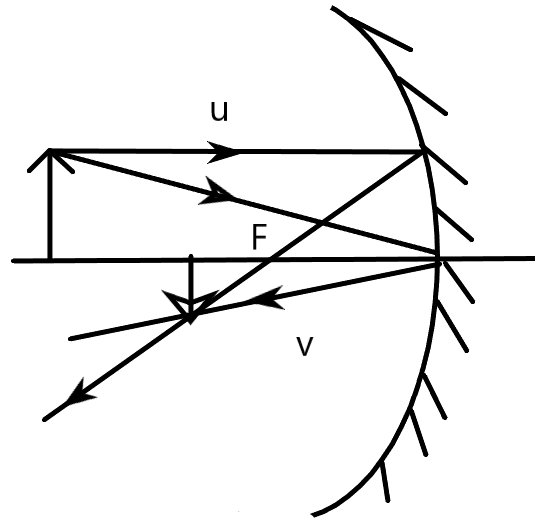
The mirror formula as we know is given by –
\[\dfrac{1}{f}=\dfrac{1}{v}+\dfrac{1}{u}\]
Where, f is the focal length of the concave mirror,
v is the image distance from the reflecting surface,
u is the object distance from the reflecting surface.
Here,
\[u=-50cm\]
Now, we can employ the formula to find the magnification in terms of image distance and object distance to find the image distance ‘v’.
\[\begin{align}
& \text{also,} \\
& \text{magnification, }m=\dfrac{v}{u} \\
& \text{given,} \\
& m=-\dfrac{1}{2} \\
& \Rightarrow \text{ }\dfrac{v}{u}=-\dfrac{1}{2} \\
& \Rightarrow \text{ }v=-\dfrac{u}{2}=-25cm \\
\end{align}\]
Now we can apply these in the mirror formula to get the focal length of the concave mirror as –
\[\begin{align}
& \dfrac{1}{f}=\dfrac{1}{v}+\dfrac{1}{u} \\
& \Rightarrow \text{ }f=\dfrac{uv}{u+v} \\
& u=-50cm\text{ and }v=-25cm \\
& \Rightarrow \text{ }f=\dfrac{-50\times -25}{-50+-25}=\dfrac{-50}{3}cm \\
\end{align}\]
Now, let us find the object distance to get an image of magnification \[-\dfrac{1}{5}\] with a focal length of \[\dfrac{-50}{3}cm\].
\[\begin{align}
& \text{given,} \\
& m'=-\dfrac{1}{5} \\
& \Rightarrow \text{ -}\dfrac{v}{u}=-\dfrac{1}{5} \\
& \Rightarrow \text{ u}=5v \\
\end{align}\]
Now, we can apply the mirror formula to find the object distance ‘u’
\[\begin{align}
& \dfrac{1}{f}=\dfrac{1}{v}+\dfrac{1}{u} \\
& \Rightarrow \text{ }f=\dfrac{uv}{u+v} \\
& u=5v \\
& \Rightarrow \text{ }\dfrac{-50}{3}=\dfrac{5v.v}{5v+v} \\
& \Rightarrow \text{ }\dfrac{5v}{6}=\dfrac{-50}{3} \\
& \Rightarrow \text{ }v=-20cm \\
& \text{but, } \\
& u=5v \\
& \Rightarrow \text{ }u=-100cm \\
\end{align}\]
We got the object distance for the image to have a magnification of \[-\dfrac{1}{5}\] to be 100cm from the mirror to the left.
Note:
We should be careful while considering the sign conventions in the mirror formula and the magnification. We have to consider the signs for a variable which is known to have a negative direction as that of the object distance always has. Errors can be severe if we avoid them.
Complete answer:
We are given a concave mirror of focal length ‘f’ which produces an image of magnification \[-\dfrac{1}{2}\] when an object is placed 50cm from its reflecting surface. We can easily find the focal length using the mirror formula and magnification formula for reflecting surfaces.
The mirror formula as we know is given by –
\[\dfrac{1}{f}=\dfrac{1}{v}+\dfrac{1}{u}\]
Where, f is the focal length of the concave mirror,
v is the image distance from the reflecting surface,
u is the object distance from the reflecting surface.
Here,
\[u=-50cm\]
Now, we can employ the formula to find the magnification in terms of image distance and object distance to find the image distance ‘v’.
\[\begin{align}
& \text{also,} \\
& \text{magnification, }m=\dfrac{v}{u} \\
& \text{given,} \\
& m=-\dfrac{1}{2} \\
& \Rightarrow \text{ }\dfrac{v}{u}=-\dfrac{1}{2} \\
& \Rightarrow \text{ }v=-\dfrac{u}{2}=-25cm \\
\end{align}\]
Now we can apply these in the mirror formula to get the focal length of the concave mirror as –
\[\begin{align}
& \dfrac{1}{f}=\dfrac{1}{v}+\dfrac{1}{u} \\
& \Rightarrow \text{ }f=\dfrac{uv}{u+v} \\
& u=-50cm\text{ and }v=-25cm \\
& \Rightarrow \text{ }f=\dfrac{-50\times -25}{-50+-25}=\dfrac{-50}{3}cm \\
\end{align}\]
Now, let us find the object distance to get an image of magnification \[-\dfrac{1}{5}\] with a focal length of \[\dfrac{-50}{3}cm\].
\[\begin{align}
& \text{given,} \\
& m'=-\dfrac{1}{5} \\
& \Rightarrow \text{ -}\dfrac{v}{u}=-\dfrac{1}{5} \\
& \Rightarrow \text{ u}=5v \\
\end{align}\]
Now, we can apply the mirror formula to find the object distance ‘u’
\[\begin{align}
& \dfrac{1}{f}=\dfrac{1}{v}+\dfrac{1}{u} \\
& \Rightarrow \text{ }f=\dfrac{uv}{u+v} \\
& u=5v \\
& \Rightarrow \text{ }\dfrac{-50}{3}=\dfrac{5v.v}{5v+v} \\
& \Rightarrow \text{ }\dfrac{5v}{6}=\dfrac{-50}{3} \\
& \Rightarrow \text{ }v=-20cm \\
& \text{but, } \\
& u=5v \\
& \Rightarrow \text{ }u=-100cm \\
\end{align}\]
We got the object distance for the image to have a magnification of \[-\dfrac{1}{5}\] to be 100cm from the mirror to the left.
Note:
We should be careful while considering the sign conventions in the mirror formula and the magnification. We have to consider the signs for a variable which is known to have a negative direction as that of the object distance always has. Errors can be severe if we avoid them.
Recently Updated Pages
Master Class 12 Economics: Engaging Questions & Answers for Success

Master Class 12 English: Engaging Questions & Answers for Success
Master Class 12 Social Science: Engaging Questions & Answers for Success
Master Class 12 Maths: Engaging Questions & Answers for Success
Master Class 12 Physics: Engaging Questions & Answers for Success
Master Class 10 English: Engaging Questions & Answers for Success
Trending doubts
Why is it 530 pm in india when it is 1200 afternoon class 10 social science CBSE
The speaker of the Lok Sabha is elected by the APresident class 10 social science CBSE
Complete the sentence with the most appropriate word class 10 english CBSE
a Draw a labelled diagram of a sectional view of the class 10 biology CBSE
Fill the blanks with proper collective nouns 1 A of class 10 english CBSE
Why did Frederic Sorrieu present utopian vision in class 10 social science CBSE