




Number of oxygen atoms in lipid molecules is always ......... as compared to the number of carbon atoms
(A) Less
(B) More
(C) Equal
(D) Double
Answer
 Verified
637.5k+ views
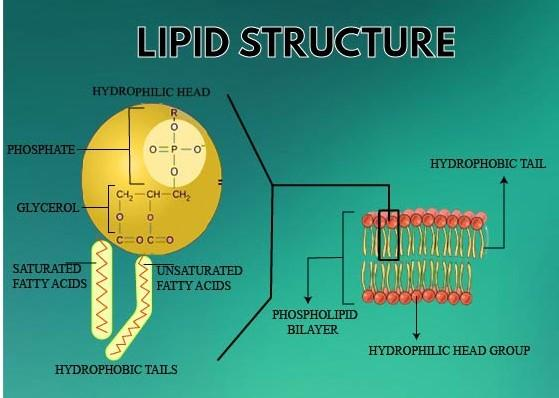
Hint: Lipid is a glycerol molecule that is bonded to long hydrocarbon chains and other molecules like phosphate group, etc. Lipid is the main component of animal cells and plant cells. In lipids that element is present in greater amounts that are non-metallic and are tetravalent.
Complete answer:
A hydrocarbon chain is a type of molecule that consists of hydrogen and carbon only. Oxygen is also present in lipid molecules but the major portion is carbon as carbon is also present in the hydrocarbon chain and lipid has a good amount of hydrocarbon chain present.
Additional Information: Lipid is defined as a substance that is not soluble in water but soluble in alcohol, ether, and chloroform which are also known as non-polar solvents
They are a crucial component of living cells. alongside carbohydrates and proteins. Lipid is also one of the main components of animal and plant cells. Lipids are the polymers of fatty acids that contain an extended, non-polar hydrocarbon chain with a little polar region containing oxygen. Lipids are majorly classified into two categories i.e Simple lipid and Complex lipid.
Simple lipids are esters of fatty acid with various alcohols, It includes fats and waxes.
Complex lipids are esters of fatty acid with various alcohol and besides, some different groups are also attached. For example, if phosphorus is added, it is known as phospholipids.
So, the correct answer is ‘Less'.
Note: As we are aware that the term ‘lipid’ is typically used as a synonym for fats, but fats are a subgroup of lipids called triglycerides. This means that all fats are lipids but all lipids are not fats.
Vitamins A, D, E, and K are called the fat-soluble vitamins, because they're soluble in organic solvents and are absorbed and transported in a manner just like that of fats.
Complete answer:
A hydrocarbon chain is a type of molecule that consists of hydrogen and carbon only. Oxygen is also present in lipid molecules but the major portion is carbon as carbon is also present in the hydrocarbon chain and lipid has a good amount of hydrocarbon chain present.
Additional Information: Lipid is defined as a substance that is not soluble in water but soluble in alcohol, ether, and chloroform which are also known as non-polar solvents
They are a crucial component of living cells. alongside carbohydrates and proteins. Lipid is also one of the main components of animal and plant cells. Lipids are the polymers of fatty acids that contain an extended, non-polar hydrocarbon chain with a little polar region containing oxygen. Lipids are majorly classified into two categories i.e Simple lipid and Complex lipid.
Simple lipids are esters of fatty acid with various alcohols, It includes fats and waxes.
Complex lipids are esters of fatty acid with various alcohol and besides, some different groups are also attached. For example, if phosphorus is added, it is known as phospholipids.
So, the correct answer is ‘Less'.
Note: As we are aware that the term ‘lipid’ is typically used as a synonym for fats, but fats are a subgroup of lipids called triglycerides. This means that all fats are lipids but all lipids are not fats.
Vitamins A, D, E, and K are called the fat-soluble vitamins, because they're soluble in organic solvents and are absorbed and transported in a manner just like that of fats.
Recently Updated Pages
Basicity of sulphurous acid and sulphuric acid are

Master Class 11 English: Engaging Questions & Answers for Success
Master Class 11 Physics: Engaging Questions & Answers for Success
Master Class 11 Computer Science: Engaging Questions & Answers for Success
Master Class 11 Chemistry: Engaging Questions & Answers for Success
Master Class 11 Social Science: Engaging Questions & Answers for Success
Trending doubts
Difference Between Prokaryotic Cells and Eukaryotic Cells
Two of the body parts which do not appear in MRI are class 11 biology CBSE
One Metric ton is equal to kg A 10000 B 1000 C 100 class 11 physics CBSE
10 examples of friction in our daily life
Draw a diagram of nephron and explain its structur class 11 biology CBSE
What will happen if the mucus is not secreted by the class 11 biology CBSE