



Non chordates are also called as _______.
(a) Vertebrates
(b) Invertebrates
(c) Protochordate
(d) Urochordates
Answer
 Verified
610.2k+ views
Hint: They are animals that neither possess nor develop a vertebral column (commonly referred to as a backbone or spine), which are derived from the notochord (a rod-like elastic structure that supports the body).
Complete answer:
Based on the presence and absence of notochord, the animals are classified into chordates and non- chordates. This notochord develops into a vertebral column. If an animal has a notochord during any stage of its life, it is classified as a chordate. If they do not have a notochord during any stage of life, they are classified as non- chordates.
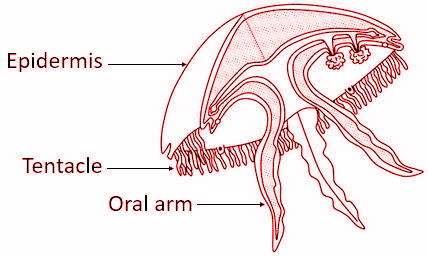
Non Chordates are also called invertebrates. Over 90 percent of entire living animal species are invertebrates. They are the animals without a notochord – the rod- like elastic structure that supports the body. Members of phylum Porifera, Coelenterata, Ctenophora, Platyhelminthes, Aschelminthes, Annelida, Arthropoda, Mollusca, Echinodermata, and Hemichordata fall under Non- chordates. This phylum consists of a little category of worm-like, marine species with an organ-system level of organization. Given is the diagram of a jellyfish:
Some non- chordate animals are earthworms, flatworms, ribbon worms, insects, sponges, starfish, snails, jellyfish, comb jellies, wheel animals, etc.
Additional information:
The general characteristic features of Non-Chordates are:
- They are mostly cylindrical in shapes
- They are triploblastic, coelomate, or pseudocoelomate animals.
- Respiration occurs through gills, trachea, or body surface.
- Most of the time, sexes cannot be distinguished among the members.
- Modes of reproduction involve sexual and asexual
- Fertilization is external, though internal fertilization also occurs in some species.
- They have an open type of circulatory system.
So, the correct answer is ‘Invertebrates’.
Note: During the 20th century, invertebrate zoology became one of the major fields of natural sciences, with prominent discoveries in the fields of medicine, genetics, paleontology, and ecology. The study of invertebrates has also benefited law enforcement, and particularly as arthropods, and especially insects were discovered to be a source of information for forensic investigators.
Complete answer:
Based on the presence and absence of notochord, the animals are classified into chordates and non- chordates. This notochord develops into a vertebral column. If an animal has a notochord during any stage of its life, it is classified as a chordate. If they do not have a notochord during any stage of life, they are classified as non- chordates.
Non Chordates are also called invertebrates. Over 90 percent of entire living animal species are invertebrates. They are the animals without a notochord – the rod- like elastic structure that supports the body. Members of phylum Porifera, Coelenterata, Ctenophora, Platyhelminthes, Aschelminthes, Annelida, Arthropoda, Mollusca, Echinodermata, and Hemichordata fall under Non- chordates. This phylum consists of a little category of worm-like, marine species with an organ-system level of organization. Given is the diagram of a jellyfish:
Some non- chordate animals are earthworms, flatworms, ribbon worms, insects, sponges, starfish, snails, jellyfish, comb jellies, wheel animals, etc.
Additional information:
The general characteristic features of Non-Chordates are:
- They are mostly cylindrical in shapes
- They are triploblastic, coelomate, or pseudocoelomate animals.
- Respiration occurs through gills, trachea, or body surface.
- Most of the time, sexes cannot be distinguished among the members.
- Modes of reproduction involve sexual and asexual
- Fertilization is external, though internal fertilization also occurs in some species.
- They have an open type of circulatory system.
So, the correct answer is ‘Invertebrates’.
Note: During the 20th century, invertebrate zoology became one of the major fields of natural sciences, with prominent discoveries in the fields of medicine, genetics, paleontology, and ecology. The study of invertebrates has also benefited law enforcement, and particularly as arthropods, and especially insects were discovered to be a source of information for forensic investigators.
Recently Updated Pages
Master Class 11 Social Science: Engaging Questions & Answers for Success

Master Class 11 Chemistry: Engaging Questions & Answers for Success
Master Class 9 General Knowledge: Engaging Questions & Answers for Success
Master Class 9 Maths: Engaging Questions & Answers for Success
Master Class 9 Science: Engaging Questions & Answers for Success
Master Class 9 English: Engaging Questions & Answers for Success
Trending doubts
One Metric ton is equal to kg A 10000 B 1000 C 100 class 11 physics CBSE
Difference Between Prokaryotic Cells and Eukaryotic Cells
Two of the body parts which do not appear in MRI are class 11 biology CBSE
1 ton equals to A 100 kg B 1000 kg C 10 kg D 10000 class 11 physics CBSE
10 examples of friction in our daily life
Name the Largest and the Smallest Cell in the Human Body ?