



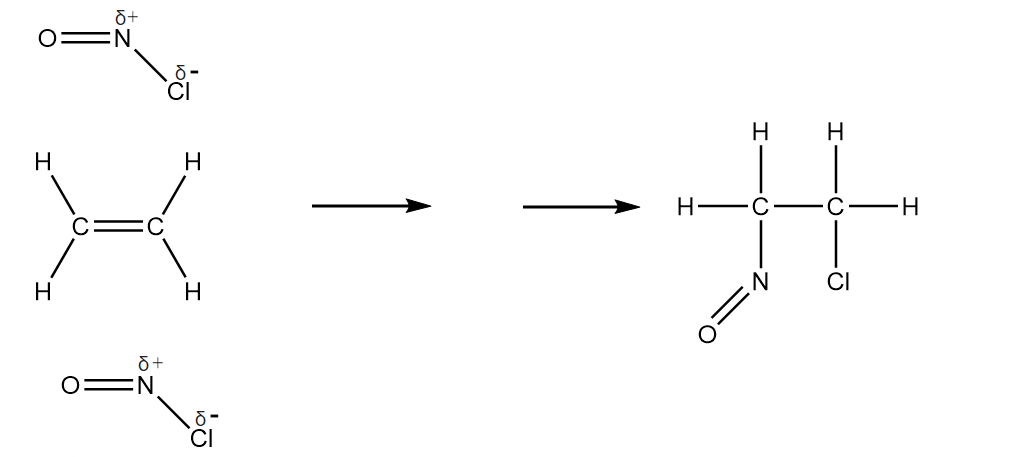
Nitrosyl chloride, $ NOCl $ is a reactive gas that is sometimes formed when $ NO $ reacts with $ C{l_2} $ . $ NOCl $ is a strong electrophile and readily undergoes an additional reaction with an alkene. Complete the diagram to show the mechanism of the electrophilic addition mechanism of the electrophilic addition reaction of $ NOCl $ with ethene.
Include all necessary charges, lone pairs, curly arrows and the structure of organic intermediate.
Answer
 Verified
586.5k+ views
Hint: Nitrosyl chloride is a chemical compound with molecular formula $ NOCl $ . It is a yellow gas which is commonly termed as a component of aqua regia i.e., a mixture of nitric acid and hydrochloric acid. It is widely used in organic reactions due to its strong electrophilic and oxidizing nature. It is also known as Tilden’s reagent.
Complete answer:
The addition of nitrosyl chloride to an ethene molecule takes place in three steps. The mechanism for the addition reaction of $ NOCl $ to ethene is as follows:
Step-1: Dissociation of nitrosyl chloride into respective cation and anion. The reaction takes place as follows:
$ NOCl \rightleftharpoons N{O^ + } + C{l^ - } $
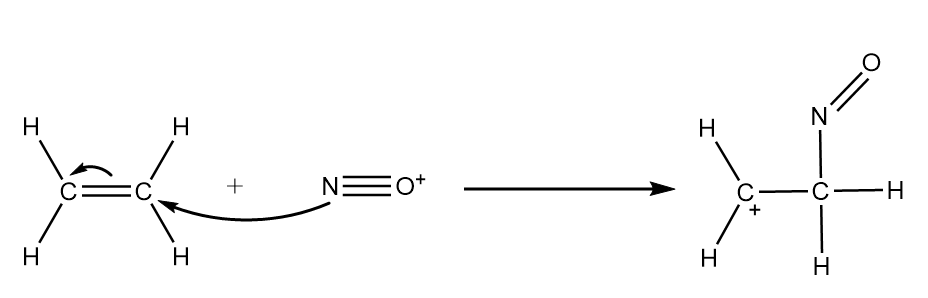
Step-2: In ethene, $ s{p^2} $ hybridized carbon is electronegative in nature i.e., it consists of an electron rich carbon atom which attacks the nitrosonium ion and formation of carbocation will take place as an intermediate. The reaction proceeds as follows:
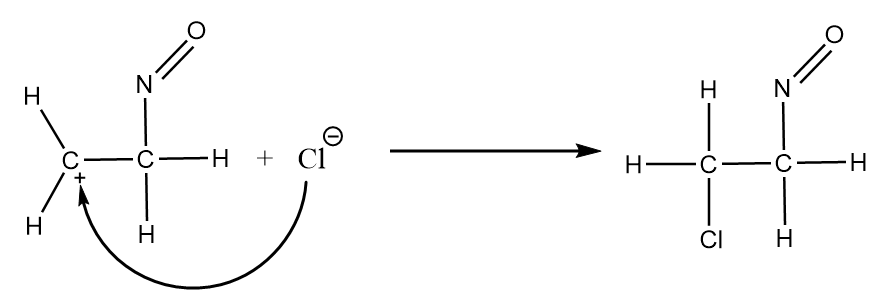
Step-3: The chloride ion will act as a nucleophile and attack the carbocation formed in the previous step to give the final product. The reaction proceeds as follows:
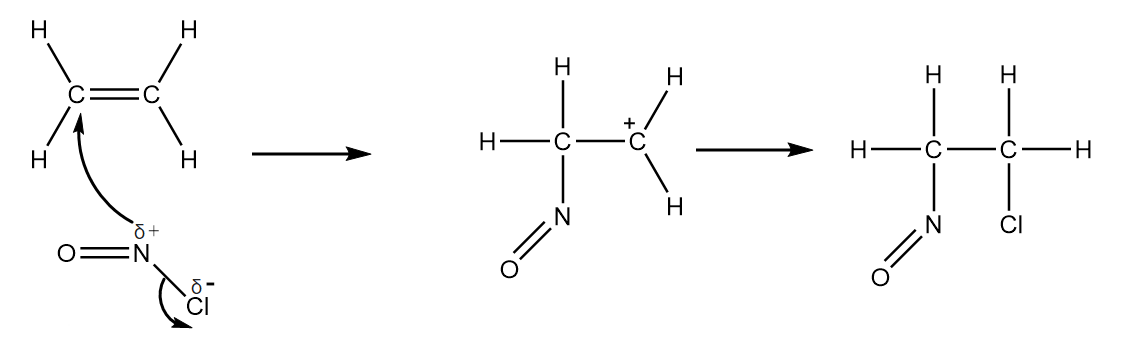
Hence, the final diagram for the given reaction mechanism will be as follows:
Note:
It is important to note that the addition of nitrosyl chloride to ethene is a stereospecific reaction i.e., the two stereochemical products are possible after the reaction. If chloride ion attacks carbocation from the sample plane where the nitrosyl group is attached, then the product formed is syn whereas if chloride ion attacks from opposite plane, then the product formed is termed as anti.
Complete answer:
The addition of nitrosyl chloride to an ethene molecule takes place in three steps. The mechanism for the addition reaction of $ NOCl $ to ethene is as follows:
Step-1: Dissociation of nitrosyl chloride into respective cation and anion. The reaction takes place as follows:
$ NOCl \rightleftharpoons N{O^ + } + C{l^ - } $
Step-2: In ethene, $ s{p^2} $ hybridized carbon is electronegative in nature i.e., it consists of an electron rich carbon atom which attacks the nitrosonium ion and formation of carbocation will take place as an intermediate. The reaction proceeds as follows:
Step-3: The chloride ion will act as a nucleophile and attack the carbocation formed in the previous step to give the final product. The reaction proceeds as follows:
Hence, the final diagram for the given reaction mechanism will be as follows:
Note:
It is important to note that the addition of nitrosyl chloride to ethene is a stereospecific reaction i.e., the two stereochemical products are possible after the reaction. If chloride ion attacks carbocation from the sample plane where the nitrosyl group is attached, then the product formed is syn whereas if chloride ion attacks from opposite plane, then the product formed is termed as anti.
Recently Updated Pages
Which will be the least stable resonating structure class 11 chemistry CBSE

How many 5 digit telephone numbers can be construc-class-11-maths-CBSE
How do you find the angle of the resultant vector class 11 physics CBSE
Draw labelled diagram of the following i Gram seed class 11 biology CBSE
1 Quintal is equal to a 110 kg b 10 kg c 100kg d 1000 class 11 physics CBSE
What is the need and importance of classification class 11 biology CBSE
Trending doubts
Find the value of the expression given below sin 30circ class 11 maths CBSE
One Metric ton is equal to kg A 10000 B 1000 C 100 class 11 physics CBSE
10 examples of friction in our daily life
Draw a diagram of a plant cell and label at least eight class 11 biology CBSE
Difference between physical and chemical change class 11 chemistry CBSE
Proton was discovered by A Thomson B Rutherford C Chadwick class 11 chemistry CBSE