




Nitration of nitrobenzene at ${125^0}C$ with mixed acids gives:
A.meta-dinitrobenzene
B.ortho-dinitrobenzene
C.para-dinitrobenzene
D.$1,3,5 - $trinitrobenzene
Answer
 Verified
615.6k+ views
Hint:In organic chemistry, nitration is the introduction of nitro groups into an organic compound.The term also is applied incorrectly to the different process of forming nitrate esters between alcohols and nitric acid (as occurs in the synthesis of nitroglycerin).
Complete step by step answer: Nitrobenzene is an organic compound. Its chemical formula is ${C_6}{H_5}N{O_2}$. A hydrogen in benzene is replaced by a nitro group to form nitrobenzene.
Nitration of compounds is a very important chemical reaction in organic chemistry. Nitration is usually carried out using a mixture of concentrated nitric acid ($HN{O_3}$) and concentrated sulphuric acid (${H_2}S{O_4}$). But nitration can be carried out using a mixture of nitric acid or nitrogen oxide with inorganic compounds like ${H_2}S{O_4}$,$B{F_3}$ or organic compounds like acetic anhydride also.
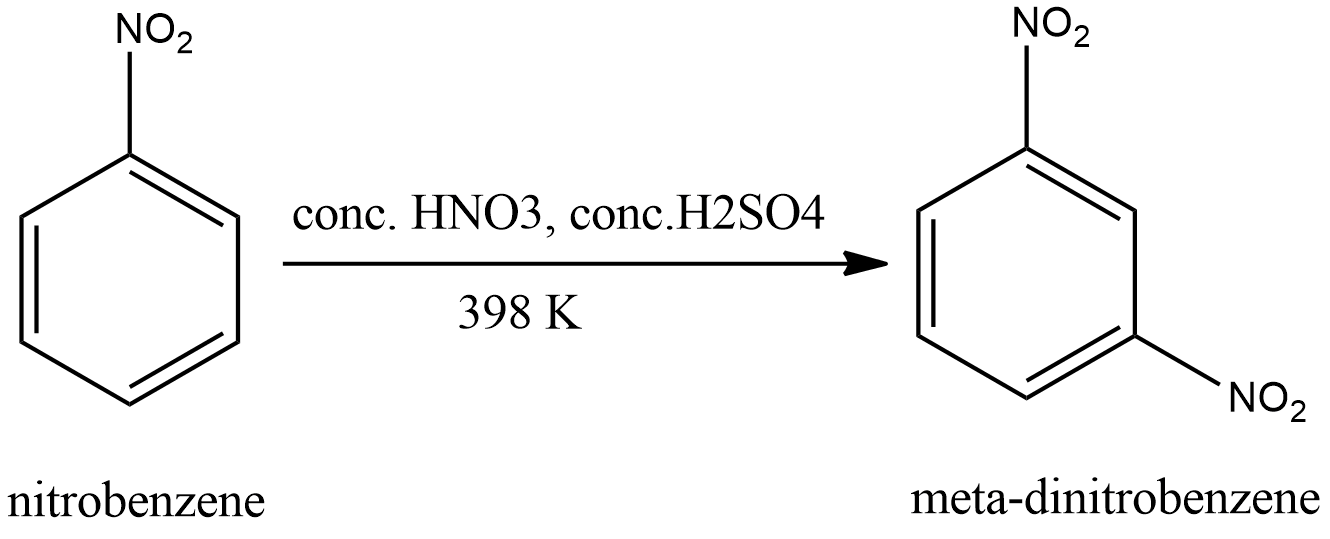
The product of nitration depends on the reactants. Nitrobenzene already contains a nitro-group. Nitro group is an electron withdrawing group. Therefore, it is a meta directing group. Hence the attachment of a new nitro group occurs in the meta position. Hence the product will be meta-dinitrobenzene. The reaction is shown in the figure.
Hence the correct option is A.
Note:
Nitration is an electrophilic substitution reaction. The electrophile is nitronium ion ($N{O^ + }_2$). Nitration of nitrobenzene is an example of aromatic electrophilic substitution reaction. Nitration is an exothermic reaction.
Nitration of nitrobenzene is more difficult than that of benzene. The reason behind is the electron withdrawing character of the nitro group. It attracts the electron density on the benzene ring towards it. Then the benzene ring becomes electron deficient. This makes the benzene ring less vulnerable to electrophilic attack.
Nitration of benzene containing electron donating groups give ortho- and para- products.
Complete step by step answer: Nitrobenzene is an organic compound. Its chemical formula is ${C_6}{H_5}N{O_2}$. A hydrogen in benzene is replaced by a nitro group to form nitrobenzene.
Nitration of compounds is a very important chemical reaction in organic chemistry. Nitration is usually carried out using a mixture of concentrated nitric acid ($HN{O_3}$) and concentrated sulphuric acid (${H_2}S{O_4}$). But nitration can be carried out using a mixture of nitric acid or nitrogen oxide with inorganic compounds like ${H_2}S{O_4}$,$B{F_3}$ or organic compounds like acetic anhydride also.
The product of nitration depends on the reactants. Nitrobenzene already contains a nitro-group. Nitro group is an electron withdrawing group. Therefore, it is a meta directing group. Hence the attachment of a new nitro group occurs in the meta position. Hence the product will be meta-dinitrobenzene. The reaction is shown in the figure.
Hence the correct option is A.
Note:
Nitration is an electrophilic substitution reaction. The electrophile is nitronium ion ($N{O^ + }_2$). Nitration of nitrobenzene is an example of aromatic electrophilic substitution reaction. Nitration is an exothermic reaction.
Nitration of nitrobenzene is more difficult than that of benzene. The reason behind is the electron withdrawing character of the nitro group. It attracts the electron density on the benzene ring towards it. Then the benzene ring becomes electron deficient. This makes the benzene ring less vulnerable to electrophilic attack.
Nitration of benzene containing electron donating groups give ortho- and para- products.
Recently Updated Pages
Onehalf of a convex lens is covered with a black paper class 12 physics CBSE

Differentiate between lanthanoids and actinoids class 12 chemistry CBSE
An object 5 cm in length is held 25 cm away from a class 12 physics CBSE
Name the following halides according to the IUPAC system class 12 chemistry CBSE
What is the Full Form of PVC, PET, HDPE, LDPE, PP and PS ?
An infinite ladder network of resistances is constructed class 12 physics CBSE
Trending doubts
Draw a labelled sketch of the human eye class 12 physics CBSE
Which are the Top 10 Largest Countries of the World?
Draw ray diagrams each showing i myopic eye and ii class 12 physics CBSE
Which is the correct genotypic ratio of mendel dihybrid class 12 biology CBSE
Differentiate between homogeneous and heterogeneous class 12 chemistry CBSE
Give 10 examples of unisexual and bisexual flowers