




Neural spine of the atlas vertebra of man is directed in the
(A) Upward and backward direction
(B) Upward and forward direction
(C) Downward and backward direction
(D) Absent
Answer
 Verified
615.3k+ views
Hint: Cervical spine is made up of a total of seven vertebrae. The first cervical vertebra of man lacks in the neural spine. The first cervical supports the skull on top of the vertebral column.
Complete step by step answer:
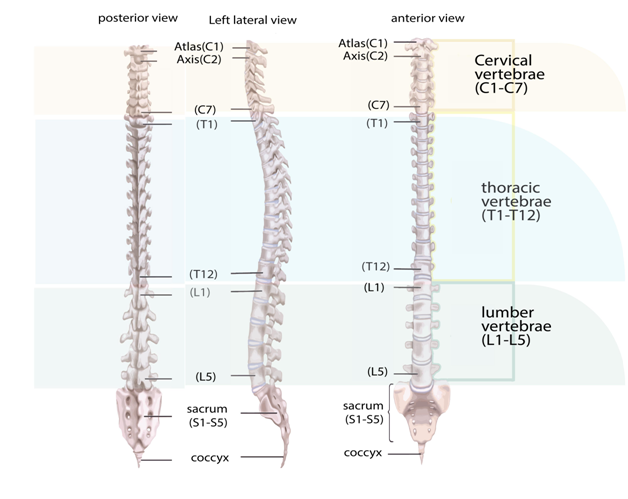
The first cervical (C1) vertebra is also called the atlas and it lacks in the Neural spine. The first two i.e, C1 and C2, are highly specialized and are given specific names which are atlas and axis, respectively. The name Atlas was related to the Greek God Atlas because, just as Atlas supported the globe, it supports the entire head.
So, the correct answer is ‘Absent’.
Additional Information: The atlas is situated at the top and, along with the axis, it forms the joint which is connecting the skull and spine. The atlas and axis are specialized to permit a greater range of motion than normal vertebrae. They're liable for the nodding and rotation movements of the top. The atlanto-occipital joint allows the top to nod up and down on the spinal column. The second cervical vertebrae act as a pivot that permits the atlas and attached head to rotate on the axis, side to side. The atlas's chief peculiarity is that it has no body. It's ring-like and consists of an anterior and a posterior arch and two lateral masses. The axis is very important neurologically because the brainstem extends right down to the axis.
Note: A break in the first vertebra is known as a Jefferson fracture. A Jefferson fracture is a bone fracture of the anterior and posterior arches of the atlas vertebra. The name Jefferson fracture was coined after the British neurologist and neurosurgeon Sir Geoffrey Jefferson, who reported four cases of the fracture in 1920.
Complete step by step answer:
The first cervical (C1) vertebra is also called the atlas and it lacks in the Neural spine. The first two i.e, C1 and C2, are highly specialized and are given specific names which are atlas and axis, respectively. The name Atlas was related to the Greek God Atlas because, just as Atlas supported the globe, it supports the entire head.
So, the correct answer is ‘Absent’.
Additional Information: The atlas is situated at the top and, along with the axis, it forms the joint which is connecting the skull and spine. The atlas and axis are specialized to permit a greater range of motion than normal vertebrae. They're liable for the nodding and rotation movements of the top. The atlanto-occipital joint allows the top to nod up and down on the spinal column. The second cervical vertebrae act as a pivot that permits the atlas and attached head to rotate on the axis, side to side. The atlas's chief peculiarity is that it has no body. It's ring-like and consists of an anterior and a posterior arch and two lateral masses. The axis is very important neurologically because the brainstem extends right down to the axis.
Note: A break in the first vertebra is known as a Jefferson fracture. A Jefferson fracture is a bone fracture of the anterior and posterior arches of the atlas vertebra. The name Jefferson fracture was coined after the British neurologist and neurosurgeon Sir Geoffrey Jefferson, who reported four cases of the fracture in 1920.
Recently Updated Pages
Master Class 12 Economics: Engaging Questions & Answers for Success

Master Class 12 English: Engaging Questions & Answers for Success
Master Class 12 Social Science: Engaging Questions & Answers for Success
Master Class 12 Maths: Engaging Questions & Answers for Success
Master Class 12 Physics: Engaging Questions & Answers for Success
Master Class 9 General Knowledge: Engaging Questions & Answers for Success
Trending doubts
One Metric ton is equal to kg A 10000 B 1000 C 100 class 11 physics CBSE
Difference Between Prokaryotic Cells and Eukaryotic Cells
Two of the body parts which do not appear in MRI are class 11 biology CBSE
Find the value of the expression given below sin 30circ class 11 maths CBSE
1 ton equals to A 100 kg B 1000 kg C 10 kg D 10000 class 11 physics CBSE
Draw a diagram of nephron and explain its structur class 11 biology CBSE