




What is the nature of the graph drawn between mass and acceleration for a constant force? Does the graph pass through origin?
Answer
 Verified
628.2k+ views
Hint: To answer this question, we need to use Newton's second law of motion to write the relation between the force, the mass, and the acceleration. Then for a constant force we will get an equation between mass and acceleration, from which we can predict the nature of the graph between them.
Formula used: The formula used to solve this question is given by
$ F = ma $, here $ F $ is the force acting on an object of mass $ m $ which is having an acceleration of $ a $.
Complete step by step answer
We know from Newton's second law of motion that the force applied on a body is directly proportional to the rate of change of momentum of the body. If the mass doesn’t change during the motion of the body, then this can be mathematically expressed as
$ F = ma $
According to the question, the force is constant. Therefore, substituting $ F = c $ we get
$ ma = c $
Now, if we plot the mass on the x-axis and the acceleration on the y-axis, then we can substitute $ m = x $, and $ a = y $ in the above equation to obtain
$ xy = c $
We know that this is the equation of a rectangular hyperbola. So the graph between mass and acceleration can be represented as
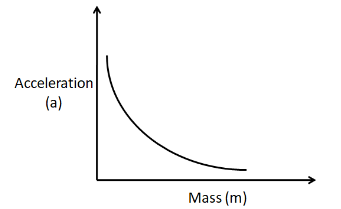
As we can see that the graph approaches the x and the y axis. It will approach both of the axes till infinity. So neither the mass, nor the acceleration can become zero. Hence, the graph cannot pass through the origin.
Note
We may argue what would happen if the constant force becomes zero. In that case, the acceleration will become zero, and the graph will be the x-axis itself. But in that case too, the graph will not be defined at the origin, as there is no concept of mass being zero. Hence, the graph between mass and acceleration can never pass through the origin.
Formula used: The formula used to solve this question is given by
$ F = ma $, here $ F $ is the force acting on an object of mass $ m $ which is having an acceleration of $ a $.
Complete step by step answer
We know from Newton's second law of motion that the force applied on a body is directly proportional to the rate of change of momentum of the body. If the mass doesn’t change during the motion of the body, then this can be mathematically expressed as
$ F = ma $
According to the question, the force is constant. Therefore, substituting $ F = c $ we get
$ ma = c $
Now, if we plot the mass on the x-axis and the acceleration on the y-axis, then we can substitute $ m = x $, and $ a = y $ in the above equation to obtain
$ xy = c $
We know that this is the equation of a rectangular hyperbola. So the graph between mass and acceleration can be represented as
As we can see that the graph approaches the x and the y axis. It will approach both of the axes till infinity. So neither the mass, nor the acceleration can become zero. Hence, the graph cannot pass through the origin.
Note
We may argue what would happen if the constant force becomes zero. In that case, the acceleration will become zero, and the graph will be the x-axis itself. But in that case too, the graph will not be defined at the origin, as there is no concept of mass being zero. Hence, the graph between mass and acceleration can never pass through the origin.
Recently Updated Pages
Master Class 11 Social Science: Engaging Questions & Answers for Success

Master Class 11 English: Engaging Questions & Answers for Success
Master Class 11 Accountancy: Engaging Questions & Answers for Success
Master Class 11 Physics: Engaging Questions & Answers for Success
Master Class 11 Computer Science: Engaging Questions & Answers for Success
Master Class 11 Business Studies: Engaging Questions & Answers for Success
Trending doubts
Find the value of the expression given below sin 30circ class 11 maths CBSE
One Metric ton is equal to kg A 10000 B 1000 C 100 class 11 physics CBSE
Draw a diagram of nephron and explain its structur class 11 biology CBSE
10 examples of friction in our daily life
Proton was discovered by A Thomson B Rutherford C Chadwick class 11 chemistry CBSE
The teeth used for biting and cutting food are called class 11 biology CBSE