




Name the type of triangle PQR formed by the points \[P(-\sqrt{2},\sqrt{2})\], \[Q(-\sqrt{2},-\sqrt{2})\] and \[R(-\sqrt{6},\sqrt{6})\].
Answer
 Verified
635.4k+ views
Hint: Find the distance between the PQ, QR and RP using the distance formula. Then check, if all the distances are same then it is equilateral triangle, or if two distances are same then it is isosceles triangle else scalene triangle. The distance formula, \[d=\sqrt{{{({{x}_{2}}-{{x}_{1}})}^{2}}+{{({{y}_{2}}-{{y}_{1}})}^{2}}}\]. Here \[({{x}_{1}},{{y}_{1}})\]and \[({{x}_{2}},{{y}_{2}})\] are two points between which the distance (d) is to be found.
Complete step-by-step answer:
In the question, we have to find the type of triangle PQR formed by the points \[P(-\sqrt{2},\sqrt{2})\], \[Q(-\sqrt{2},-\sqrt{2})\] and \[R(-\sqrt{6},\sqrt{6})\].
So, we will use the distance formula here and will find the length of each line that joins points PQ, QR and PR.
Now, the distance formula between the two points is given as follows.
Now, distance (d) between points \[({{x}_{1}},{{y}_{1}})\] and \[({{x}_{2}},{{y}_{2}})\]
is found using the formula: \[d=\sqrt{{{({{x}_{2}}-{{x}_{1}})}^{2}}+{{({{y}_{2}}-{{y}_{1}})}^{2}}}\]
So now, the distance between \[P(-\sqrt{2},\sqrt{2})\] and \[Q(-\sqrt{2},-\sqrt{2})\] is given by:
\[\begin{align}
& \Rightarrow PQ=\sqrt{{{\left( -\sqrt{2}-(-\sqrt{2}) \right)}^{2}}+{{\left( -\sqrt{2}-(\sqrt{2}) \right)}^{2}}} \\
& \because {{x}_{2}}=-\sqrt{2}\,,\,\,{{x}_{1}}=-\sqrt{2},\,\,{{y}_{2}}=-\sqrt{2}\,,\,\,{{y}_{1}}=\sqrt{2} \\
& \Rightarrow PQ=\sqrt{{{0}^{2}}+{{\left( -2\sqrt{2} \right)}^{2}}} \\
& \Rightarrow PQ=2\sqrt{2} \\
\end{align}\]
Next, the distance between \[Q(-\sqrt{2},-\sqrt{2})\] and \[R(-\sqrt{6},\sqrt{6})\], is given by:
\[\begin{align}
& \Rightarrow QR=\sqrt{{{\left( -\sqrt{6}-(-\sqrt{2}) \right)}^{2}}+{{\left( \sqrt{6}-(-\sqrt{2}) \right)}^{2}}} \\
& \because {{x}_{2}}=-\sqrt{6}\,,\,\,{{x}_{1}}=-\sqrt{2},\,\,{{y}_{2}}=\sqrt{6}\,,\,\,{{y}_{1}}=-\sqrt{2} \\
& \Rightarrow QR=\sqrt{{{\left( -\sqrt{6}+\sqrt{2} \right)}^{2}}+{{\left( \sqrt{6}+\sqrt{2}) \right)}^{2}}} \\
& \Rightarrow QR=\sqrt{\left( 6+2-2\sqrt{12} \right)+\left( 6+2+2\sqrt{12} \right)} \\
& \Rightarrow QR=4 \\
\end{align}\]
Next, we will find the distance between \[R(-\sqrt{6},\sqrt{6})\] and \[P(-\sqrt{2},\sqrt{2})\], which is given by:
\[\begin{align}
& \Rightarrow RP=\sqrt{{{\left( -\sqrt{2}-(-\sqrt{6}) \right)}^{2}}+{{\left( \sqrt{2}-(\sqrt{6}) \right)}^{2}}} \\
& \because {{x}_{2}}=-\sqrt{2}\,,\,\,{{x}_{1}}=-\sqrt{6},\,\,{{y}_{2}}=\sqrt{2}\,,\,\,{{y}_{1}}=\sqrt{6} \\
& \Rightarrow RP=\sqrt{{{\left( -\sqrt{2}+\sqrt{6} \right)}^{2}}+{{\left( \sqrt{2}-\sqrt{6} \right)}^{2}}} \\
& \Rightarrow QR=\sqrt{\left( 2+6-2\sqrt{12} \right)+\left( 2+6-2\sqrt{12} \right)} \\
& \Rightarrow QR=\left( 8-2\sqrt{12} \right) \\
\end{align}\]
So, here we can see that all three distances points PQ, QR and PR are unequal. Hence, this is a scalene triangle with no two sides lengths equal.
Note: The alternative method to solve this problem is graphically. We will first plot all the points and then draw the line joining them to form a triangle. So, the diagram will look as follows:
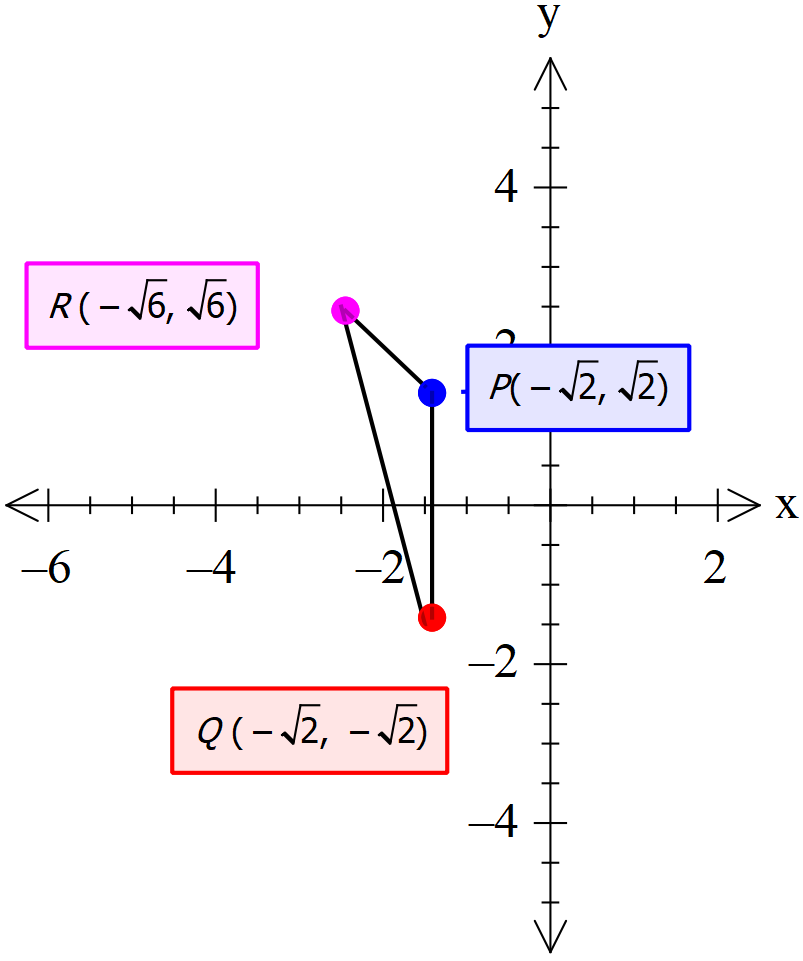
Now, here all the three sides are unequal as can be seen graphically. So, it is a scalene triangle with all three sides of unequal lengths.
Complete step-by-step answer:
In the question, we have to find the type of triangle PQR formed by the points \[P(-\sqrt{2},\sqrt{2})\], \[Q(-\sqrt{2},-\sqrt{2})\] and \[R(-\sqrt{6},\sqrt{6})\].
So, we will use the distance formula here and will find the length of each line that joins points PQ, QR and PR.
Now, the distance formula between the two points is given as follows.
Now, distance (d) between points \[({{x}_{1}},{{y}_{1}})\] and \[({{x}_{2}},{{y}_{2}})\]
is found using the formula: \[d=\sqrt{{{({{x}_{2}}-{{x}_{1}})}^{2}}+{{({{y}_{2}}-{{y}_{1}})}^{2}}}\]
So now, the distance between \[P(-\sqrt{2},\sqrt{2})\] and \[Q(-\sqrt{2},-\sqrt{2})\] is given by:
\[\begin{align}
& \Rightarrow PQ=\sqrt{{{\left( -\sqrt{2}-(-\sqrt{2}) \right)}^{2}}+{{\left( -\sqrt{2}-(\sqrt{2}) \right)}^{2}}} \\
& \because {{x}_{2}}=-\sqrt{2}\,,\,\,{{x}_{1}}=-\sqrt{2},\,\,{{y}_{2}}=-\sqrt{2}\,,\,\,{{y}_{1}}=\sqrt{2} \\
& \Rightarrow PQ=\sqrt{{{0}^{2}}+{{\left( -2\sqrt{2} \right)}^{2}}} \\
& \Rightarrow PQ=2\sqrt{2} \\
\end{align}\]
Next, the distance between \[Q(-\sqrt{2},-\sqrt{2})\] and \[R(-\sqrt{6},\sqrt{6})\], is given by:
\[\begin{align}
& \Rightarrow QR=\sqrt{{{\left( -\sqrt{6}-(-\sqrt{2}) \right)}^{2}}+{{\left( \sqrt{6}-(-\sqrt{2}) \right)}^{2}}} \\
& \because {{x}_{2}}=-\sqrt{6}\,,\,\,{{x}_{1}}=-\sqrt{2},\,\,{{y}_{2}}=\sqrt{6}\,,\,\,{{y}_{1}}=-\sqrt{2} \\
& \Rightarrow QR=\sqrt{{{\left( -\sqrt{6}+\sqrt{2} \right)}^{2}}+{{\left( \sqrt{6}+\sqrt{2}) \right)}^{2}}} \\
& \Rightarrow QR=\sqrt{\left( 6+2-2\sqrt{12} \right)+\left( 6+2+2\sqrt{12} \right)} \\
& \Rightarrow QR=4 \\
\end{align}\]
Next, we will find the distance between \[R(-\sqrt{6},\sqrt{6})\] and \[P(-\sqrt{2},\sqrt{2})\], which is given by:
\[\begin{align}
& \Rightarrow RP=\sqrt{{{\left( -\sqrt{2}-(-\sqrt{6}) \right)}^{2}}+{{\left( \sqrt{2}-(\sqrt{6}) \right)}^{2}}} \\
& \because {{x}_{2}}=-\sqrt{2}\,,\,\,{{x}_{1}}=-\sqrt{6},\,\,{{y}_{2}}=\sqrt{2}\,,\,\,{{y}_{1}}=\sqrt{6} \\
& \Rightarrow RP=\sqrt{{{\left( -\sqrt{2}+\sqrt{6} \right)}^{2}}+{{\left( \sqrt{2}-\sqrt{6} \right)}^{2}}} \\
& \Rightarrow QR=\sqrt{\left( 2+6-2\sqrt{12} \right)+\left( 2+6-2\sqrt{12} \right)} \\
& \Rightarrow QR=\left( 8-2\sqrt{12} \right) \\
\end{align}\]
So, here we can see that all three distances points PQ, QR and PR are unequal. Hence, this is a scalene triangle with no two sides lengths equal.
Note: The alternative method to solve this problem is graphically. We will first plot all the points and then draw the line joining them to form a triangle. So, the diagram will look as follows:
Now, here all the three sides are unequal as can be seen graphically. So, it is a scalene triangle with all three sides of unequal lengths.
Recently Updated Pages
Master Class 12 Economics: Engaging Questions & Answers for Success

Master Class 12 English: Engaging Questions & Answers for Success
Master Class 12 Social Science: Engaging Questions & Answers for Success
Master Class 12 Maths: Engaging Questions & Answers for Success
Master Class 12 Physics: Engaging Questions & Answers for Success
Master Class 10 English: Engaging Questions & Answers for Success
Trending doubts
Explain the Treaty of Vienna of 1815 class 10 social science CBSE
Why is it 530 pm in india when it is 1200 afternoon class 10 social science CBSE
What is the full form of POSCO class 10 social science CBSE
Define Potential, Developed, Stock and Reserved resources
Which Country Has the Largest Border with India?
Choose the feminine form of the given noun Fox AFoxess class 10 english CBSE