




Name the two parts with which the ear bone stapes is attached at its opposite ends.
Answer
 Verified
611.4k+ views
Hint: The ear in humans is made up of three parts: outer, middle, and inner ear. Ear bone stapes is stirrup-(horse-shoe) shaped and is situated in the middle ear. In the human body, the smallest bone is stapes.
Complete answer:
Ears are the organ of hearing and are also known to maintain the balance. Ear structure is made of the outer, middle, and inner ear. The outer ear comprises the auricle, auditory canal, and eardrum outer layer (tympanic membrane). The middle ear comprises the eardrum, tympanic cavity, and three ossicles: malleus (is a long hammer attached to the eardrum), incus (a bridge between malleus and stapes), and stapes (the footplate). The inner ear, the last part of the ear, comprises an oval window (connecting the middle ear with the inner ear), semicircular ducts, cochlea (shaped like a snail), and auditory tube.
Thus, the opposite ends of ear bone stapes are attached to the incus and oval window.
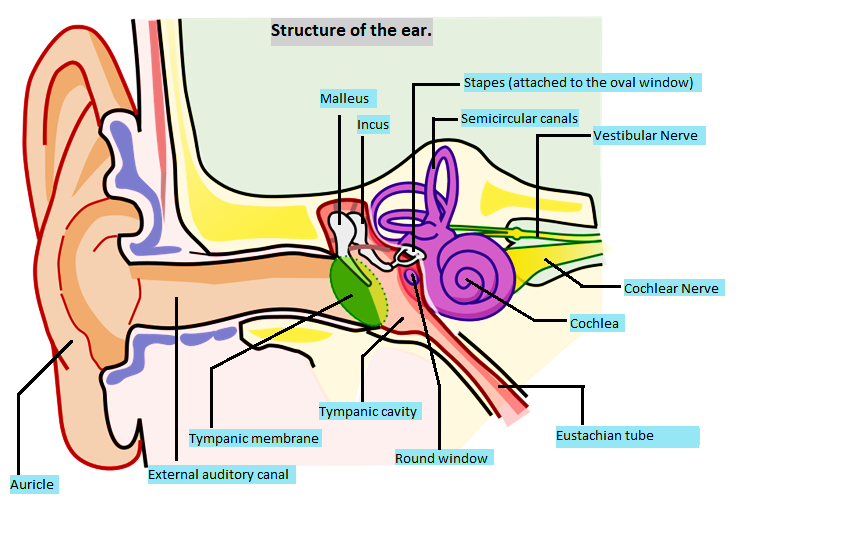
Additional information:
The ear is the organ of hearing and its different parts are responsible for transmitting the sound waves from the source to the brain in the form of a signal which is recognized by our brain and we hear a sound. The sound waves enter into the ear and they travel through the auditory canal until it reaches the eardrum. The eardrum then transmits these waves to the middle ear part from where they enter into the inner ear. Cochlea present in the inner ear possesses tiny hair cells which are known for converting these vibrations of sound waves into an electrical impulse that is carried to the brain by the hearing nerve. The brain then tells us about the sound and makes us able to hear that sound.
Note: The three ossicles present in the middle ear form a vibrating chain and the stapes bone is the last part of the middle ear. The Stapes bone of the ear has its base connected to the oval window while its head forms a joint with the incus bone through the incudostapedial joint.
Complete answer:
Ears are the organ of hearing and are also known to maintain the balance. Ear structure is made of the outer, middle, and inner ear. The outer ear comprises the auricle, auditory canal, and eardrum outer layer (tympanic membrane). The middle ear comprises the eardrum, tympanic cavity, and three ossicles: malleus (is a long hammer attached to the eardrum), incus (a bridge between malleus and stapes), and stapes (the footplate). The inner ear, the last part of the ear, comprises an oval window (connecting the middle ear with the inner ear), semicircular ducts, cochlea (shaped like a snail), and auditory tube.
Thus, the opposite ends of ear bone stapes are attached to the incus and oval window.
Additional information:
The ear is the organ of hearing and its different parts are responsible for transmitting the sound waves from the source to the brain in the form of a signal which is recognized by our brain and we hear a sound. The sound waves enter into the ear and they travel through the auditory canal until it reaches the eardrum. The eardrum then transmits these waves to the middle ear part from where they enter into the inner ear. Cochlea present in the inner ear possesses tiny hair cells which are known for converting these vibrations of sound waves into an electrical impulse that is carried to the brain by the hearing nerve. The brain then tells us about the sound and makes us able to hear that sound.
Note: The three ossicles present in the middle ear form a vibrating chain and the stapes bone is the last part of the middle ear. The Stapes bone of the ear has its base connected to the oval window while its head forms a joint with the incus bone through the incudostapedial joint.
Recently Updated Pages
Master Class 5 English: Engaging Questions & Answers for Success

Master Class 5 Maths: Engaging Questions & Answers for Success
Master Class 5 Social Science: Engaging Questions & Answers for Success
Master Class 5 Science: Engaging Questions & Answers for Success
Class 5 Question and Answer - Your Ultimate Solutions Guide
Master Class 9 General Knowledge: Engaging Questions & Answers for Success
Trending doubts
One Metric ton is equal to kg A 10000 B 1000 C 100 class 11 physics CBSE
What is cell theory Who formulated it class 11 biology CBSE
Phyllotaxy is the arrangement of ALeaflets BLeaves class 11 biology CBSE
Difference Between Prokaryotic Cells and Eukaryotic Cells
The symbiotic association of fungi and algae is called class 11 biology CBSE
Cell theory was formulated by A Schleiden and Schwann class 11 biology CBSE