




Name the tissue that lines the inner lining of the mouth.
Answer
 Verified
617.1k+ views
Hint: It is formed by a single layer of flat cells with irregular boundaries. It also forms the lining of the skin.
Complete Answer:
- Tissues are formed by groups of cells that perform a specific function. There are different types of tissues in the body that perform different functions. The tissues in the body are divided into four types- epithelial, connective, muscular and neural.
- The epithelial tissues are the tissues forming the lining of all surfaces, organs and cavities of the body. Cells of the epithelial tissue are packed tightly and form a continual sheet. They have just a small amount of cementing material and almost no intercellular spaces.
- The epithelial tissues are of two types- simple epithelium and compound epithelium.
(I) Simple epithelium is made up of a single layer of cells which serves as a covering for ducts, cavities and tubes throughout the body.
(II) The compound epithelium consists of two or three layers of cells and has a defensive role. Regardless of the form, all epithelium is typically divided from the underlying tissue by an extracellular fibrous membrane called basement membrane.
- The simple epithelium is further classified into three forms depending on the structural modification of the cells: (i) Squamous, (ii) Cuboidal, (iii) Columnar
- Simple epithelial squamous cells are extremely thin, flat, and form a delicate lining. The lining of the mouth is covered with squamous epithelium.
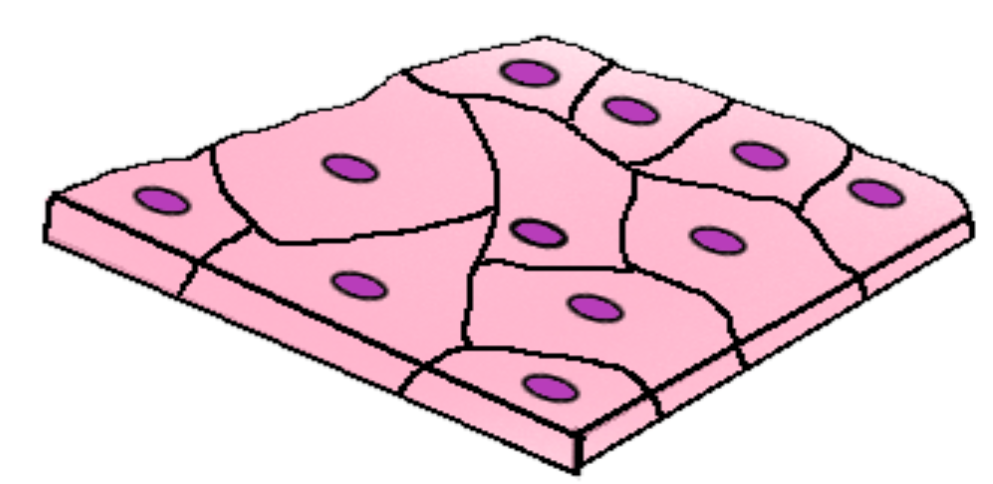
Fig: Squamous epithelium made of flat cells
Thus, the tissue that lines the inner lining of the mouth is the squamous epithelium.
Note: Various epithelia display different structures which correspond with their specific functions. Specialized junctions provide structural and functional links between its individual cells in almost all animal tissues.
Complete Answer:
- Tissues are formed by groups of cells that perform a specific function. There are different types of tissues in the body that perform different functions. The tissues in the body are divided into four types- epithelial, connective, muscular and neural.
- The epithelial tissues are the tissues forming the lining of all surfaces, organs and cavities of the body. Cells of the epithelial tissue are packed tightly and form a continual sheet. They have just a small amount of cementing material and almost no intercellular spaces.
- The epithelial tissues are of two types- simple epithelium and compound epithelium.
(I) Simple epithelium is made up of a single layer of cells which serves as a covering for ducts, cavities and tubes throughout the body.
(II) The compound epithelium consists of two or three layers of cells and has a defensive role. Regardless of the form, all epithelium is typically divided from the underlying tissue by an extracellular fibrous membrane called basement membrane.
- The simple epithelium is further classified into three forms depending on the structural modification of the cells: (i) Squamous, (ii) Cuboidal, (iii) Columnar
- Simple epithelial squamous cells are extremely thin, flat, and form a delicate lining. The lining of the mouth is covered with squamous epithelium.
Fig: Squamous epithelium made of flat cells
Thus, the tissue that lines the inner lining of the mouth is the squamous epithelium.
Note: Various epithelia display different structures which correspond with their specific functions. Specialized junctions provide structural and functional links between its individual cells in almost all animal tissues.
Recently Updated Pages
Master Class 12 Economics: Engaging Questions & Answers for Success

Master Class 12 English: Engaging Questions & Answers for Success
Master Class 12 Social Science: Engaging Questions & Answers for Success
Master Class 12 Maths: Engaging Questions & Answers for Success
Master Class 12 Physics: Engaging Questions & Answers for Success
Master Class 10 English: Engaging Questions & Answers for Success
Trending doubts
Explain the Treaty of Vienna of 1815 class 10 social science CBSE
Who Won 36 Oscar Awards? Record Holder Revealed
Why is it 530 pm in india when it is 1200 afternoon class 10 social science CBSE
What is the full form of POSCO class 10 social science CBSE
Define Potential, Developed, Stock and Reserved resources
The speaker of the Lok Sabha is elected by the APresident class 10 social science CBSE