




Name the three parts in which the small intestine can be divided.
Answer
 Verified
541.5k+ views
Hint: The small intestine is basically made up of 3 parts that play a major role in the absorption of nutrients and minerals from the food we intake. The stomach opens first into the small intestine. The small intestine receives the enzymes from the pancreas and liver for the digestion of food.
Complete answer:
We all know that the main functions of the small intestine are the absorption of nutrients and water from the food we take in and excrete out the waste out into the large intestine from where the excretory products are excreted out in the form of faeces from the rectum.
The small intestine is in between the stomach and large intestine, which receive the bile juice as well as pancreatic juice that helps indigestion. It about 20 feet or 6 meters long with many folds being compacted and fitted into the abdomen.
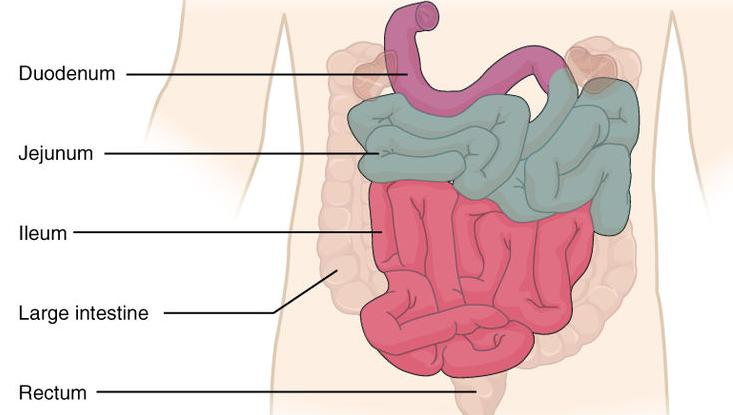
The organ is divided into 3 distinct regions namely the duodenum, jejunum and ileum.
i) The duodenum is U-shaped and is the shortest where the preparation for the absorption of the food from a small finger-like projection called villi begins. In the sub-mucosa layer of the duodenum, several glands are present that help in digestion and absorption.
ii) The jejunum has the major role of absorption through the lining by enterocytes. All the small nutrients that are previously digested by the enzymes in the duodenum.
iii) Ileum- The last part of being ileum is the most coiled region whose main function is the absorption of vitamins; bile salts and the other products being not absorbed by the jejunum.
A detailed structure of the digestive system is given in the figure below.
The wall of the alimentary canal from the oesophagus to the rectum possesses four layers- namely serosa, muscularis, submucosa and mucosa. Serosa is the innermost layer and made up of a thin mesothelium with some connective tissues. Muscularis is formed by smooth muscles usually arranged into an inner circular and an outer longitudinal layer. This muscle layer might be present in some regions. The sub- mucosa layer is formed of loose connective tissues containing nerves, blood and lymph vessels. The innermost layer is the mucosa that forms irregular folds in the stomach and small - finger-like projections called villi in the small intestine.
Note: Small intestine is the principal organ for absorption of nutrients. The digestion is completed here and the final products of digestion such as glucose. fructose, fatty acids, glycerol and amino acids are absorbed through the mucosa into the bloodstream and lymph. The absorbed substances finally reach the tissues which utilise them for their activities.
Complete answer:
We all know that the main functions of the small intestine are the absorption of nutrients and water from the food we take in and excrete out the waste out into the large intestine from where the excretory products are excreted out in the form of faeces from the rectum.
The small intestine is in between the stomach and large intestine, which receive the bile juice as well as pancreatic juice that helps indigestion. It about 20 feet or 6 meters long with many folds being compacted and fitted into the abdomen.
The organ is divided into 3 distinct regions namely the duodenum, jejunum and ileum.
i) The duodenum is U-shaped and is the shortest where the preparation for the absorption of the food from a small finger-like projection called villi begins. In the sub-mucosa layer of the duodenum, several glands are present that help in digestion and absorption.
ii) The jejunum has the major role of absorption through the lining by enterocytes. All the small nutrients that are previously digested by the enzymes in the duodenum.
iii) Ileum- The last part of being ileum is the most coiled region whose main function is the absorption of vitamins; bile salts and the other products being not absorbed by the jejunum.
A detailed structure of the digestive system is given in the figure below.
The wall of the alimentary canal from the oesophagus to the rectum possesses four layers- namely serosa, muscularis, submucosa and mucosa. Serosa is the innermost layer and made up of a thin mesothelium with some connective tissues. Muscularis is formed by smooth muscles usually arranged into an inner circular and an outer longitudinal layer. This muscle layer might be present in some regions. The sub- mucosa layer is formed of loose connective tissues containing nerves, blood and lymph vessels. The innermost layer is the mucosa that forms irregular folds in the stomach and small - finger-like projections called villi in the small intestine.
Note: Small intestine is the principal organ for absorption of nutrients. The digestion is completed here and the final products of digestion such as glucose. fructose, fatty acids, glycerol and amino acids are absorbed through the mucosa into the bloodstream and lymph. The absorbed substances finally reach the tissues which utilise them for their activities.
Recently Updated Pages
Master Class 11 Social Science: Engaging Questions & Answers for Success

Master Class 11 English: Engaging Questions & Answers for Success
Master Class 11 Maths: Engaging Questions & Answers for Success
Master Class 11 Chemistry: Engaging Questions & Answers for Success
Master Class 11 Biology: Engaging Questions & Answers for Success
Master Class 11 Physics: Engaging Questions & Answers for Success
Trending doubts
One Metric ton is equal to kg A 10000 B 1000 C 100 class 11 physics CBSE
Difference Between Prokaryotic Cells and Eukaryotic Cells
How many of the following diseases can be studied with class 11 biology CBSE
Two of the body parts which do not appear in MRI are class 11 biology CBSE
Which of the following enzymes is used for carboxylation class 11 biology CBSE
Explain zero factorial class 11 maths CBSE