




Name the nitrifying bacteria of the soil. Why are they called Chemoautotrophs?
Answer
 Verified
618.6k+ views
Hint: These are chemoautotrophic nitrifying bacteria. Those organisms who are able to manufacture organic compounds from inorganic raw materials with the assistance of the sun within the presence of photosynthetic pigments are called photoautotrophs. For e.g., Nostoc, Char, Porphyra and Wolffia .
Complete Step by Step answer:
Nitrosomonas and Nitrobacter are the nitrifying bacteria of the soil. They obtain energy from the oxidation of ammonium and nitrate ions and hence they are called Chemoautotrophs.
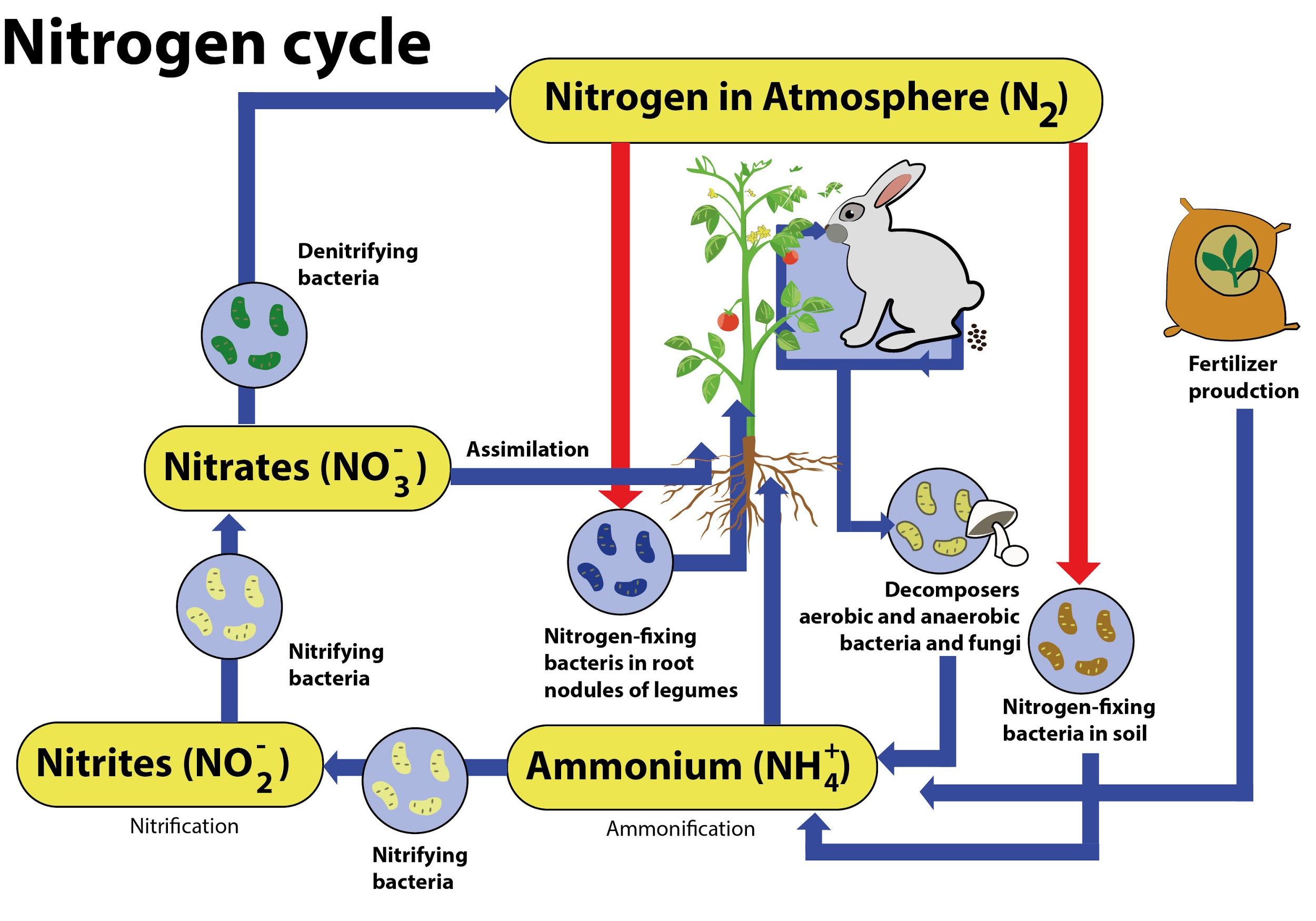
- Nitrogen is abundant within the atmosphere, but it's unusable to plants or animals unless it's converted into nitrogen compounds.
- Nitrogen-fixing bacteria play an important role in fixing the atmospheric nitrogen into nitrogen compounds which will be employed by the plants.
- During the ultimate stages of the organic process, bacteria and fungi help decompose organic matter, where the nitrogenous compounds get dissolved into the soil which is again employed by the plants.
- Some bacteria then convert these nitrogenous compounds within the soil and switch it into nitrogen gas. Eventually, it goes back to the atmosphere.
- These set of processes repeat continuously and thus maintain the proportion of nitrogen within the atmosphere.
Note: Importance of the nitrogen cycle are as follows:
- Helps the plants to synthesise the required chlorophyll from the nitrogen compounds.
- Helps in converting the inert nitrogen gas into a usable form for the plants through the biochemical process in the soil.
- In the process of ammonification, the bacteria help in decomposing the animal and plant matter, which indirectly helps to clean up the environment and make the nitrogen back to the atmosphere.
- Nitrates and nitrites are released into the soil, which helps in enriching the soil with necessary nutrients required for the cultivation of the crops or for agriculture.
- Nitrogen is an integral component of the cell and it makes up many crucial compounds and important biomolecules.
Complete Step by Step answer:
Nitrosomonas and Nitrobacter are the nitrifying bacteria of the soil. They obtain energy from the oxidation of ammonium and nitrate ions and hence they are called Chemoautotrophs.
- Nitrogen is abundant within the atmosphere, but it's unusable to plants or animals unless it's converted into nitrogen compounds.
- Nitrogen-fixing bacteria play an important role in fixing the atmospheric nitrogen into nitrogen compounds which will be employed by the plants.
- During the ultimate stages of the organic process, bacteria and fungi help decompose organic matter, where the nitrogenous compounds get dissolved into the soil which is again employed by the plants.
- Some bacteria then convert these nitrogenous compounds within the soil and switch it into nitrogen gas. Eventually, it goes back to the atmosphere.
- These set of processes repeat continuously and thus maintain the proportion of nitrogen within the atmosphere.
Note: Importance of the nitrogen cycle are as follows:
- Helps the plants to synthesise the required chlorophyll from the nitrogen compounds.
- Helps in converting the inert nitrogen gas into a usable form for the plants through the biochemical process in the soil.
- In the process of ammonification, the bacteria help in decomposing the animal and plant matter, which indirectly helps to clean up the environment and make the nitrogen back to the atmosphere.
- Nitrates and nitrites are released into the soil, which helps in enriching the soil with necessary nutrients required for the cultivation of the crops or for agriculture.
- Nitrogen is an integral component of the cell and it makes up many crucial compounds and important biomolecules.
Recently Updated Pages
Master Class 11 English: Engaging Questions & Answers for Success

Master Class 11 Social Science: Engaging Questions & Answers for Success
Master Class 11 Maths: Engaging Questions & Answers for Success
Master Class 11 Biology: Engaging Questions & Answers for Success
Master Class 11 Physics: Engaging Questions & Answers for Success
Master Class 11 Chemistry: Engaging Questions & Answers for Success
Trending doubts
One Metric ton is equal to kg A 10000 B 1000 C 100 class 11 physics CBSE
Difference Between Prokaryotic Cells and Eukaryotic Cells
Find the value of the expression given below sin 30circ class 11 maths CBSE
1 ton equals to A 100 kg B 1000 kg C 10 kg D 10000 class 11 physics CBSE
Two of the body parts which do not appear in MRI are class 11 biology CBSE
What are hard magnetic materials class 11 physics CBSE