




Name the following:
Kind of retinal cells sensitive to dim light.
Answer
 Verified
631.2k+ views
Hint: In the eyes, there is the presence of the retinal cells which help detect the light and colour in our surroundings. There are two types of photoreceptor cells present in our eyes. They are rods and cones. They both have different functions.
Complete answer:
The photoreceptor cells are present in the retina of the eyes. These cells are capable of absorbing light and convert these signals to trigger the change in the membrane potential. Rods are one of the types of cells which are sensitive to the dim light conditions. Hence, making them responsible for the low light vision. They are present at the peripheral portion of the retina. They are cylindrical in shape and are comparatively longer and narrower than the cone cells. They are extremely sensitive to the low lights. In the human eye, they are present in the average number of 120million cells. They can be easily triggered by a single photon of light. They also help in scotopic vision which is low light vision. They have a faster regenerative power than the cone cells. Rod cells contain a pigment known as rhodopsin. They are also sensitive to scattered and direct light. The visual acuity of rod cells is less than the cone cells. They are absent in the fovea. And their loss can lead to night blindness in humans.
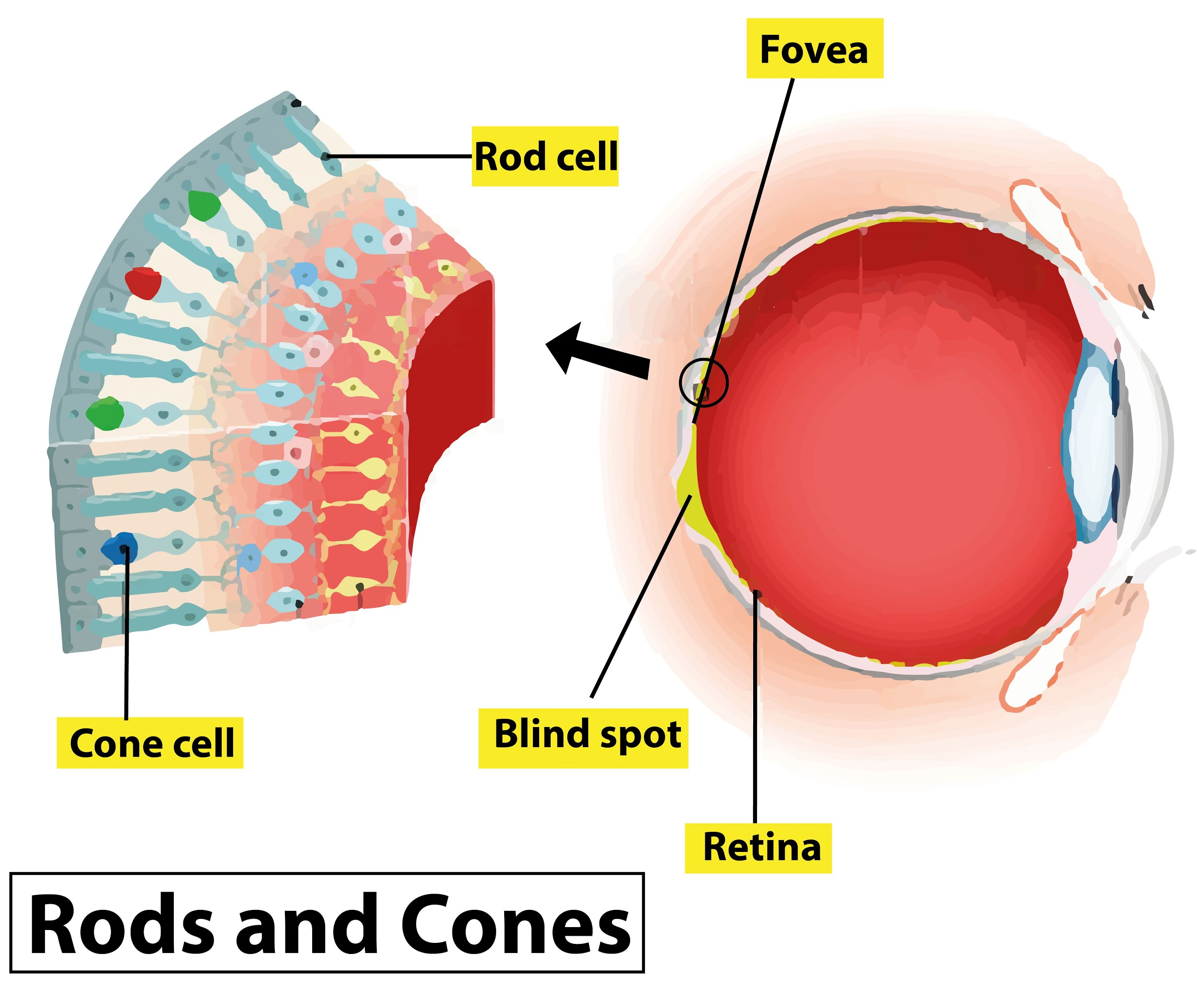
Note: Rods are sensitive to dim lights whereas, cones are sensitive to bright light. In cones, there is a pigment present named photopsin which helps in the detection of the different wavelengths of the light.
Complete answer:
The photoreceptor cells are present in the retina of the eyes. These cells are capable of absorbing light and convert these signals to trigger the change in the membrane potential. Rods are one of the types of cells which are sensitive to the dim light conditions. Hence, making them responsible for the low light vision. They are present at the peripheral portion of the retina. They are cylindrical in shape and are comparatively longer and narrower than the cone cells. They are extremely sensitive to the low lights. In the human eye, they are present in the average number of 120million cells. They can be easily triggered by a single photon of light. They also help in scotopic vision which is low light vision. They have a faster regenerative power than the cone cells. Rod cells contain a pigment known as rhodopsin. They are also sensitive to scattered and direct light. The visual acuity of rod cells is less than the cone cells. They are absent in the fovea. And their loss can lead to night blindness in humans.
Note: Rods are sensitive to dim lights whereas, cones are sensitive to bright light. In cones, there is a pigment present named photopsin which helps in the detection of the different wavelengths of the light.
Recently Updated Pages
Master Class 11 Social Science: Engaging Questions & Answers for Success

Master Class 11 English: Engaging Questions & Answers for Success
Master Class 11 Accountancy: Engaging Questions & Answers for Success
Master Class 11 Physics: Engaging Questions & Answers for Success
Master Class 11 Computer Science: Engaging Questions & Answers for Success
Master Class 11 Business Studies: Engaging Questions & Answers for Success
Trending doubts
One Metric ton is equal to kg A 10000 B 1000 C 100 class 11 physics CBSE
Find the value of the expression given below sin 30circ class 11 maths CBSE
Draw a diagram of nephron and explain its structur class 11 biology CBSE
10 examples of friction in our daily life
Proton was discovered by A Thomson B Rutherford C Chadwick class 11 chemistry CBSE
The teeth used for biting and cutting food are called class 11 biology CBSE