




Name the blood group in which antibodies are absent.
Answer
 Verified
597.6k+ views
Hint: When a person of any type of blood group donated to the person of the AB blood group, agglutination of the blood is not seen. Agglutination is seen when antigens mix with different antibodies.
Complete answer:
The four types of antibodies present in the human body are A, B, O, and AB characterized by the presence or absence of antigens on the plasma membrane of RBCs. The person having A blood has antigen A on their RBC and anti-B antibodies in the plasma.
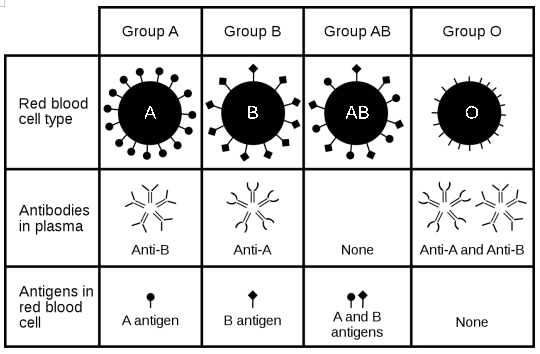
The person having B blood group has antigen B on their plasma and anti-A antibodies in the plasma. The person having the AB blood group has both antigens A and B on RBC but antibodies are absent in the plasma. The person having an O blood group has both A and B antibodies in the plasma but antigens on the RBC are absent.
Additional information:
- Karl Landsteiner won the Nobel prize in 1930 for the discovery of the ABO blood group system in 1900.
- A and B antigens are actually carbohydrate groups that are bound to the lipid molecules and they protrude from the membrane of the red blood cells. They are also called iso agglutinogens because they cause agglutination during blood transfusions.
- Antibodies A and B are also called isoagglutinin or isohemagglutinins that are usually IgM type.
- These phenotypes are inherited by the interaction of three autosomal alleles of the gene named I.
Note: The isoagglutinin of individuals causes agglutination reactions with the antigens of other individuals.
Because the absence of antibodies is in the AB blood group, it is considered a universal recipient and because of the absence of antigens in the O blood group, it is called a universal donor.
Complete answer:
The four types of antibodies present in the human body are A, B, O, and AB characterized by the presence or absence of antigens on the plasma membrane of RBCs. The person having A blood has antigen A on their RBC and anti-B antibodies in the plasma.
The person having B blood group has antigen B on their plasma and anti-A antibodies in the plasma. The person having the AB blood group has both antigens A and B on RBC but antibodies are absent in the plasma. The person having an O blood group has both A and B antibodies in the plasma but antigens on the RBC are absent.
Additional information:
- Karl Landsteiner won the Nobel prize in 1930 for the discovery of the ABO blood group system in 1900.
- A and B antigens are actually carbohydrate groups that are bound to the lipid molecules and they protrude from the membrane of the red blood cells. They are also called iso agglutinogens because they cause agglutination during blood transfusions.
- Antibodies A and B are also called isoagglutinin or isohemagglutinins that are usually IgM type.
- These phenotypes are inherited by the interaction of three autosomal alleles of the gene named I.
Note: The isoagglutinin of individuals causes agglutination reactions with the antigens of other individuals.
Because the absence of antibodies is in the AB blood group, it is considered a universal recipient and because of the absence of antigens in the O blood group, it is called a universal donor.
Recently Updated Pages
Master Class 12 Economics: Engaging Questions & Answers for Success

Master Class 12 English: Engaging Questions & Answers for Success
Master Class 12 Social Science: Engaging Questions & Answers for Success
Master Class 12 Maths: Engaging Questions & Answers for Success
Master Class 12 Physics: Engaging Questions & Answers for Success
Master Class 9 General Knowledge: Engaging Questions & Answers for Success
Trending doubts
One Metric ton is equal to kg A 10000 B 1000 C 100 class 11 physics CBSE
Difference Between Prokaryotic Cells and Eukaryotic Cells
Two of the body parts which do not appear in MRI are class 11 biology CBSE
1 ton equals to A 100 kg B 1000 kg C 10 kg D 10000 class 11 physics CBSE
Draw a diagram of nephron and explain its structur class 11 biology CBSE
10 examples of friction in our daily life