




What is the name of the central part of the atom?
Answer
 Verified
565.5k+ views
Hint : Atoms consist of three part- electrons, protons and neutrons. Each of these parts has an associated charge, with electrons carrying negative charge, protons carrying positive charge and neutrons with no net charge. Protons and neutrons are found in the very center of the atom, while electrons orbit around the outside.
Complete Step By Step Answer:
The central part of the atom consists of protons and neutrons, called the nucleus. An atom will have the same number of protons and electrons and have at least as many neutrons as protons.
Therefore, the central part of the atom is called nucleus.
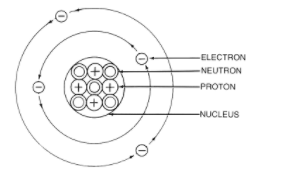
Fig: Structure of an atom
Note :
An important property of atom is charge. There are positive and negative charges. Protons are positive, electrons are negative and neutrons are neutral, so is the name neutron. Even though electrons are very small compared to protons, they carry the same charge as protons do (but negative charge).
Electrons are fundamental particles of atom since they cannot be further broken down. But protons and neutrons consists of smaller pieces called quarks.
Complete Step By Step Answer:
The central part of the atom consists of protons and neutrons, called the nucleus. An atom will have the same number of protons and electrons and have at least as many neutrons as protons.
Therefore, the central part of the atom is called nucleus.
Fig: Structure of an atom
Note :
An important property of atom is charge. There are positive and negative charges. Protons are positive, electrons are negative and neutrons are neutral, so is the name neutron. Even though electrons are very small compared to protons, they carry the same charge as protons do (but negative charge).
Electrons are fundamental particles of atom since they cannot be further broken down. But protons and neutrons consists of smaller pieces called quarks.
Recently Updated Pages
Master Class 11 English: Engaging Questions & Answers for Success

Master Class 11 Social Science: Engaging Questions & Answers for Success
Master Class 11 Maths: Engaging Questions & Answers for Success
Master Class 11 Biology: Engaging Questions & Answers for Success
Master Class 11 Physics: Engaging Questions & Answers for Success
Master Class 11 Chemistry: Engaging Questions & Answers for Success
Trending doubts
One Metric ton is equal to kg A 10000 B 1000 C 100 class 11 physics CBSE
Difference Between Prokaryotic Cells and Eukaryotic Cells
Find the value of the expression given below sin 30circ class 11 maths CBSE
Difference between physical and chemical change class 11 chemistry CBSE
Two of the body parts which do not appear in MRI are class 11 biology CBSE
Draw a diagram of a plant cell and label at least eight class 11 biology CBSE