




Name any two figures that have both line symmetry and rotational symmetry.
Answer
 Verified
618k+ views
Hint: Rotational symmetry is the property a shape has when it looks the same after some rotation by a partial turn. Line symmetry is a type of symmetry with respect to reflection. Thus, in the question, we have to basically draw those figures which when rotated through an angle (less than\[{{360}^{o}}\]) looks exactly the same as the figure in original form and they should also have symmetry with respect to the axis passing through them. So, let us start the solution of the above question.
Complete step-by-step answer:
So, now we will start drawing the figures which have both rotational and line symmetry. So our first figure is an equilateral triangle: -
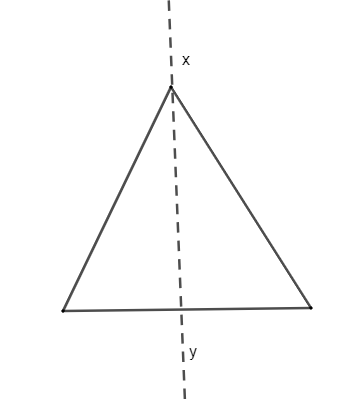
We can see that, in the above triangle, the figure is symmetry with respect to the axis line x-y. So, the x-y line acts as a mirror for one portion of the triangle. Therefore, we can say that an equilateral triangle has a line symmetry. Also when the figure is rotated through \[{{120}^{o}},{{240}^{o}},{{360}^{o}}\] it appears to be same as the original figure. So, it has rotational symmetric. Thus, we can say that an equilateral triangle has both line and rotational symmetry.
Our next figure is a rectangle: -
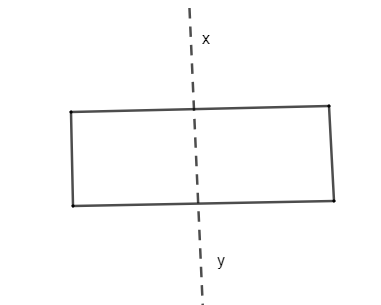
We can see that in the above rectangle the figure is symmetric with respect to the axis line x-y. SO, the x-y line acts as a mirror for one portion of the rectangle. Therefore, we can say that a rectangle has a line symmetry. Also, when the figure is rotated through \[{{180}^{o}}\] and \[{{360}^{o}}\], it appears to be same as the original figure. So, it has rotational symmetry. Thus, we can say that a rectangle has both line and rotational symmetry.
So, a triangle and a rectangle has both line and rotational symmetry.
Note: Instead of a triangle and a rectangle, we can have any regular polygon because regular polygons of any number of sides have both line symmetry and rotational symmetry.
Complete step-by-step answer:
So, now we will start drawing the figures which have both rotational and line symmetry. So our first figure is an equilateral triangle: -
We can see that, in the above triangle, the figure is symmetry with respect to the axis line x-y. So, the x-y line acts as a mirror for one portion of the triangle. Therefore, we can say that an equilateral triangle has a line symmetry. Also when the figure is rotated through \[{{120}^{o}},{{240}^{o}},{{360}^{o}}\] it appears to be same as the original figure. So, it has rotational symmetric. Thus, we can say that an equilateral triangle has both line and rotational symmetry.
Our next figure is a rectangle: -
We can see that in the above rectangle the figure is symmetric with respect to the axis line x-y. SO, the x-y line acts as a mirror for one portion of the rectangle. Therefore, we can say that a rectangle has a line symmetry. Also, when the figure is rotated through \[{{180}^{o}}\] and \[{{360}^{o}}\], it appears to be same as the original figure. So, it has rotational symmetry. Thus, we can say that a rectangle has both line and rotational symmetry.
So, a triangle and a rectangle has both line and rotational symmetry.
Note: Instead of a triangle and a rectangle, we can have any regular polygon because regular polygons of any number of sides have both line symmetry and rotational symmetry.
Recently Updated Pages
Basicity of sulphurous acid and sulphuric acid are

Master Class 10 English: Engaging Questions & Answers for Success
Master Class 10 Social Science: Engaging Questions & Answers for Success
Master Class 10 Computer Science: Engaging Questions & Answers for Success
Class 10 Question and Answer - Your Ultimate Solutions Guide
Master Class 10 General Knowledge: Engaging Questions & Answers for Success
Trending doubts
Which country won the ICC Men's ODI World Cup in 2023?
In cricket, how many legal balls are there in a standard over?
Explain the Treaty of Vienna of 1815 class 10 social science CBSE
A boat goes 24 km upstream and 28 km downstream in class 10 maths CBSE
What does "powerplay" mean in limited-overs cricket?
What is the "Powerplay" in T20 cricket?