




Myopia may arise due to:
A.Elongation of eyeball
B.Shrinking of the eyeball
C.Long focal length of the eye
D.Increased curvature of the eye lens
Answer
 Verified
607.2k+ views
Hint: In this question, we will understand the basics of myopia. This will directly give us the required reason for the rise of myopia. Also, we will discuss the correction of myopia with different correcting measures, for our better understanding.
Complete answer: As we know that a person with myopia can see nearby objects clearly whereas he/she cannot see distant objects distinctly. So, we can say that a person with this defect i.e., myopia, has the far point nearer than infinity. In a myopic eye, the image of a distant object is formed in front of the retina and not on the retina itself. This is because of the excessive curvature of the eye lens or elongation of the eyeball.
In the below diagram, we can see a myopic eye, where the image is formed in front of the retina.
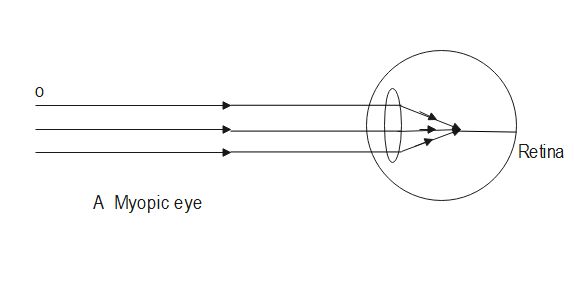
Therefore, the correct options are A. and D., according to which, we can say that myopia may arise due to elongation of the eyeball and increase in curvature of the eye lens.
Additional information:
When we discuss myopia treatment, we can see that nearsightedness or myopia can be corrected by using eyeglasses, contact lenses or having refractive surgery.
Further, depending on the degree of myopia, a person can wear the glasses or contact lenses all the time or only when he/she needs very clear distance vision, like when driving, or studying.
We need to make good choices for eyeglass lenses for nearsightedness, which include high-index lenses and lenses with anti-reflective coating. Also, one can consider photo chromics to protect the eyes from UV rays and high-energy blue light. This will reduce the need for a separate pair of prescription of sunglasses when we are outdoors. Also, refractive surgery can reduce or even eliminate your need for glasses or contacts.
Note:
We should remember that myopia typically begins in childhood, and one can have a higher risk if his/her parents are nearsighted. Also, in most cases, nearsightedness or myopia stabilizes in early adulthood but sometimes it continues to progress with age.
Complete answer: As we know that a person with myopia can see nearby objects clearly whereas he/she cannot see distant objects distinctly. So, we can say that a person with this defect i.e., myopia, has the far point nearer than infinity. In a myopic eye, the image of a distant object is formed in front of the retina and not on the retina itself. This is because of the excessive curvature of the eye lens or elongation of the eyeball.
In the below diagram, we can see a myopic eye, where the image is formed in front of the retina.
Therefore, the correct options are A. and D., according to which, we can say that myopia may arise due to elongation of the eyeball and increase in curvature of the eye lens.
Additional information:
When we discuss myopia treatment, we can see that nearsightedness or myopia can be corrected by using eyeglasses, contact lenses or having refractive surgery.
Further, depending on the degree of myopia, a person can wear the glasses or contact lenses all the time or only when he/she needs very clear distance vision, like when driving, or studying.
We need to make good choices for eyeglass lenses for nearsightedness, which include high-index lenses and lenses with anti-reflective coating. Also, one can consider photo chromics to protect the eyes from UV rays and high-energy blue light. This will reduce the need for a separate pair of prescription of sunglasses when we are outdoors. Also, refractive surgery can reduce or even eliminate your need for glasses or contacts.
Note:
We should remember that myopia typically begins in childhood, and one can have a higher risk if his/her parents are nearsighted. Also, in most cases, nearsightedness or myopia stabilizes in early adulthood but sometimes it continues to progress with age.
Recently Updated Pages
Master Class 12 Business Studies: Engaging Questions & Answers for Success

Master Class 12 Biology: Engaging Questions & Answers for Success
Master Class 12 Chemistry: Engaging Questions & Answers for Success
Class 12 Question and Answer - Your Ultimate Solutions Guide
Master Class 11 Social Science: Engaging Questions & Answers for Success
Master Class 11 English: Engaging Questions & Answers for Success
Trending doubts
Which are the Top 10 Largest Countries of the World?
Draw a labelled sketch of the human eye class 12 physics CBSE
Differentiate between homogeneous and heterogeneous class 12 chemistry CBSE
Why is the cell called the structural and functional class 12 biology CBSE
Draw ray diagrams each showing i myopic eye and ii class 12 physics CBSE
Which is the correct genotypic ratio of mendel dihybrid class 12 biology CBSE