




Most digestion and absorption of food takes place in
A. Stomach
B. Small intestine
C. Large intestine
D. Caecum
Answer
 Verified
593.1k+ views
Hint:The gastrointestinal tract begins from the mouth and ends at the rectum. In it, the longest part of the gastrointestinal tract is about 7.5 meters long and is distinguishable in three regions.
Complete answer:
1.The primary function of the small intestine is the absorption of nutrients and minerals which are found in food.
2. It begins at the pyloric valve of the stomach and is differentiated into three regions which are Duodenum (smallest first part and forms a U-shaped loop containing the pancreas), jejunum (long coiled), and Ileum (highly coiled).
3. Various secretions released in the small intestine such as bile, pancreatic juice (both released through a hepato-pancreatic duct), and intestinal juice help in the digestion of food.
4. The bile is secreted into the duodenum contains various bile pigments such as bilirubin and biliverdin, bile salts, cholesterol, and Phospholipid but has no enzyme. It helps in the emulsification of fats.
5. The lining of the small intestine bears a series of transverse folds called valves of Kerckring. Their internal lining is raised into innumerable minute finger-like processes called “ villi''.
Each villus is a finger-like fold of mucosa that projects into the intestinal lumen and is covered with columnar epithelial cells interspersed with mucus-secreting Goblet cells.
These are absent in the stomach.
The actual main function of intestinal villi is to provide a large surface area for absorption. The absorption of food mainly occurs in the small intestine.
6. The stomach is a muscular sac that functions primarily as a food storage organ. It can hold food for 2 or more hours. The food mixes thoroughly with gastric juice by churning movements of its muscular wall and is called chyme. The stomach has no villi for absorption.
7. On the other hand, the large intestine functions by absorbing water and salts from the material that has not been digested as food. By the time food reaches the large intestine it has already been digested. The leftover contents are lubricated with mucus in the caecum.
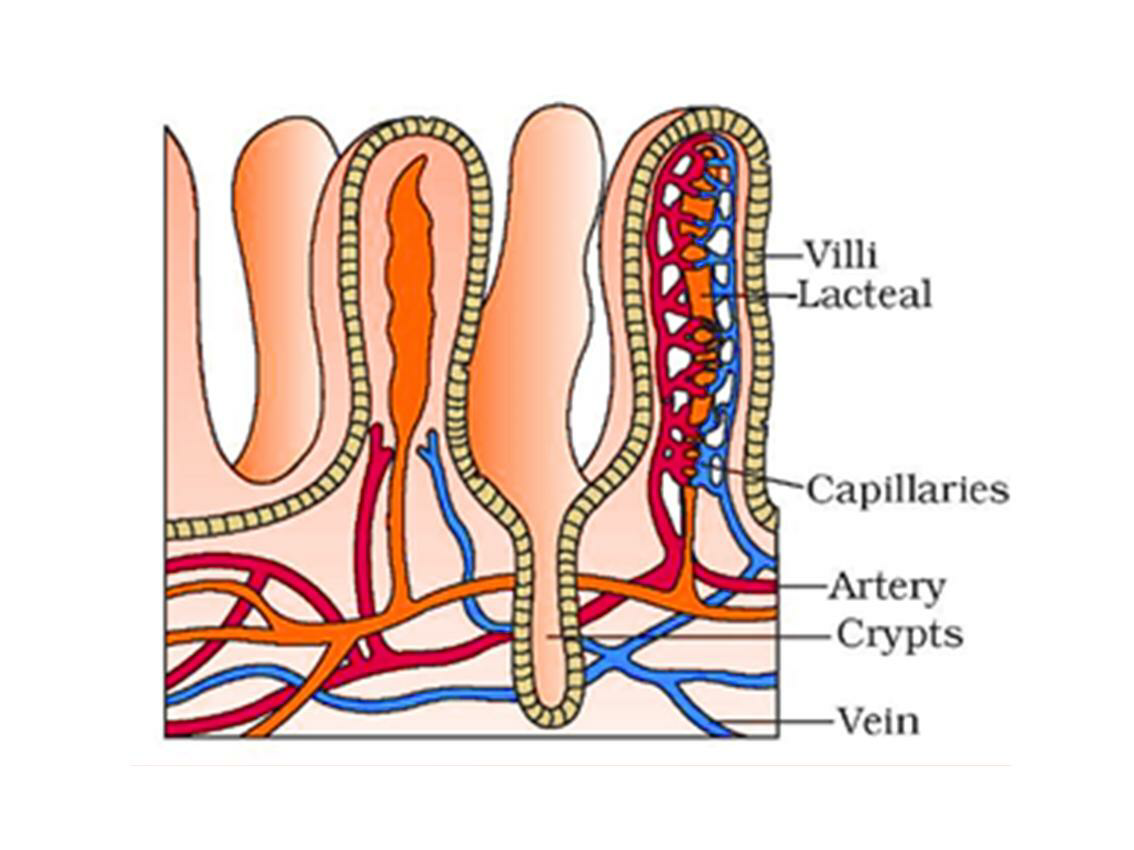
Hence the correct answer is an option (B) i.e., Small intestine.
Note: The mucosa of the duodenum is simple columnar epithelial with four major cell type-
Absorptive cells (has microvilli that produce digestive enzymes and absorb digested food). Goblet cells (produce a protective mucus).
Granular cells (may help protect the intestinal epithelial from bacteria).
Endocrine cells (produce regulatory hormones).
Complete answer:
1.The primary function of the small intestine is the absorption of nutrients and minerals which are found in food.
2. It begins at the pyloric valve of the stomach and is differentiated into three regions which are Duodenum (smallest first part and forms a U-shaped loop containing the pancreas), jejunum (long coiled), and Ileum (highly coiled).
3. Various secretions released in the small intestine such as bile, pancreatic juice (both released through a hepato-pancreatic duct), and intestinal juice help in the digestion of food.
4. The bile is secreted into the duodenum contains various bile pigments such as bilirubin and biliverdin, bile salts, cholesterol, and Phospholipid but has no enzyme. It helps in the emulsification of fats.
5. The lining of the small intestine bears a series of transverse folds called valves of Kerckring. Their internal lining is raised into innumerable minute finger-like processes called “ villi''.
Each villus is a finger-like fold of mucosa that projects into the intestinal lumen and is covered with columnar epithelial cells interspersed with mucus-secreting Goblet cells.
These are absent in the stomach.
The actual main function of intestinal villi is to provide a large surface area for absorption. The absorption of food mainly occurs in the small intestine.
6. The stomach is a muscular sac that functions primarily as a food storage organ. It can hold food for 2 or more hours. The food mixes thoroughly with gastric juice by churning movements of its muscular wall and is called chyme. The stomach has no villi for absorption.
7. On the other hand, the large intestine functions by absorbing water and salts from the material that has not been digested as food. By the time food reaches the large intestine it has already been digested. The leftover contents are lubricated with mucus in the caecum.
Hence the correct answer is an option (B) i.e., Small intestine.
Note: The mucosa of the duodenum is simple columnar epithelial with four major cell type-
Absorptive cells (has microvilli that produce digestive enzymes and absorb digested food). Goblet cells (produce a protective mucus).
Granular cells (may help protect the intestinal epithelial from bacteria).
Endocrine cells (produce regulatory hormones).
Recently Updated Pages
Master Class 11 Social Science: Engaging Questions & Answers for Success

Master Class 11 Chemistry: Engaging Questions & Answers for Success
Master Class 12 Business Studies: Engaging Questions & Answers for Success
Master Class 12 Chemistry: Engaging Questions & Answers for Success
Master Class 12 Biology: Engaging Questions & Answers for Success
Class 12 Question and Answer - Your Ultimate Solutions Guide
Trending doubts
One Metric ton is equal to kg A 10000 B 1000 C 100 class 11 physics CBSE
Difference Between Prokaryotic Cells and Eukaryotic Cells
How many of the following diseases can be studied with class 11 biology CBSE
Two of the body parts which do not appear in MRI are class 11 biology CBSE
Which of the following enzymes is used for carboxylation class 11 biology CBSE
Explain zero factorial class 11 maths CBSE