




Morphology of flowering plants.
Answer
 Verified
610.2k+ views
Hint: The flowering plants are multicellular organisms. They grow by cell division and their morphology and their morphological features and traits are genetically determined. Morphology plays an important role in the classification of angiosperm. Morphology deals with the study of forms and features of different plant organs like roots, shoot, leaf, flower, seeds, fruits, etc.
Complete answer:
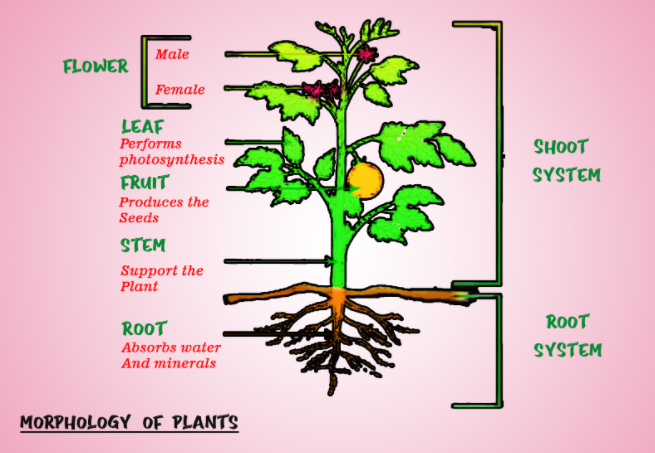
-The Roots:
Roots are cylindrical, underground, and non-green parts of the plant. It is generally the descending portion of the plant axis i.e.; it grows downwards into the soil. It lacks nodes, leaves, buds but gives rise to endogenous lateral branches. Root moves in the direction of gravity (geotropism) and against the direction of light (phototropism). Plants have well-developed root systems, these are of three types:
(1)Taproot system
(2)Fibrous root system
(3)Adventitious root system
Functions of the root are: Absorption of water and mineral from the soil, Provide anchorage to the plant parts, Storage of reserve food material, Synthesis of plant growth regulators.
-The Stem:
The ascending part of the plant axis which bears branches, leaves, flowers, and fruits is called the stem. It generally grows above the ground and hence is considered as the aerial part of the plant. The plumule of the embryo, present in the germinating gives rise to the stem.
Functions of the stem are Bears and support leaves, fruits, flowers, etc., It conducts water and minerals salts from roots to leaves and fruits, acts as a storage of reserve food materials.
-The Leaves:
A leaf is a lateral generally flattened structure borne on the stem. It develops at the node and bears a bud in its exile. Leaves are the most important vegetative organ for photosynthesis.
-The Flower:
A flower is a reproductive unit in the angiosperm. It is a modified shoot, meant for sexual reproduction. It consists of four whorls namely Calyx, Corolla, Androecium, Gynoecium. The swollen part of the pedicle or the stock is called the thalamus.
-The Fruit:
The flowering plant or the angiosperms are characterized by the presence of fruit. After fertilization, the ripened or the mature ovary is called the fruit. Parts of the fruit are Fruit wall and seed.
Note: There are various modifications of roots, stems, leaves.
Fruit formed without fertilization is called parthenocarpic fruits. Example: Banana.
Complete answer:
-The Roots:
Roots are cylindrical, underground, and non-green parts of the plant. It is generally the descending portion of the plant axis i.e.; it grows downwards into the soil. It lacks nodes, leaves, buds but gives rise to endogenous lateral branches. Root moves in the direction of gravity (geotropism) and against the direction of light (phototropism). Plants have well-developed root systems, these are of three types:
(1)Taproot system
(2)Fibrous root system
(3)Adventitious root system
Functions of the root are: Absorption of water and mineral from the soil, Provide anchorage to the plant parts, Storage of reserve food material, Synthesis of plant growth regulators.
-The Stem:
The ascending part of the plant axis which bears branches, leaves, flowers, and fruits is called the stem. It generally grows above the ground and hence is considered as the aerial part of the plant. The plumule of the embryo, present in the germinating gives rise to the stem.
Functions of the stem are Bears and support leaves, fruits, flowers, etc., It conducts water and minerals salts from roots to leaves and fruits, acts as a storage of reserve food materials.
-The Leaves:
A leaf is a lateral generally flattened structure borne on the stem. It develops at the node and bears a bud in its exile. Leaves are the most important vegetative organ for photosynthesis.
-The Flower:
A flower is a reproductive unit in the angiosperm. It is a modified shoot, meant for sexual reproduction. It consists of four whorls namely Calyx, Corolla, Androecium, Gynoecium. The swollen part of the pedicle or the stock is called the thalamus.
-The Fruit:
The flowering plant or the angiosperms are characterized by the presence of fruit. After fertilization, the ripened or the mature ovary is called the fruit. Parts of the fruit are Fruit wall and seed.
Note: There are various modifications of roots, stems, leaves.
Fruit formed without fertilization is called parthenocarpic fruits. Example: Banana.
Recently Updated Pages
Master Class 12 Economics: Engaging Questions & Answers for Success

Master Class 12 English: Engaging Questions & Answers for Success
Master Class 12 Social Science: Engaging Questions & Answers for Success
Master Class 12 Maths: Engaging Questions & Answers for Success
Master Class 12 Physics: Engaging Questions & Answers for Success
Master Class 9 General Knowledge: Engaging Questions & Answers for Success
Trending doubts
One Metric ton is equal to kg A 10000 B 1000 C 100 class 11 physics CBSE
Difference Between Prokaryotic Cells and Eukaryotic Cells
Two of the body parts which do not appear in MRI are class 11 biology CBSE
Find the value of the expression given below sin 30circ class 11 maths CBSE
1 ton equals to A 100 kg B 1000 kg C 10 kg D 10000 class 11 physics CBSE
Draw a diagram of nephron and explain its structur class 11 biology CBSE