




Monoecious plants are-
a. If both male and female flowers are present but the flowers are bisexual.
b. If both male and female flowers are present but flower unisexual.
c. If both gynoecium and androecium are present in the same flower.
d. Male and female flowers are present on the different plant but flowers are unisexual.
Answer
 Verified
629.1k+ views
Hint: The monoecious plants do not need any pollinators for pollination and contain imperfect flowers.
Complete answer:
Monoecious plants are the plants that bear both male and female sex organs in different unisexual flowers but on the same plant. For example, Zea mays, pine, spruce, birch, etc. While dioecious plants are the one that bears both male and female sex organs on different plants. For example Carica papaya. Unisexual flowers possess either male reproductive organ (stamens) or the female reproductive organ (pistil) while a bisexual flower has both the sexes together. The position of flowers in maize plant can be depicted as-
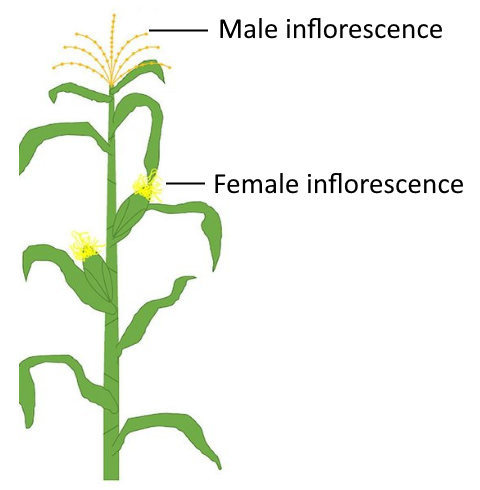
Additional information:
Monoecious plants can have both- self-pollination or cross-pollination as they male and female parts on the same plant. The male flower is usually situated at the top position to aid in self-pollination. The pollination of a flower by pollen from the same flower or from another flower on the same plant is called self-pollination. While pollination of a flower or plant with pollen from another flower or plant is called cross-pollination.
So, the correct answer is ‘If both male and female flowers are present but flower unisexual'.
Note: For monoecious plants, the main advantage is having the ability to reproduce from the same plant and thus their survival doesn’t depend on other trees or pollinators. The disadvantage however is that they do not usually have much genetic variation due to self-pollination.
Complete answer:
Monoecious plants are the plants that bear both male and female sex organs in different unisexual flowers but on the same plant. For example, Zea mays, pine, spruce, birch, etc. While dioecious plants are the one that bears both male and female sex organs on different plants. For example Carica papaya. Unisexual flowers possess either male reproductive organ (stamens) or the female reproductive organ (pistil) while a bisexual flower has both the sexes together. The position of flowers in maize plant can be depicted as-
Additional information:
Monoecious plants can have both- self-pollination or cross-pollination as they male and female parts on the same plant. The male flower is usually situated at the top position to aid in self-pollination. The pollination of a flower by pollen from the same flower or from another flower on the same plant is called self-pollination. While pollination of a flower or plant with pollen from another flower or plant is called cross-pollination.
So, the correct answer is ‘If both male and female flowers are present but flower unisexual'.
Note: For monoecious plants, the main advantage is having the ability to reproduce from the same plant and thus their survival doesn’t depend on other trees or pollinators. The disadvantage however is that they do not usually have much genetic variation due to self-pollination.
Recently Updated Pages
Master Class 12 Economics: Engaging Questions & Answers for Success

Master Class 12 English: Engaging Questions & Answers for Success
Master Class 12 Social Science: Engaging Questions & Answers for Success
Master Class 12 Maths: Engaging Questions & Answers for Success
Master Class 12 Physics: Engaging Questions & Answers for Success
Master Class 11 Social Science: Engaging Questions & Answers for Success
Trending doubts
One Metric ton is equal to kg A 10000 B 1000 C 100 class 11 physics CBSE
Difference Between Prokaryotic Cells and Eukaryotic Cells
Two of the body parts which do not appear in MRI are class 11 biology CBSE
1 ton equals to A 100 kg B 1000 kg C 10 kg D 10000 class 11 physics CBSE
Draw a diagram of nephron and explain its structur class 11 biology CBSE
10 examples of friction in our daily life