




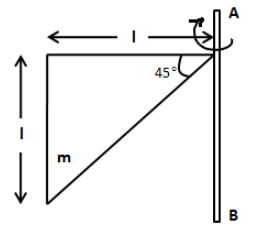
Moment of inertia of a triangle plane of mass M shown in the figure, about axis AB is:
Answer
 Verified
594.6k+ views
Hint:The centre of mass of a right angle triangle is \[\dfrac{2}{3}l\] from the axis. According to the parallel axes theorem, the moment of inertia of the body is the sum of the moment of inertia of the body about the axis passing through the centre of the body and the product of the mass of the body and square of the distance between the two axes. The moment of inertia of the triangle about the axis passing through the centre is \[{I_C} = \dfrac{{M{l^2}}}{{18}}\].
Formula used:
Parallel axes theorem, \[I = {I_C} + M{R^2}\]
Here, \[{I_C}\] is the moment of inertia about the centre of mass, M is the mass of the body and R is the distance between the two parallel axes.
Complete step by step answer:
We have given that the base and height of the triangle is l. Also, the mass of the triangle is M. We know that the centre of mass of a right angle triangle is \[\dfrac{2}{3}l\] from the axis. Here, l is the base length of the triangle.
We have from the parallel axis theorem, the moment of inertia of the body is the sum of the moment of inertia of the body about the axis passing through the centre of the body and the product of the mass of the body and square of the distance between the two axes. Therefore, we can express the moment of inertia of this triangle about the axis AB as,
\[{I_{AB}} = {I_C} + M{R^2}\]
Here, R is the distance between the two axes and it is equal to \[\dfrac{2}{3}l\]. Therefore, the above equation becomes,
\[{I_{AB}} = {I_C} + M{\left( {\dfrac{2}{3}l} \right)^2}\]
\[ \Rightarrow {I_{AB}} = {I_C} + \dfrac{4}{9}M{l^2}\] …… (1)
We know the moment of inertia of the triangle about the axis passing through the centre is,
\[{I_C} = \dfrac{{M{l^2}}}{{18}}\]
Substituting the above equation in equation (1), we get,
\[ \Rightarrow {I_{AB}} = \dfrac{{M{l^2}}}{{18}} + \dfrac{4}{9}M{l^2}\]
\[ \Rightarrow {I_{AB}} = M{l^2}\left( {\dfrac{1}{{18}} + \dfrac{4}{9}} \right)\]
\[ \therefore {I_{AB}} = \dfrac{{M{l^2}}}{2}\]
Thus, the moment of inertia of the triangle about the axis AB is \[\dfrac{{M{l^2}}}{2}\].
Note: To derive the expression for the centre of mass of a triangle requires a lot of calculations. To avoid this, students can memorize the expression for centre of mass of the right angle triangle, \[{\text{COM}} = \dfrac{2}{3}l\]. Whether the triangle moves clockwise or counter clockwise, the moment of inertia of the triangle will not change.
Formula used:
Parallel axes theorem, \[I = {I_C} + M{R^2}\]
Here, \[{I_C}\] is the moment of inertia about the centre of mass, M is the mass of the body and R is the distance between the two parallel axes.
Complete step by step answer:
We have given that the base and height of the triangle is l. Also, the mass of the triangle is M. We know that the centre of mass of a right angle triangle is \[\dfrac{2}{3}l\] from the axis. Here, l is the base length of the triangle.
We have from the parallel axis theorem, the moment of inertia of the body is the sum of the moment of inertia of the body about the axis passing through the centre of the body and the product of the mass of the body and square of the distance between the two axes. Therefore, we can express the moment of inertia of this triangle about the axis AB as,
\[{I_{AB}} = {I_C} + M{R^2}\]
Here, R is the distance between the two axes and it is equal to \[\dfrac{2}{3}l\]. Therefore, the above equation becomes,
\[{I_{AB}} = {I_C} + M{\left( {\dfrac{2}{3}l} \right)^2}\]
\[ \Rightarrow {I_{AB}} = {I_C} + \dfrac{4}{9}M{l^2}\] …… (1)
We know the moment of inertia of the triangle about the axis passing through the centre is,
\[{I_C} = \dfrac{{M{l^2}}}{{18}}\]
Substituting the above equation in equation (1), we get,
\[ \Rightarrow {I_{AB}} = \dfrac{{M{l^2}}}{{18}} + \dfrac{4}{9}M{l^2}\]
\[ \Rightarrow {I_{AB}} = M{l^2}\left( {\dfrac{1}{{18}} + \dfrac{4}{9}} \right)\]
\[ \therefore {I_{AB}} = \dfrac{{M{l^2}}}{2}\]
Thus, the moment of inertia of the triangle about the axis AB is \[\dfrac{{M{l^2}}}{2}\].
Note: To derive the expression for the centre of mass of a triangle requires a lot of calculations. To avoid this, students can memorize the expression for centre of mass of the right angle triangle, \[{\text{COM}} = \dfrac{2}{3}l\]. Whether the triangle moves clockwise or counter clockwise, the moment of inertia of the triangle will not change.
Recently Updated Pages
Master Class 11 Social Science: Engaging Questions & Answers for Success

Master Class 11 English: Engaging Questions & Answers for Success
Master Class 11 Maths: Engaging Questions & Answers for Success
Master Class 11 Chemistry: Engaging Questions & Answers for Success
Master Class 11 Biology: Engaging Questions & Answers for Success
Master Class 11 Physics: Engaging Questions & Answers for Success
Trending doubts
One Metric ton is equal to kg A 10000 B 1000 C 100 class 11 physics CBSE
Difference Between Prokaryotic Cells and Eukaryotic Cells
Draw a diagram of a plant cell and label at least eight class 11 biology CBSE
Two of the body parts which do not appear in MRI are class 11 biology CBSE
Which gas is abundant in air class 11 chemistry CBSE
10 examples of friction in our daily life