




Mirror formula is valid for:
A. Convex mirror
B. Concave mirror
C. both A. and B.
D. for lenses and mirrors
Answer
 Verified
608.1k+ views
Hint: Mirror formula is an equation which represents a relationship between the object distance (u), image distance (v) and the focal length of the mirror from the surface of the centers. This formula is used for the special mirrors (concave and convex). One side of the mirror is shaded by silver coating to make them opaque from the particular side.
Complete answer:
Mirror formula shows a relationship between the focal length, the object distance and the image distance. The relation mathematically is expressed as:
$\dfrac{1}{f}=\dfrac{1}{v}+\dfrac{1}{u}$
The distances are measured with the sign convention principle of mirror.
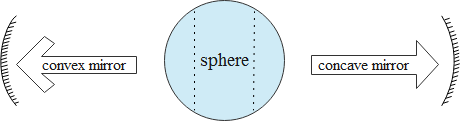
This formula is used for special kinds of mirrors (spherical mirrors). Consider a sphere of certain radius R, a section of it is taken out to form two different types of spherical mirrors. To form a mirror one side of the spherical section is coated with a silver coating. If coating is done on the inner surface and convex mirror is formed. And if we do the same for the outer side of the sphere a concave mirror is obtained.
For better understanding you can refer to the diagram shown here:
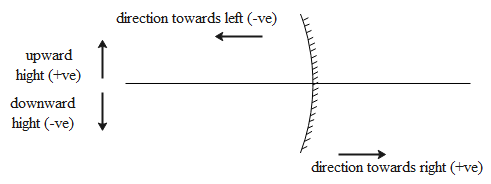
The sign convention of a mirror is such that; the region where we place the objects is considered as the negative side and the other section is known as the positive side. And the region above the axis is considered positive and below it is considered to be negative. Consider the below diagram for better understanding.
Thus, the correct option is both concave and convex mirrors using mirror formula.
So, the correct answer is “Option C”.
Note:
The mirror formula is used for both the special (spherical) type of mirrors using the standard sign convention for spherical mirrors. The coating is done with the silver coating because silver is very luminous matter and maximum reflection can be achieved for accurate output images. One of the use of mirror formulas is to find the focal length of a mirror which must be used for a specific experiment or image formation.
Complete answer:
Mirror formula shows a relationship between the focal length, the object distance and the image distance. The relation mathematically is expressed as:
$\dfrac{1}{f}=\dfrac{1}{v}+\dfrac{1}{u}$
The distances are measured with the sign convention principle of mirror.
This formula is used for special kinds of mirrors (spherical mirrors). Consider a sphere of certain radius R, a section of it is taken out to form two different types of spherical mirrors. To form a mirror one side of the spherical section is coated with a silver coating. If coating is done on the inner surface and convex mirror is formed. And if we do the same for the outer side of the sphere a concave mirror is obtained.
For better understanding you can refer to the diagram shown here:
The sign convention of a mirror is such that; the region where we place the objects is considered as the negative side and the other section is known as the positive side. And the region above the axis is considered positive and below it is considered to be negative. Consider the below diagram for better understanding.
Thus, the correct option is both concave and convex mirrors using mirror formula.
So, the correct answer is “Option C”.
Note:
The mirror formula is used for both the special (spherical) type of mirrors using the standard sign convention for spherical mirrors. The coating is done with the silver coating because silver is very luminous matter and maximum reflection can be achieved for accurate output images. One of the use of mirror formulas is to find the focal length of a mirror which must be used for a specific experiment or image formation.
Recently Updated Pages
Master Class 11 English: Engaging Questions & Answers for Success

Master Class 11 Maths: Engaging Questions & Answers for Success
Class 11 Question and Answer - Your Ultimate Solutions Guide
Master Class 11 Biology: Engaging Questions & Answers for Success
Master Class 11 Physics: Engaging Questions & Answers for Success
Master Class 11 Accountancy: Engaging Questions & Answers for Success
Trending doubts
Explain the Treaty of Vienna of 1815 class 10 social science CBSE
Who Won 36 Oscar Awards? Record Holder Revealed
What is the median of the first 10 natural numbers class 10 maths CBSE
Why is it 530 pm in india when it is 1200 afternoon class 10 social science CBSE
Why is there a time difference of about 5 hours between class 10 social science CBSE
What is the full form of POSCO class 10 social science CBSE