




Mirage is an example of ________
Answer
 Verified
639.9k+ views
Hint: Hot air makes different levels of air with various refractive index and density. So during sunny days, we can see optical illusions. Due to the variation in refractive index and density, makes the light ray to bend. This will create inverted images of the distant objects to our eyes.
Complete Step-by-Step solution:
Mirage is also known as Fata morgana. It's an optical phenomenon in which light rays bend and produce a displaced image of distant objects. It can be seen on land or at sea, in polar regions or desserts. So it will form distant object images such as boats, islands and coastline. Mirage normally happens on the sunny days, which will make the air hotter and dry.
On a sunny day, the ground will be dry. Thus the air above the ground also gets warmer. If we are going to the upper layers of air, we can see the reduction in temperature levels. As we know the refractive index and density depends on the temperature levels. So the light has to pass through these different levels of air with different temperatures. Therefore the light bends due to the refraction. Refraction is happening when the light moves through different mediums. If the light bends at an angle greater than the critical angle then total internal reflection takes place. So the light can reflect in the same medium. When the reflected light ray reaches our eyes, it appears as coming from the sky or tree. This inverted image creates an optical illusion of the presence of water or the presence of islands etc. So the mirage is an example of refraction of light and total internal reflection.
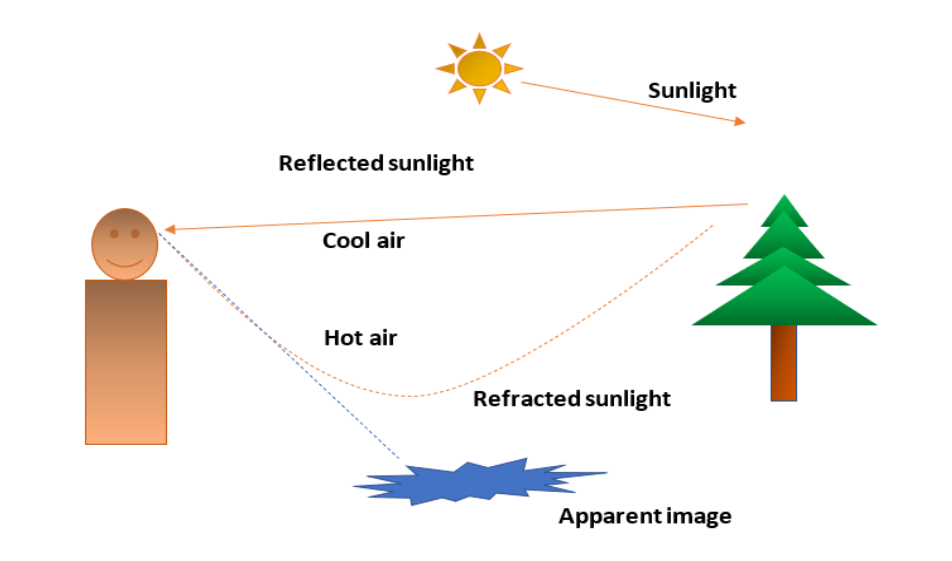
Additional information:
There are two types of mirages;
Inferior mirages: In this phenomenon the apparent image will form below an object’s actual position.
Superior mirages: In this phenomenon the apparent images will form above the actual position.
Note: Do not think the only refraction is the reason behind the mirages. It is a combined effect of total internal reflection and refraction. These are happening due to the temperature difference between the weather and land.
Complete Step-by-Step solution:
Mirage is also known as Fata morgana. It's an optical phenomenon in which light rays bend and produce a displaced image of distant objects. It can be seen on land or at sea, in polar regions or desserts. So it will form distant object images such as boats, islands and coastline. Mirage normally happens on the sunny days, which will make the air hotter and dry.
On a sunny day, the ground will be dry. Thus the air above the ground also gets warmer. If we are going to the upper layers of air, we can see the reduction in temperature levels. As we know the refractive index and density depends on the temperature levels. So the light has to pass through these different levels of air with different temperatures. Therefore the light bends due to the refraction. Refraction is happening when the light moves through different mediums. If the light bends at an angle greater than the critical angle then total internal reflection takes place. So the light can reflect in the same medium. When the reflected light ray reaches our eyes, it appears as coming from the sky or tree. This inverted image creates an optical illusion of the presence of water or the presence of islands etc. So the mirage is an example of refraction of light and total internal reflection.
Additional information:
There are two types of mirages;
Inferior mirages: In this phenomenon the apparent image will form below an object’s actual position.
Superior mirages: In this phenomenon the apparent images will form above the actual position.
Note: Do not think the only refraction is the reason behind the mirages. It is a combined effect of total internal reflection and refraction. These are happening due to the temperature difference between the weather and land.
Recently Updated Pages
Master Class 11 English: Engaging Questions & Answers for Success

Master Class 11 Social Science: Engaging Questions & Answers for Success
Master Class 11 Maths: Engaging Questions & Answers for Success
Master Class 11 Biology: Engaging Questions & Answers for Success
Master Class 11 Physics: Engaging Questions & Answers for Success
Master Class 11 Chemistry: Engaging Questions & Answers for Success
Trending doubts
In cricket, what is a "Yorker" designed to do?
Identify the plural form of the word child from the class 10 english CBSE
Draw a circuit diagram showing the cell switch and class 10 physics CBSE
Write a letter to the newspaper editor highlighting class 10 english CBSE
Make a sketch of the human nerve cell What function class 10 biology CBSE
Fill the blanks with proper collective nouns 1 A of class 10 english CBSE