




Minimum distance between the curves ${{y}^{2}}=x-1$ and ${{x}^{2}}=y-1$ is equal to :
(a) $\dfrac{3\sqrt{2}}{4}$
(b) $\dfrac{5\sqrt{2}}{4}$
(c) $\dfrac{7\sqrt{2}}{4}$
(d) $\dfrac{\sqrt{2}}{4}$
Answer
 Verified
634.8k+ views
Hint: Here, we will first draw the curves and then we will find the shortest distance between them. If the curves are intersecting then obviously the shortest distance between them is zero. If they are not intersecting then we will find the points on the curves which corresponds to nearest distance and then calculate the distance using the distance formula which states that distance between two points (a, b) and (c, d) is given as $d=\sqrt{{{\left( a-c \right)}^{2}}+{{\left( b-d \right)}^{2}}}$ .
Complete step-by-step answer:
The curves given here are:
${{y}^{2}}=x-1$ and ${{x}^{2}}=y-1$
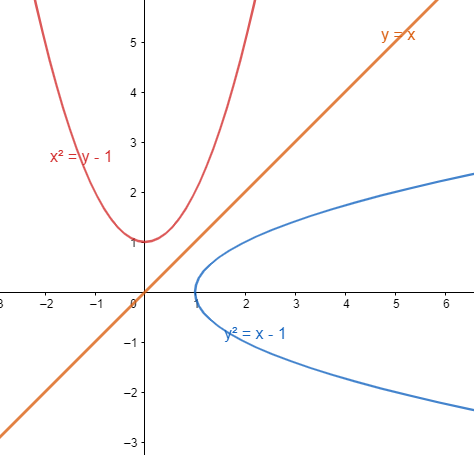
Both of the curves given here are symmetric about the origin. Thus the curves are symmetrical along the line y = x, that is one curve is the mirror image of the other curve along this line.
Now the shortest distance between the two curves is along the common normal to both the curves . The common normal of two non-intersecting curves is a line perpendicular to both the curves . So, the common normal is perpendicular to y = x.
The points on the curve which corresponds to the shortest distance between the curves will have the slope of their tangent equal to that of the line y =x. That is, if tangents are drawn at points corresponding to the shortest distance then these tangents will have a slope equal to 1.
The first curve is: ${{y}^{2}}=x-1$
On differentiating both sides with respect to x, we get:
$\begin{align}
& 2y.\dfrac{dy}{dx}=1-0 \\
& \Rightarrow \dfrac{dy}{dx}=\dfrac{1}{2y} \\
\end{align}$
But, we have found that the slope of tangent to the curves at the required point is 1.
So, we can write:
$\begin{align}
& 1=\dfrac{1}{2y} \\
& \Rightarrow y=\dfrac{1}{2} \\
\end{align}$
On putting value of y in the first curve, we get:
$\begin{align}
& {{\left( \dfrac{1}{2} \right)}^{2}}=x-1 \\
& \Rightarrow \dfrac{1}{4}+1=x \\
& \Rightarrow x=\dfrac{5}{4} \\
\end{align}$
Similarly, on differentiating the second curve with respect to x, we get:
$\begin{align}
& \dfrac{d\left( {{x}^{2}} \right)}{dx}=\dfrac{d\left( y-1 \right)}{dx} \\
& \Rightarrow 2x=\dfrac{dy}{dx} \\
\end{align}$
Since, we have slope = 1. So:
$\begin{align}
& 1=2x \\
& \Rightarrow x = \dfrac{1}{2} \\
\end{align}$
On putting the value of x in second equation, we get:
$\begin{align}
& {{\left( \dfrac{1}{2} \right)}^{2}}=y-1 \\
& \Rightarrow y=\dfrac{1}{4}+1=\dfrac{5}{4} \\
\end{align}$
Now, we know that the distance between two points (a, b) and (c, d) is given as $d=\sqrt{{{\left( a-c \right)}^{2}}+{{\left( b-d \right)}^{2}}}$ . We also know that the distance between the points $\left( \dfrac{5}{4},\dfrac{1}{2} \right)$ and $\left( \dfrac{1}{2},\dfrac{5}{4} \right)$ will give the shortest distance between the two curves.
So, the shortest distance is:
\[\begin{align}
& =\sqrt{{{\left( \dfrac{1}{2}-\dfrac{5}{4} \right)}^{2}}+{{\left( \dfrac{5}{4}-\dfrac{1}{2}
\right)}^{2}}} \\
& =\sqrt{{{\left( \dfrac{2-5}{4} \right)}^{2}}+{{\left( \dfrac{5-2}{4} \right)}^{2}}} \\
& =\sqrt{\dfrac{9}{16}+\dfrac{9}{16}}=\dfrac{3\sqrt{2}}{4} \\
\end{align}\]
Hence, option (a) is the correct answer.
Note: Students should note here that the slope of tangent to a curve is always given as the value of derivative of the curve at that point. The calculations must be done properly to avoid mistakes.
Complete step-by-step answer:
The curves given here are:
${{y}^{2}}=x-1$ and ${{x}^{2}}=y-1$
Both of the curves given here are symmetric about the origin. Thus the curves are symmetrical along the line y = x, that is one curve is the mirror image of the other curve along this line.
Now the shortest distance between the two curves is along the common normal to both the curves . The common normal of two non-intersecting curves is a line perpendicular to both the curves . So, the common normal is perpendicular to y = x.
The points on the curve which corresponds to the shortest distance between the curves will have the slope of their tangent equal to that of the line y =x. That is, if tangents are drawn at points corresponding to the shortest distance then these tangents will have a slope equal to 1.
The first curve is: ${{y}^{2}}=x-1$
On differentiating both sides with respect to x, we get:
$\begin{align}
& 2y.\dfrac{dy}{dx}=1-0 \\
& \Rightarrow \dfrac{dy}{dx}=\dfrac{1}{2y} \\
\end{align}$
But, we have found that the slope of tangent to the curves at the required point is 1.
So, we can write:
$\begin{align}
& 1=\dfrac{1}{2y} \\
& \Rightarrow y=\dfrac{1}{2} \\
\end{align}$
On putting value of y in the first curve, we get:
$\begin{align}
& {{\left( \dfrac{1}{2} \right)}^{2}}=x-1 \\
& \Rightarrow \dfrac{1}{4}+1=x \\
& \Rightarrow x=\dfrac{5}{4} \\
\end{align}$
Similarly, on differentiating the second curve with respect to x, we get:
$\begin{align}
& \dfrac{d\left( {{x}^{2}} \right)}{dx}=\dfrac{d\left( y-1 \right)}{dx} \\
& \Rightarrow 2x=\dfrac{dy}{dx} \\
\end{align}$
Since, we have slope = 1. So:
$\begin{align}
& 1=2x \\
& \Rightarrow x = \dfrac{1}{2} \\
\end{align}$
On putting the value of x in second equation, we get:
$\begin{align}
& {{\left( \dfrac{1}{2} \right)}^{2}}=y-1 \\
& \Rightarrow y=\dfrac{1}{4}+1=\dfrac{5}{4} \\
\end{align}$
Now, we know that the distance between two points (a, b) and (c, d) is given as $d=\sqrt{{{\left( a-c \right)}^{2}}+{{\left( b-d \right)}^{2}}}$ . We also know that the distance between the points $\left( \dfrac{5}{4},\dfrac{1}{2} \right)$ and $\left( \dfrac{1}{2},\dfrac{5}{4} \right)$ will give the shortest distance between the two curves.
So, the shortest distance is:
\[\begin{align}
& =\sqrt{{{\left( \dfrac{1}{2}-\dfrac{5}{4} \right)}^{2}}+{{\left( \dfrac{5}{4}-\dfrac{1}{2}
\right)}^{2}}} \\
& =\sqrt{{{\left( \dfrac{2-5}{4} \right)}^{2}}+{{\left( \dfrac{5-2}{4} \right)}^{2}}} \\
& =\sqrt{\dfrac{9}{16}+\dfrac{9}{16}}=\dfrac{3\sqrt{2}}{4} \\
\end{align}\]
Hence, option (a) is the correct answer.
Note: Students should note here that the slope of tangent to a curve is always given as the value of derivative of the curve at that point. The calculations must be done properly to avoid mistakes.
Recently Updated Pages
Master Class 12 Business Studies: Engaging Questions & Answers for Success

Master Class 12 Biology: Engaging Questions & Answers for Success
Master Class 12 Chemistry: Engaging Questions & Answers for Success
Class 12 Question and Answer - Your Ultimate Solutions Guide
Master Class 11 Social Science: Engaging Questions & Answers for Success
Master Class 11 English: Engaging Questions & Answers for Success
Trending doubts
Explain the Treaty of Vienna of 1815 class 10 social science CBSE
Who Won 36 Oscar Awards? Record Holder Revealed
What is the median of the first 10 natural numbers class 10 maths CBSE
Why is it 530 pm in india when it is 1200 afternoon class 10 social science CBSE
What is the full form of POSCO class 10 social science CBSE
The highest temperature in Karnataka is recorded in class 10 social science CBSE