




What is the minimum acceleration with which bar A (shown in the figure below) should be shifted horizontally to keep bodies 1 and 2 stationary relative to the bar? The masses of the bodies are equal and the coefficient of friction between the bar and the bodies is equal to k. The masses of the pulley and the threads are negligible, the friction in the pulley is absent.

Answer
 Verified
558k+ views
Hint: This given question can be solved by using second law of motion given by the Isaac Newton and also, we have to calculate the minimum acceleration on the bar by bodies 1 and 2 so, we need to check whether static friction between the given bodies 1 and 2 in the above question is acting or not.
Step by step solution: Body 1 and body 2 are in rest with respect to bar A.
Let us assume the minimum acceleration of the bar is \[{{w}_{\min }}\]
Let us assume the maximum acceleration of the bar is \[{{w}_{\max }}\]
Let us assume the acceleration of the bar is\[w\].
So we can write
\[{{w}_{\min }}\le w\le {{w}_{\begin{smallmatrix}
\max \\
\end{smallmatrix}}}\]
If we go beyond these limits there will be a relative motion between the bar and the given bodies.
The tendency of the body 1 in relation to bar A to move towards right is
\[0\le w\le {{w}_{\begin{smallmatrix}
\min \\
\end{smallmatrix}}}\]
And in the opposite sense the tendency of the body 1 in relation to bar A is
\[w\le {{w}_{\begin{smallmatrix}
\max \\
\end{smallmatrix}}}\]
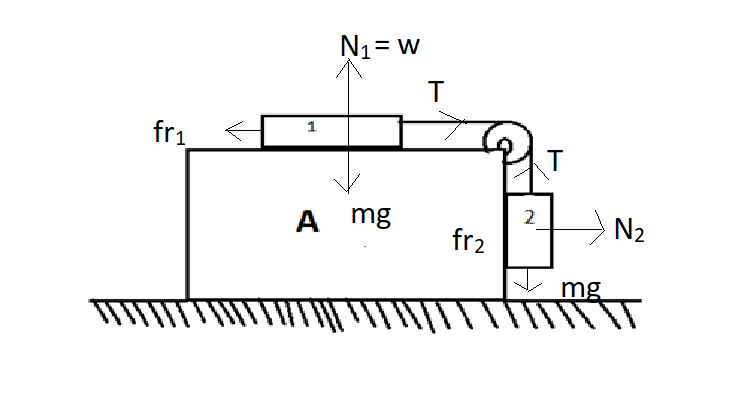 So according to the above equation,The static friction on body 1 by A is \[{{f}_{{{r}_{1}}}}\]directed towards left and the static friction on body 2 by A is \[{{f}_{{{r}_{2}}}}\]directed upwards for the purpose of calculating the min.
Now, according to the second law of motion for bodies 1 and 2, we get
\[\begin{align}
& \text{T-f}{{\text{r}}_{1}}\text{= mw } \\
& \Rightarrow \text{f}{{\text{r}}_{1}}\text{= T- mw }.........\text{equation (1)} \\
\end{align}\]
\[{{N}_{2}}=mw.........equation(2)\]
Here m is the mass of the given body 1.
The body 2 has no acceleration in vertical direction
\[\text{f}{{\text{r}}_{2}}\text{ = mg - T}.....\text{equation (3)}\]
Where m is the mass of the given body 2
And g is the acceleration due to gravity acting on the given body 2
Add equation 1 and equation 3 we can write,
\[(\text{f}{{\text{r}}_{1}}\text{ + f}{{\text{r}}_{2}})\text{ = m(g - w)}........\text{equation(4)}\]
Since we know that, \[\text{f}{{\text{r}}_{1}}+\text{ f}{{\text{r}}_{2}}\text{ }\le \text{ k(}{{\text{N}}_{1}}\text{ + }{{\text{N}}_{2}})\].
So put the value of N1 and N2 from the figure and we get
\[\text{f}{{\text{r}}_{1}}+\text{ f}{{\text{r}}_{2}}\text{ }\le \text{ k(mg + mw})\] …….. Equation (5)
Now from equation 4 and equation 5, we can write
\[\begin{align}
& \text{m( g - w) }\le \text{ mk( g}\text{ + w)} \\
& \Rightarrow \text{ w }\le \text{ }\dfrac{\text{g( 1 - k)}}{(1+\text{ k)}} \\
\end{align}\]
Hence, minimum acceleration will be
\[{{\text{w}}_{\min }}\text{ }\le \text{ }\dfrac{\text{g( 1 - k)}}{(1+\text{ k)}}\]
So according to the question, the minimum acceleration with which bar A should be shifted horizontally to keep the given body 1 and given body 2 stationary the bar where the masses of the two bodies are equal and the coefficient of friction of the two bodies is equal to k and the masses of the pulley and the threads are negligible, the friction in the pulley is absent.
Note:
While solving these types of questions always keep in mind that we have to take account of every aspect like the mass of the pulley and threads should be negligible and also the friction in the pulley must be negligible otherwise the answer will not be appropriate.
Step by step solution: Body 1 and body 2 are in rest with respect to bar A.
Let us assume the minimum acceleration of the bar is \[{{w}_{\min }}\]
Let us assume the maximum acceleration of the bar is \[{{w}_{\max }}\]
Let us assume the acceleration of the bar is\[w\].
So we can write
\[{{w}_{\min }}\le w\le {{w}_{\begin{smallmatrix}
\max \\
\end{smallmatrix}}}\]
If we go beyond these limits there will be a relative motion between the bar and the given bodies.
The tendency of the body 1 in relation to bar A to move towards right is
\[0\le w\le {{w}_{\begin{smallmatrix}
\min \\
\end{smallmatrix}}}\]
And in the opposite sense the tendency of the body 1 in relation to bar A is
\[w\le {{w}_{\begin{smallmatrix}
\max \\
\end{smallmatrix}}}\]
Now, according to the second law of motion for bodies 1 and 2, we get
\[\begin{align}
& \text{T-f}{{\text{r}}_{1}}\text{= mw } \\
& \Rightarrow \text{f}{{\text{r}}_{1}}\text{= T- mw }.........\text{equation (1)} \\
\end{align}\]
\[{{N}_{2}}=mw.........equation(2)\]
Here m is the mass of the given body 1.
The body 2 has no acceleration in vertical direction
\[\text{f}{{\text{r}}_{2}}\text{ = mg - T}.....\text{equation (3)}\]
Where m is the mass of the given body 2
And g is the acceleration due to gravity acting on the given body 2
Add equation 1 and equation 3 we can write,
\[(\text{f}{{\text{r}}_{1}}\text{ + f}{{\text{r}}_{2}})\text{ = m(g - w)}........\text{equation(4)}\]
Since we know that, \[\text{f}{{\text{r}}_{1}}+\text{ f}{{\text{r}}_{2}}\text{ }\le \text{ k(}{{\text{N}}_{1}}\text{ + }{{\text{N}}_{2}})\].
So put the value of N1 and N2 from the figure and we get
\[\text{f}{{\text{r}}_{1}}+\text{ f}{{\text{r}}_{2}}\text{ }\le \text{ k(mg + mw})\] …….. Equation (5)
Now from equation 4 and equation 5, we can write
\[\begin{align}
& \text{m( g - w) }\le \text{ mk( g}\text{ + w)} \\
& \Rightarrow \text{ w }\le \text{ }\dfrac{\text{g( 1 - k)}}{(1+\text{ k)}} \\
\end{align}\]
Hence, minimum acceleration will be
\[{{\text{w}}_{\min }}\text{ }\le \text{ }\dfrac{\text{g( 1 - k)}}{(1+\text{ k)}}\]
So according to the question, the minimum acceleration with which bar A should be shifted horizontally to keep the given body 1 and given body 2 stationary the bar where the masses of the two bodies are equal and the coefficient of friction of the two bodies is equal to k and the masses of the pulley and the threads are negligible, the friction in the pulley is absent.
Note:
While solving these types of questions always keep in mind that we have to take account of every aspect like the mass of the pulley and threads should be negligible and also the friction in the pulley must be negligible otherwise the answer will not be appropriate.
Recently Updated Pages
Master Class 12 Economics: Engaging Questions & Answers for Success

Master Class 12 English: Engaging Questions & Answers for Success
Master Class 12 Social Science: Engaging Questions & Answers for Success
Master Class 12 Maths: Engaging Questions & Answers for Success
Master Class 12 Physics: Engaging Questions & Answers for Success
Master Class 11 Social Science: Engaging Questions & Answers for Success
Trending doubts
One Metric ton is equal to kg A 10000 B 1000 C 100 class 11 physics CBSE
Difference Between Prokaryotic Cells and Eukaryotic Cells
Find the value of the expression given below sin 30circ class 11 maths CBSE
Two of the body parts which do not appear in MRI are class 11 biology CBSE
Draw a diagram of nephron and explain its structur class 11 biology CBSE
10 examples of friction in our daily life