




How is the metamorphosis of a salamander different from the metamorphosis of a frog?
Answer
 Verified
580.2k+ views
Hint: The process of physical development after birth or hatching occurring in various organisms is called metamorphosis. It results in the bodily changes in structure by the process of cell division and differentiation.
Complete answer:
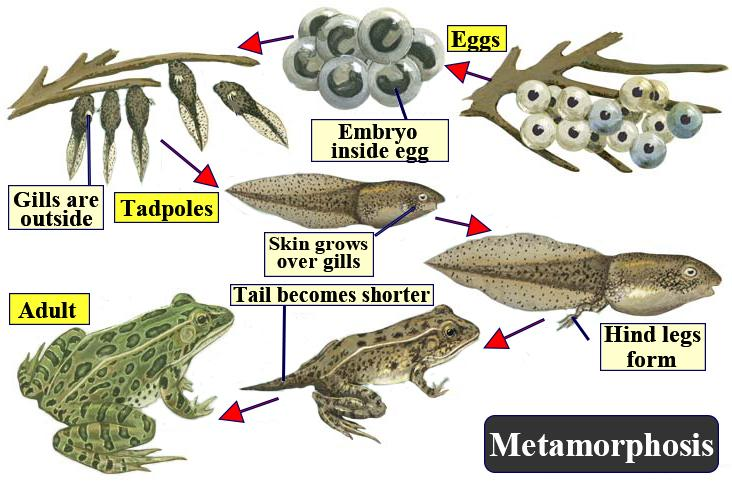
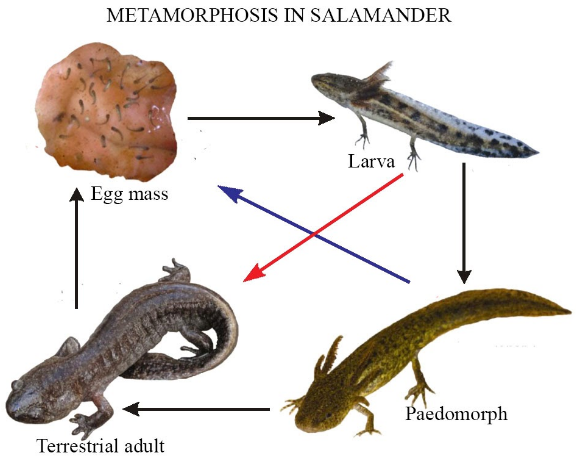
The metamorphosis is the process of transformation of the larva into an adult, it is a part of the life cycle of an organism. The metamorphosis in a salamander is different from the metamorphosis of a frog because in the case of a frog during metamorphosis they lose their tail while in the case of salamander even after metamorphosis their tail remains intact. The metamorphosis in Salamander is of incomplete type while in the case of frog metamorphosis is of complete type.
The frog undergoes all the stages of the life cycle that includes eggs, tadpole, froglet, and adult. In the case of Salamander, the stages of the life cycle include egg, larva, juvenile, and adult.
The process of metamorphosis leads to a change in the morphological structure of the larva. The change in Metamorphosis is of two types that are complete metamorphosis and incomplete metamorphosis. The metamorphosis is controlled by the hormones in an organism resulting in the structures being changed drastically. Their life cycle has four phases which involve eggs, larvae, pupa, and then adults.
The two types of metamorphosis are:
1) Ametabolous metamorphosis is the growth of the life cycle in an insect where there is slight or no metamorphosis. It only increases in size gradually.
2) Hemimetabolous metamorphosis is also known as incomplete metamorphosis and paurometabolous metamorphosis. It is a mode of development in certain insects that includes three distinct stages. These stages include egg, nymph, and the adult stage or imago. They change gradually without a pupal stage.
Note:
In human’s metamorphosis is not seen because as we grow our body grows too but it does not transform into some new complex structure. The body structure remains the same throughout the lifetime that is from the time of birth till the death. Thus, in the case of humans, there is no metamorphosis found.
Complete answer:
The metamorphosis is the process of transformation of the larva into an adult, it is a part of the life cycle of an organism. The metamorphosis in a salamander is different from the metamorphosis of a frog because in the case of a frog during metamorphosis they lose their tail while in the case of salamander even after metamorphosis their tail remains intact. The metamorphosis in Salamander is of incomplete type while in the case of frog metamorphosis is of complete type.
The frog undergoes all the stages of the life cycle that includes eggs, tadpole, froglet, and adult. In the case of Salamander, the stages of the life cycle include egg, larva, juvenile, and adult.
The process of metamorphosis leads to a change in the morphological structure of the larva. The change in Metamorphosis is of two types that are complete metamorphosis and incomplete metamorphosis. The metamorphosis is controlled by the hormones in an organism resulting in the structures being changed drastically. Their life cycle has four phases which involve eggs, larvae, pupa, and then adults.
The two types of metamorphosis are:
1) Ametabolous metamorphosis is the growth of the life cycle in an insect where there is slight or no metamorphosis. It only increases in size gradually.
2) Hemimetabolous metamorphosis is also known as incomplete metamorphosis and paurometabolous metamorphosis. It is a mode of development in certain insects that includes three distinct stages. These stages include egg, nymph, and the adult stage or imago. They change gradually without a pupal stage.
Note:
In human’s metamorphosis is not seen because as we grow our body grows too but it does not transform into some new complex structure. The body structure remains the same throughout the lifetime that is from the time of birth till the death. Thus, in the case of humans, there is no metamorphosis found.
Recently Updated Pages
Master Class 11 Social Science: Engaging Questions & Answers for Success

Master Class 11 English: Engaging Questions & Answers for Success
Master Class 11 Maths: Engaging Questions & Answers for Success
Master Class 11 Chemistry: Engaging Questions & Answers for Success
Master Class 11 Biology: Engaging Questions & Answers for Success
Class 11 Question and Answer - Your Ultimate Solutions Guide
Trending doubts
One Metric ton is equal to kg A 10000 B 1000 C 100 class 11 physics CBSE
Difference Between Prokaryotic Cells and Eukaryotic Cells
Find the value of the expression given below sin 30circ class 11 maths CBSE
1 ton equals to A 100 kg B 1000 kg C 10 kg D 10000 class 11 physics CBSE
Two of the body parts which do not appear in MRI are class 11 biology CBSE
Draw a diagram of nephron and explain its structur class 11 biology CBSE