




Megakaryocytes, special cells in the bone marrow that produce cell fragments are called:
A. Leukocytes
B. Erythrocytes
C. Thrombocytes
D. Fibrinogen
Answer
 Verified
602.4k+ views
Hint: Fluid matrix, plasma, and formed elements are the components of blood. Blood is a connective tissue that circulates in the blood vessels in fluid form. The formed elements consist of erythrocytes, thrombocytes or platelets, and leukocytes. Megakaryocytes are large cells in the bone marrow that forms one of the formed elements that help in blood clotting.
Complete answer: Blood is an important connective tissue of our body that consists of various elements that form it. It is a red fluid comprising a fluid matrix, plasma that is a transparent liquid, and formed elements. The formed elements are those elements that give characteristic features to the blood. These include erythrocytes or RBCs that give red colour to blood due to the presence of haemoglobin. The second formed element is leucocytes or WBCs. These are protective cells that form an important component of the immune system of the body. The last formed element is thrombocytes or platelets. These are the key component factors in the process of blood clotting.
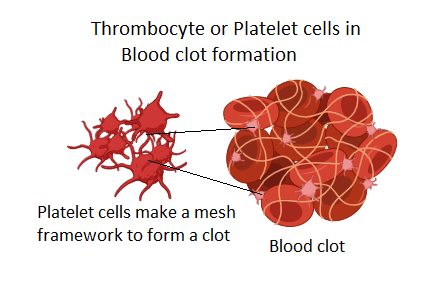
The megakaryocytes are large-sized cells in the bone marrow that produces platelet cells or thrombocytes. The thrombocytes are the cell fragments that help in blood clotting. Whenever we get a cut, blood rushes out from the injured spot. To stop excessive blood flow from the body, the platelet cells make a jelly-like substance called a clot that resists further blood loss. Reduction in the formation of thrombocytes can lead to clotting disorders and blood loss. Fibrinogen is also a clotting factor that is made in the liver. It circulates in blood and aids in blood coagulation along with thrombocytes. But it is not produced by megakaryocytes in the bone marrow.
Therefore, the right answer is option C, Thrombocytes.
Note: The megakaryocytes are 10 to 15 times larger than normal RBCs. Also, the normal number of megakaryocytes increases in cases of certain diseases related to clotting disorders. Thrombopoietin is a growth-inducing factor that stimulates the megakaryocytes to produce platelet cells. This is essential in controlling the rate of formation of Thrombocytes.
Complete answer: Blood is an important connective tissue of our body that consists of various elements that form it. It is a red fluid comprising a fluid matrix, plasma that is a transparent liquid, and formed elements. The formed elements are those elements that give characteristic features to the blood. These include erythrocytes or RBCs that give red colour to blood due to the presence of haemoglobin. The second formed element is leucocytes or WBCs. These are protective cells that form an important component of the immune system of the body. The last formed element is thrombocytes or platelets. These are the key component factors in the process of blood clotting.
The megakaryocytes are large-sized cells in the bone marrow that produces platelet cells or thrombocytes. The thrombocytes are the cell fragments that help in blood clotting. Whenever we get a cut, blood rushes out from the injured spot. To stop excessive blood flow from the body, the platelet cells make a jelly-like substance called a clot that resists further blood loss. Reduction in the formation of thrombocytes can lead to clotting disorders and blood loss. Fibrinogen is also a clotting factor that is made in the liver. It circulates in blood and aids in blood coagulation along with thrombocytes. But it is not produced by megakaryocytes in the bone marrow.
Therefore, the right answer is option C, Thrombocytes.
Note: The megakaryocytes are 10 to 15 times larger than normal RBCs. Also, the normal number of megakaryocytes increases in cases of certain diseases related to clotting disorders. Thrombopoietin is a growth-inducing factor that stimulates the megakaryocytes to produce platelet cells. This is essential in controlling the rate of formation of Thrombocytes.
Recently Updated Pages
Master Class 12 Economics: Engaging Questions & Answers for Success

Master Class 12 English: Engaging Questions & Answers for Success
Master Class 12 Social Science: Engaging Questions & Answers for Success
Master Class 12 Maths: Engaging Questions & Answers for Success
Master Class 12 Physics: Engaging Questions & Answers for Success
Master Class 9 General Knowledge: Engaging Questions & Answers for Success
Trending doubts
One Metric ton is equal to kg A 10000 B 1000 C 100 class 11 physics CBSE
Difference Between Prokaryotic Cells and Eukaryotic Cells
Two of the body parts which do not appear in MRI are class 11 biology CBSE
1 ton equals to A 100 kg B 1000 kg C 10 kg D 10000 class 11 physics CBSE
Draw a diagram of nephron and explain its structur class 11 biology CBSE
10 examples of friction in our daily life