




What is meant by zero error of Vernier calipers?
Answer
 Verified
646.8k+ views
Hint – In this question use the concept that a Vernier caliper has two scales that is the scale of Vernier caliper and the main scale of Vernier caliper, so if the scale of the Vernier caliper does not exactly coincides with the main scale than the Vernier caliper has the zero error.
Step by Step Answer:
Before performing the experiment we have to calibrate the instrument and calculate its zero error.
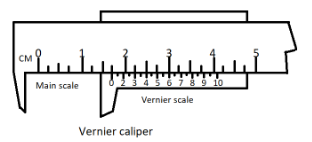
So if the pointer of the instrument indicates below zero then it is called a negative zero error and we have to add the magnitude of this error in the measured reading of the instrument.
Therefore true reading = measured reading + magnitude of negative zero error.
Now if the pointer of the instrument indicates above zero then it is called a positive zero error and we have to subtract the magnitude of this error in the measured reading of the instrument.
Therefore true reading = measured reading – magnitude of positive zero error.
Now if the pointer of the instrument indicates exactly at zero then it is called a null zero error and in this case measured reading is equal to the true reading of the instrument.
So in general we can say if the scale of the Vernier caliper does not exactly coincides with the main scale than the Vernier caliper has the zero error, it can be positive or negative i.e. if the scale of the Vernier caliper is on right side of the main scale than the zeroth error is called as positive zeroth error otherwise negative zeroth error.
Note – Vernier caliper plays a major role in measurement of the outer dimensions of an object or even the inner dimensions of it. It can also be used to measure the depth. In general a Vernier scale has the length of 9 mains scale divisions and these are further divided into 10 more divisions. The least count is equal to the difference of 1 main scale division to that of 1 Vernier scale division.
Step by Step Answer:
Before performing the experiment we have to calibrate the instrument and calculate its zero error.
So if the pointer of the instrument indicates below zero then it is called a negative zero error and we have to add the magnitude of this error in the measured reading of the instrument.
Therefore true reading = measured reading + magnitude of negative zero error.
Now if the pointer of the instrument indicates above zero then it is called a positive zero error and we have to subtract the magnitude of this error in the measured reading of the instrument.
Therefore true reading = measured reading – magnitude of positive zero error.
Now if the pointer of the instrument indicates exactly at zero then it is called a null zero error and in this case measured reading is equal to the true reading of the instrument.
So in general we can say if the scale of the Vernier caliper does not exactly coincides with the main scale than the Vernier caliper has the zero error, it can be positive or negative i.e. if the scale of the Vernier caliper is on right side of the main scale than the zeroth error is called as positive zeroth error otherwise negative zeroth error.
Note – Vernier caliper plays a major role in measurement of the outer dimensions of an object or even the inner dimensions of it. It can also be used to measure the depth. In general a Vernier scale has the length of 9 mains scale divisions and these are further divided into 10 more divisions. The least count is equal to the difference of 1 main scale division to that of 1 Vernier scale division.
Recently Updated Pages
Basicity of sulphurous acid and sulphuric acid are

Master Class 11 English: Engaging Questions & Answers for Success
Master Class 11 Physics: Engaging Questions & Answers for Success
Master Class 11 Computer Science: Engaging Questions & Answers for Success
Master Class 11 Chemistry: Engaging Questions & Answers for Success
Master Class 11 Social Science: Engaging Questions & Answers for Success
Trending doubts
Difference Between Prokaryotic Cells and Eukaryotic Cells
Two of the body parts which do not appear in MRI are class 11 biology CBSE
One Metric ton is equal to kg A 10000 B 1000 C 100 class 11 physics CBSE
10 examples of friction in our daily life
Draw a diagram of nephron and explain its structur class 11 biology CBSE
What will happen if the mucus is not secreted by the class 11 biology CBSE