




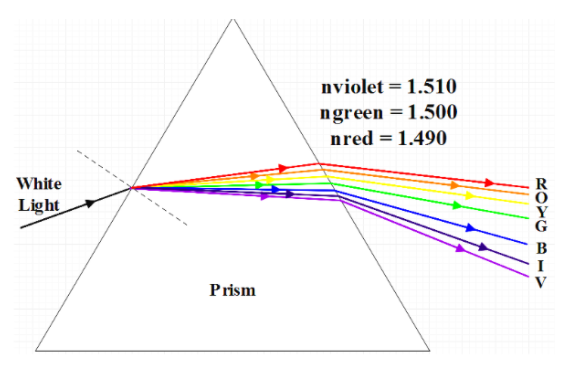
What is meant by the process of dispersion and recombination? Describe this with the help of a diagram. What is meant by a spectrum? Which are the colours of spectrum of white light in proper sequence.
Answer
 Verified
599.7k+ views
Hint: When a stream of sunlight happens to pass through a small circular aperture in one of the shutters, then it will produce a small circular patch on the opposite wall. When we place a triangular prism before the hole, an elongated coloured patch of light will be developed on the wall. This process is known as dispersion and recombination. This will help you in answering this question.
Complete answer:
First of all let us discuss dispersion and recombination of light. The splitting of white light into its constituent colours is defined as dispersion. If the light is passed through a prism, it will be deviated. The angle of deviation is dependent on the angle of incidence, the angle of the prism, on the refractive index of material of the prism and the colour of the light. If white light gets passed through a prism, a band of seven colours will be found, which is generally known as the spectrum. There are basically seven colours in the spectrum. They include violet, indigo, blue, green, yellow, orange and red. A spectrum is developed due to the lights of different colours which are refracted through different angles if they pass through a prism. Hence the answer has been found.
Note:
A rainbow is an example for the process of dispersion of light by water drops in the atmosphere. A rainbow is always developed in the direction opposite to that of the sun. If the light enters a water droplet, it is refracted first and dispersed into its constituent colours. Then there will be total internal reflection taking place at the water-air interface, and finally the ray emerges from the water drop forming a rainbow.
Complete answer:
First of all let us discuss dispersion and recombination of light. The splitting of white light into its constituent colours is defined as dispersion. If the light is passed through a prism, it will be deviated. The angle of deviation is dependent on the angle of incidence, the angle of the prism, on the refractive index of material of the prism and the colour of the light. If white light gets passed through a prism, a band of seven colours will be found, which is generally known as the spectrum. There are basically seven colours in the spectrum. They include violet, indigo, blue, green, yellow, orange and red. A spectrum is developed due to the lights of different colours which are refracted through different angles if they pass through a prism. Hence the answer has been found.
Note:
A rainbow is an example for the process of dispersion of light by water drops in the atmosphere. A rainbow is always developed in the direction opposite to that of the sun. If the light enters a water droplet, it is refracted first and dispersed into its constituent colours. Then there will be total internal reflection taking place at the water-air interface, and finally the ray emerges from the water drop forming a rainbow.
Recently Updated Pages
Master Class 12 Business Studies: Engaging Questions & Answers for Success

Master Class 12 Biology: Engaging Questions & Answers for Success
Master Class 12 Chemistry: Engaging Questions & Answers for Success
Class 12 Question and Answer - Your Ultimate Solutions Guide
Master Class 11 Social Science: Engaging Questions & Answers for Success
Master Class 11 English: Engaging Questions & Answers for Success
Trending doubts
Which are the Top 10 Largest Countries of the World?
Draw a labelled sketch of the human eye class 12 physics CBSE
Name the crygenes that control cotton bollworm and class 12 biology CBSE
Differentiate between homogeneous and heterogeneous class 12 chemistry CBSE
Ribosomal RNA is actively synthesised in A Nucleoplasm class 12 biology CBSE
How many molecules of ATP and NADPH are required information class 12 biology CBSE