




What do you mean by plastids? What are their various types? Draw only a labeled diagram of the transverse section of chloroplast of leaf cell as seen under electron microscope.
Answer
 Verified
608.4k+ views
Hint: Plastids are present in the plant cells. They play a very important role in synthesis and storage of food materials in the plants. They are mainly of four types. Chloroplast is responsible for the green color of the leaves. It contains thylakoids in which photosynthesis occurs.
Complete answer:
The sites of manufacture and storage of important chemical compounds in the cell are called plastids. These compounds are used by the cells of autotrophic eukaryotes. Plastids are mainly of four types that are:
Chloroplasts- These are the most known plastids and are responsible for photosynthesis. They are found in green leaves and responsible for the green color of the leaves. Chloroplasts trap sunlight and perform photosynthesis.
Chromoplasts– It is an area for all the pigments to be kept and synthesized in the plant. Chromoplasts are developed from the chloroplasts. Chromoplasts are carotenoid pigments. It allows different colors to be seen in leaves and fruits.
Gerontoplasts –Protoplasts are found in ageing tissues like dead leaves, etc. The basic chloroplasts that go with the ageing process.
Leucoplasts – These are the colorless or non-pigmented organelles in the cells. They are mostly found in non-photosynthetic parts of the plant such as roots. They are the storage site for starches, lipids, and proteins depending on the needs of the plant.
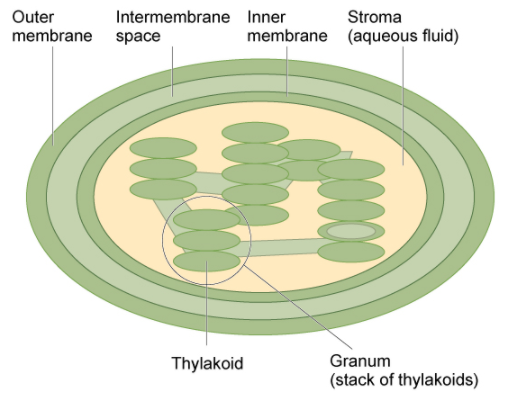
Note: The leaf is also called as the kitchen of the plants. It converts the solar energy into chemical energy. The chloroplast contains a photo system which traps sunlight. Stomata present in the leaves help in gaseous exchange. Roots take the water from the soil. Leaves use these raw materials and make starch and oxygen. Due to this phenomenon in plants are called autotrophs.
Complete answer:
The sites of manufacture and storage of important chemical compounds in the cell are called plastids. These compounds are used by the cells of autotrophic eukaryotes. Plastids are mainly of four types that are:
Chloroplasts- These are the most known plastids and are responsible for photosynthesis. They are found in green leaves and responsible for the green color of the leaves. Chloroplasts trap sunlight and perform photosynthesis.
Chromoplasts– It is an area for all the pigments to be kept and synthesized in the plant. Chromoplasts are developed from the chloroplasts. Chromoplasts are carotenoid pigments. It allows different colors to be seen in leaves and fruits.
Gerontoplasts –Protoplasts are found in ageing tissues like dead leaves, etc. The basic chloroplasts that go with the ageing process.
Leucoplasts – These are the colorless or non-pigmented organelles in the cells. They are mostly found in non-photosynthetic parts of the plant such as roots. They are the storage site for starches, lipids, and proteins depending on the needs of the plant.
Note: The leaf is also called as the kitchen of the plants. It converts the solar energy into chemical energy. The chloroplast contains a photo system which traps sunlight. Stomata present in the leaves help in gaseous exchange. Roots take the water from the soil. Leaves use these raw materials and make starch and oxygen. Due to this phenomenon in plants are called autotrophs.
Recently Updated Pages
Master Class 11 English: Engaging Questions & Answers for Success

Master Class 11 Social Science: Engaging Questions & Answers for Success
Master Class 11 Maths: Engaging Questions & Answers for Success
Master Class 11 Biology: Engaging Questions & Answers for Success
Master Class 11 Physics: Engaging Questions & Answers for Success
Master Class 11 Chemistry: Engaging Questions & Answers for Success
Trending doubts
Find the value of the expression given below sin 30circ class 11 maths CBSE
Draw a diagram of nephron and explain its structur class 11 biology CBSE
Difference between physical and chemical change class 11 chemistry CBSE
How do I convert ms to kmh Give an example class 11 physics CBSE
What is the atomic mass of Sodium a 22 gmol b 23 gmol class 11 chemistry CBSE
In which country Lascaux cave is located A India B class 11 social science CBSE