




What do you mean by epipetalous stamen, explain with the help of image?
Answer
 Verified
568.2k+ views
Hint: It regularly comprises a stalk called the filament and an anther which contains microsporangia. Either at the base or inside the center zone of the anther, most usually anthers are 2-lobed and are attached to the filament.
Complete answer
According to the question, the term epipetalous stamen might be a stamen that is borne over a petal as opposed to being embedded legitimately over the thalamus. For example, Solanum.
Depending on the species of plant, some or all of the stamens during a flower could also be attached to the petals or to the floral axis. They also could also be free-standing or fused to at least one another in many various ways, including fusion of some but not all stamens. The filaments could also be fused and therefore the anthers free, or the filaments free and therefore the anthers fused. As opposed to there being two locules, one locule of a stamen may neglect to create, or on the other hand, the 2 locules may blend late being developed to offer one locule. Extraordinary instances of stamen combination happen in certain types of Cyclanthera inside the Cucurbitaceae and in area Cyclanthera of variety Phyllanthus (family Euphorbiaceae) where the stamens structure a ring around the gynoecium, with a solitary locule.
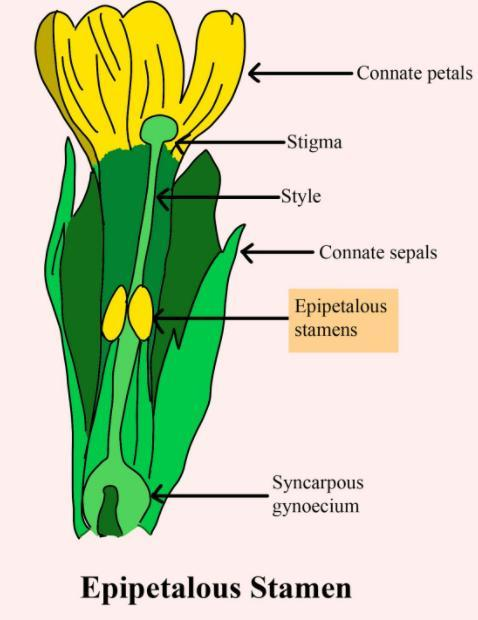
Note:
The androecium, when stamens in a flower collectively. As in Canna species, the androecium can contain as few as one-half stamen (i.e. a single locule) or as many as 3,482 stamens which have been counted in the saguaro (Carnegiea gigantea). The androecium in various species of plants forms an excellent sort of pattern, a number of them highly complex. It by and large encompasses the gynoecium and is encircled by the perianth.
Complete answer
According to the question, the term epipetalous stamen might be a stamen that is borne over a petal as opposed to being embedded legitimately over the thalamus. For example, Solanum.
Depending on the species of plant, some or all of the stamens during a flower could also be attached to the petals or to the floral axis. They also could also be free-standing or fused to at least one another in many various ways, including fusion of some but not all stamens. The filaments could also be fused and therefore the anthers free, or the filaments free and therefore the anthers fused. As opposed to there being two locules, one locule of a stamen may neglect to create, or on the other hand, the 2 locules may blend late being developed to offer one locule. Extraordinary instances of stamen combination happen in certain types of Cyclanthera inside the Cucurbitaceae and in area Cyclanthera of variety Phyllanthus (family Euphorbiaceae) where the stamens structure a ring around the gynoecium, with a solitary locule.
Note:
The androecium, when stamens in a flower collectively. As in Canna species, the androecium can contain as few as one-half stamen (i.e. a single locule) or as many as 3,482 stamens which have been counted in the saguaro (Carnegiea gigantea). The androecium in various species of plants forms an excellent sort of pattern, a number of them highly complex. It by and large encompasses the gynoecium and is encircled by the perianth.
Recently Updated Pages
Master Class 11 Social Science: Engaging Questions & Answers for Success

Master Class 11 English: Engaging Questions & Answers for Success
Master Class 11 Accountancy: Engaging Questions & Answers for Success
Master Class 11 Physics: Engaging Questions & Answers for Success
Master Class 11 Computer Science: Engaging Questions & Answers for Success
Master Class 11 Business Studies: Engaging Questions & Answers for Success
Trending doubts
One Metric ton is equal to kg A 10000 B 1000 C 100 class 11 physics CBSE
Find the value of the expression given below sin 30circ class 11 maths CBSE
Draw a diagram of nephron and explain its structur class 11 biology CBSE
10 examples of friction in our daily life
Proton was discovered by A Thomson B Rutherford C Chadwick class 11 chemistry CBSE
Bond order ofO2 O2+ O2 and O22 is in order A O2 langle class 11 chemistry CBSE