




Match the fractions given in Column I with the shaded portion of figures in Column II
Column I Column II \[\left( i \right)\dfrac{6}{8}\] (p)
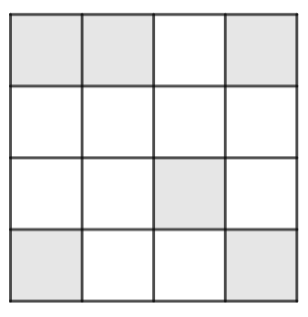
\[\left( ii \right)\dfrac{6}{10}\] (q)
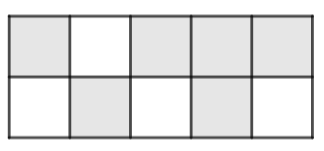
\[\left( iii \right)\dfrac{6}{6}\] (r)
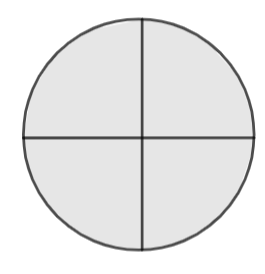
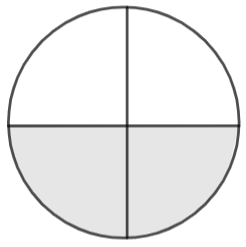
\[\left( iv \right)\dfrac{6}{8}\] (s)
(a) (i) – (p), (ii) – (q), (iii) – (s), (iv) – (r)
(b) (i) – (s), (ii) – (p), (iii) – (r), (iv) – (q)
(c) (i) – (r), (ii) – (s), (iii) – (p), (iv) – (q)
(d) (i) – (p), (ii) – (q), (iii) – (s), (iv) – (r)
| Column I | Column II |
| \[\left( i \right)\dfrac{6}{8}\] | (p)
|
| \[\left( ii \right)\dfrac{6}{10}\] | (q)
|
| \[\left( iii \right)\dfrac{6}{6}\] | (r)
|
| \[\left( iv \right)\dfrac{6}{8}\] | (s)
|
Answer
 Verified
601.8k+ views
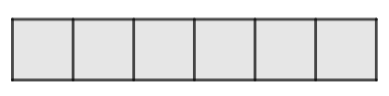
Hint: To solve this question, we will consider all the options in column II and then calculate all the values of elements p, q, r and s in column II and then match it with the column I. Also, we will make the fraction of the given element of column II and then solve it. The fraction can be calculated by using the formula, \[\text{Fraction}=\dfrac{\text{Shaded Blocks}}{\text{Total Number of Blocks}}.\]
Complete step by step answer:
Consider part (p) of column II. It is,
The fraction of (p) can be calculated using
\[\text{Fraction}=\dfrac{\text{Shaded Blocks}}{\text{Total Number of Blocks}}\]
\[\text{Fraction of p}=\dfrac{6}{8}\]
Hence, (p) matches with option (i).
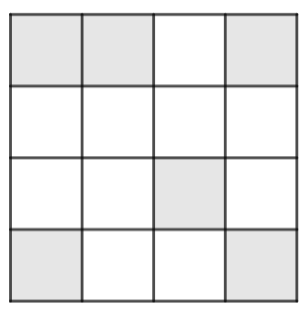
Now, similarly consider part (q) of column II.
It is,
(q)
The fraction of (q) can be calculated using
\[\text{Fraction}=\dfrac{\text{Shaded Blocks}}{\text{Total Number of Blocks}}\]
\[\text{Fraction of q}=\dfrac{6}{10}\]
Hence, (q) matches with option (ii).
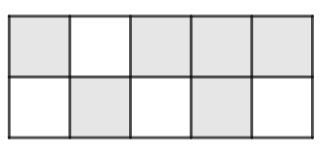
Now, again similarly, consider part (r) of the column (II). It is as,
(r)
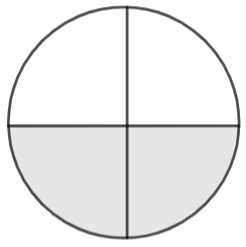
The fraction of (r) can be calculated using
\[\text{Fraction}=\dfrac{\text{Shaded Blocks}}{\text{Total Number of Blocks}}\]
\[\text{Fraction of r}=\dfrac{6}{8}\]
Hence, (r) matches with option (iv).
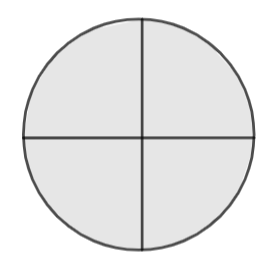
Now, again similarly consider option (s) in column II. It is as,
(s)
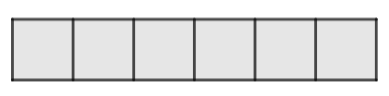
Fraction (s) can be calculated by using
\[\text{Fraction}=\dfrac{\text{Shaded Blocks}}{\text{Total Number of Blocks}}\]
\[\text{Fraction of s}=\dfrac{6}{6}\]
So, (s) matches with option (iii).
So, we finally have correct answer as,
(a) (i) – (p), (ii) – (q), (iii) – (s), (iv) – (r)
Hence, option (a) is the right answer.
Note:
The possibility of a mistake in this question can be at the point where (r) of column II is considered.
(r)
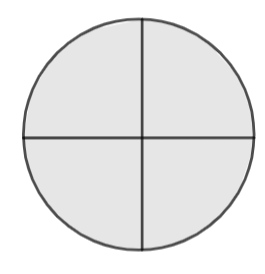
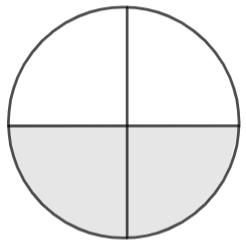
Students can add all the blocks together which is 4 + 4 = 8 and total number of shaded blocks = 4 + 2 = 6. So, the fraction becomes \[\dfrac{6}{8}.\]
Complete step by step answer:
Consider part (p) of column II. It is,
The fraction of (p) can be calculated using
\[\text{Fraction}=\dfrac{\text{Shaded Blocks}}{\text{Total Number of Blocks}}\]
\[\text{Fraction of p}=\dfrac{6}{8}\]
Hence, (p) matches with option (i).
Now, similarly consider part (q) of column II.
It is,
(q)
The fraction of (q) can be calculated using
\[\text{Fraction}=\dfrac{\text{Shaded Blocks}}{\text{Total Number of Blocks}}\]
\[\text{Fraction of q}=\dfrac{6}{10}\]
Hence, (q) matches with option (ii).
Now, again similarly, consider part (r) of the column (II). It is as,
(r)
The fraction of (r) can be calculated using
\[\text{Fraction}=\dfrac{\text{Shaded Blocks}}{\text{Total Number of Blocks}}\]
\[\text{Fraction of r}=\dfrac{6}{8}\]
Hence, (r) matches with option (iv).
Now, again similarly consider option (s) in column II. It is as,
(s)
Fraction (s) can be calculated by using
\[\text{Fraction}=\dfrac{\text{Shaded Blocks}}{\text{Total Number of Blocks}}\]
\[\text{Fraction of s}=\dfrac{6}{6}\]
So, (s) matches with option (iii).
So, we finally have correct answer as,
(a) (i) – (p), (ii) – (q), (iii) – (s), (iv) – (r)
Hence, option (a) is the right answer.
Note:
The possibility of a mistake in this question can be at the point where (r) of column II is considered.
(r)
Students can add all the blocks together which is 4 + 4 = 8 and total number of shaded blocks = 4 + 2 = 6. So, the fraction becomes \[\dfrac{6}{8}.\]
Recently Updated Pages
Master Class 10 Social Science: Engaging Questions & Answers for Success

Master Class 10 Science: Engaging Questions & Answers for Success
Master Class 10 Maths: Engaging Questions & Answers for Success
Master Class 10 General Knowledge: Engaging Questions & Answers for Success
Master Class 10 Computer Science: Engaging Questions & Answers for Success
Class 10 Question and Answer - Your Ultimate Solutions Guide
Trending doubts
What is the full form of PNG A Petrol Natural Gas B class 10 chemistry CBSE
Explain the Treaty of Vienna of 1815 class 10 social science CBSE
In cricket, how many legal balls are there in a standard over?
Why is there a time difference of about 5 hours between class 10 social science CBSE
Who Won 36 Oscar Awards? Record Holder Revealed
What is the median of the first 10 natural numbers class 10 maths CBSE