




Mass of the earth is 81 times the mass of the moon and the distance between the earth and moon is 60 times the radius of the earth. If R is the radius of the earth, then the distance between the moon and the point on the line joining the moon and the earth where the gravitational force becomes zero is
$
\left( a \right)30R \\
\left( b \right)15R \\
\left( c \right)6R \\
\left( d \right)5R \\
$
Answer
 Verified
624.6k+ views
Hint-In this question, we use the concept of gravitational force. If the gravitational force becomes zero at any point of a system then the net gravitational force due to the system at that point is always zero (0).
Formula used: $F = \dfrac{{GMm}}{{{r^2}}}$
Complete step-by-step solution -
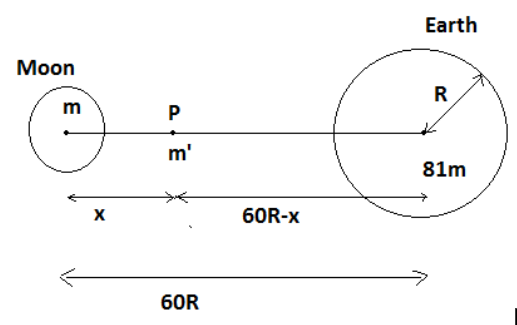
The mass of the moon is m and the distance between the moon and a point where the gravitational force becomes zero is x.
Given that mass of earth, M=81m and also the distance between the earth and moon is 60R where R is the radius of the earth.
Now, we assume a point P on the line joining the moon and the earth where the gravitational force becomes zero and also we assume the mass of point P is m’.
At point P net gravitational forces are zero (0). So,
The gravitational force between the moon and point P = Gravitational force between earth and point P
$
\Rightarrow \dfrac{{Gmm'}}{{{x^2}}} = \dfrac{{GMm'}}{{{{\left( {60R - x} \right)}^2}}} \\
\Rightarrow \dfrac{m}{{{x^2}}} = \dfrac{M}{{{{\left( {60R - x} \right)}^2}}} \\
$
We know, M=81m
$
\Rightarrow \dfrac{m}{{{x^2}}} = \dfrac{{81m}}{{{{\left( {60R - x} \right)}^2}}} \\
\Rightarrow \dfrac{1}{{{x^2}}} = \dfrac{{81}}{{{{\left( {60R - x} \right)}^2}}} \\
\Rightarrow \dfrac{{{{\left( {60R - x} \right)}^2}}}{{{x^2}}} = 81 \\
$
Taking square root on both sides,
$
\Rightarrow \dfrac{{\left( {60R - x} \right)}}{x} = 9 \\
\Rightarrow 60R - x = 9x \\
\Rightarrow 10x = 60R \\
\Rightarrow x = 6R \\
$
So, the correct option is (c).
Note- In such types of problems we use some important points to solve questions in an easy way. First, we find the gravitational force between the moon and a point P and also find the gravitational force between earth and a point P then we know at point P gravitational forces are zero so we put both forces equal to each other.
Formula used: $F = \dfrac{{GMm}}{{{r^2}}}$
Complete step-by-step solution -
The mass of the moon is m and the distance between the moon and a point where the gravitational force becomes zero is x.
Given that mass of earth, M=81m and also the distance between the earth and moon is 60R where R is the radius of the earth.
Now, we assume a point P on the line joining the moon and the earth where the gravitational force becomes zero and also we assume the mass of point P is m’.
At point P net gravitational forces are zero (0). So,
The gravitational force between the moon and point P = Gravitational force between earth and point P
$
\Rightarrow \dfrac{{Gmm'}}{{{x^2}}} = \dfrac{{GMm'}}{{{{\left( {60R - x} \right)}^2}}} \\
\Rightarrow \dfrac{m}{{{x^2}}} = \dfrac{M}{{{{\left( {60R - x} \right)}^2}}} \\
$
We know, M=81m
$
\Rightarrow \dfrac{m}{{{x^2}}} = \dfrac{{81m}}{{{{\left( {60R - x} \right)}^2}}} \\
\Rightarrow \dfrac{1}{{{x^2}}} = \dfrac{{81}}{{{{\left( {60R - x} \right)}^2}}} \\
\Rightarrow \dfrac{{{{\left( {60R - x} \right)}^2}}}{{{x^2}}} = 81 \\
$
Taking square root on both sides,
$
\Rightarrow \dfrac{{\left( {60R - x} \right)}}{x} = 9 \\
\Rightarrow 60R - x = 9x \\
\Rightarrow 10x = 60R \\
\Rightarrow x = 6R \\
$
So, the correct option is (c).
Note- In such types of problems we use some important points to solve questions in an easy way. First, we find the gravitational force between the moon and a point P and also find the gravitational force between earth and a point P then we know at point P gravitational forces are zero so we put both forces equal to each other.
Recently Updated Pages
Master Class 11 Social Science: Engaging Questions & Answers for Success

Master Class 11 Physics: Engaging Questions & Answers for Success
Master Class 11 Maths: Engaging Questions & Answers for Success
Master Class 11 Economics: Engaging Questions & Answers for Success
Master Class 11 Computer Science: Engaging Questions & Answers for Success
Master Class 11 Chemistry: Engaging Questions & Answers for Success
Trending doubts
One Metric ton is equal to kg A 10000 B 1000 C 100 class 11 physics CBSE
There are 720 permutations of the digits 1 2 3 4 5 class 11 maths CBSE
1 Quintal is equal to a 110 kg b 10 kg c 100kg d 1000 class 11 physics CBSE
State and prove Bernoullis theorem class 11 physics CBSE
Difference Between Prokaryotic Cells and Eukaryotic Cells
Which among the following are examples of coming together class 11 social science CBSE