



How to make anhydride from carboxylic acid?
Answer
 Verified
603.6k+ views
Hint: When a water molecule is removed from any acid molecule, the product that we get is known as an anhydride. In organic acid anhydride, there are two acyl groups (R-C=O) bonded to the same oxygen atom. Its generic structure is
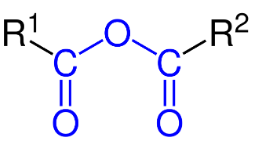
Complete step-by-step answer: The anhydride obtained from carboxylic acid is one of the most common types of organic acid anhydride. It is also known as carboxylic anhydride. The molecular formula of carboxylic anhydride is ${{(RC(O))}_{2}}O$.
Formation of acid anhydrides from carboxylic acid occurs when the carboxylic acid reacts with an acid chloride in the presence of a base.

Mechanism of synthesis of carboxylic anhydride from acid chloride:
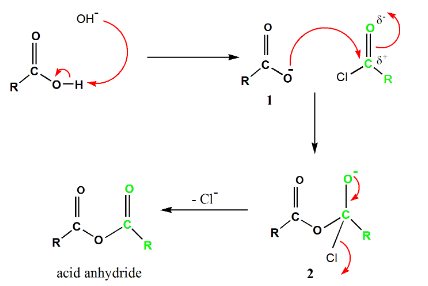
- In the carboxylic acid synthesis, addition-elimination mechanism is followed.
- Chloride anion $(C{{l}^{-}})$ acts as a leaving group.
- First, a proton is extracted by the base from carboxylic acid and forms carboxylate anion.
- The negatively charged oxygen of the carboxylate anion attacks the carbonyl carbon of acyl chloride, which is electrophilic in nature, and forms a tetrahedral intermediate.
- Lastly, the tetrahedral intermediate eliminates the chloride anion to form acid anhydride.
Hence by adding acid anhydride to a carboxylic acid, in the presence of a strong base, acid anhydride can be obtained.
Note: While naming the acid anhydrides, it is important to note that in an unsymmetrical acid anhydride, both of the carboxylic acids reacted must be named before adding the word anhydride. Whereas in symmetrical acid anhydride, simply renaming the word "acid" to "anhydride" of the parent carboxylic acid would suffice.
Complete step-by-step answer: The anhydride obtained from carboxylic acid is one of the most common types of organic acid anhydride. It is also known as carboxylic anhydride. The molecular formula of carboxylic anhydride is ${{(RC(O))}_{2}}O$.
Formation of acid anhydrides from carboxylic acid occurs when the carboxylic acid reacts with an acid chloride in the presence of a base.
Mechanism of synthesis of carboxylic anhydride from acid chloride:
- In the carboxylic acid synthesis, addition-elimination mechanism is followed.
- Chloride anion $(C{{l}^{-}})$ acts as a leaving group.
- First, a proton is extracted by the base from carboxylic acid and forms carboxylate anion.
- The negatively charged oxygen of the carboxylate anion attacks the carbonyl carbon of acyl chloride, which is electrophilic in nature, and forms a tetrahedral intermediate.
- Lastly, the tetrahedral intermediate eliminates the chloride anion to form acid anhydride.
Hence by adding acid anhydride to a carboxylic acid, in the presence of a strong base, acid anhydride can be obtained.
Note: While naming the acid anhydrides, it is important to note that in an unsymmetrical acid anhydride, both of the carboxylic acids reacted must be named before adding the word anhydride. Whereas in symmetrical acid anhydride, simply renaming the word "acid" to "anhydride" of the parent carboxylic acid would suffice.
Recently Updated Pages
Which of the following graphs shows the variation of class 12 physics CBSE

Draw a labelled diagram of the human male reproductive class 12 biology CBSE
Describe the experiment to compare the emf of two cells class 12 physics CBSE
What is standard hydrogen electrode
What is conventional current and electric current class 12 physics CBSE
2Bromopentane is treated with an alcoholic KOH solution class 12 chemistry CBSE
Trending doubts
Draw a labelled sketch of the human eye class 12 physics CBSE
Which are the Top 10 Largest Countries of the World?
A member of Simon commission later became Prime Minister class 12 social science CBSE
Draw ray diagrams each showing i myopic eye and ii class 12 physics CBSE
Give one example of a reptile that is viviparous class 12 biology CBSE
Which is the correct genotypic ratio of mendel dihybrid class 12 biology CBSE