




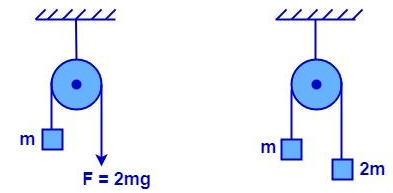
What is the magnitude of difference in accelerations of blocks of mass m in both the cases shown below?
(A) g
(B) $ \dfrac{2g}{3} $
(C) Zero
(D) $ \dfrac{g}{3} $
Answer
 Verified
564.6k+ views
Hint: In general, acceleration of a system is directly proportional to and in the same direction as the net external force acting on the system, and inversely proportional to its mass. And acceleration due to gravity is the acceleration gained by an object due to gravitational force.
For a body hanging on the pulley, the force acting on it is given by
$ F=mg $
Where m is the mass of the body . And g is the acceleration due to gravity acting on it.
Complete step by step solution
In the first diagram,
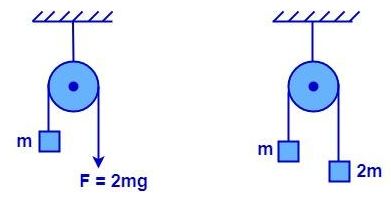
$ F=2mg $ (Given)
This is also possible when instead of this applied force, a mass of 2m is placed at that end.
When this mass of 2m is placed at the end where external force $ F=2mg $ is applied, we observe that both the diagrams become the same.
Hence there is no difference in the accelerations as well.
Hence, our answer is Zero i.e. option (C).
Note
While solving the pulley problems, the following assumptions are to be kept in mind i.e.
The string is taut and inextensible at each and every point of time.
The string is massless and hence the tension is uniform throughout.
Pulley is massless.
So we do not consider any mass of the pulley or the string while calculating the net force due to masses attached or due to the applied force.
Being the difference in magnitudes of accelerations to be zero, we can here calculate their accelerations as:
$ a=\dfrac{F_{net}}{\text{Total Mass}} $
$ a=\dfrac{2mg}{m+2m} $
$ a=\dfrac{2mg}{3m} $
$ a=\dfrac{2g}{3} $.
For a body hanging on the pulley, the force acting on it is given by
$ F=mg $
Where m is the mass of the body . And g is the acceleration due to gravity acting on it.
Complete step by step solution
In the first diagram,
$ F=2mg $ (Given)
This is also possible when instead of this applied force, a mass of 2m is placed at that end.
When this mass of 2m is placed at the end where external force $ F=2mg $ is applied, we observe that both the diagrams become the same.
Hence there is no difference in the accelerations as well.
Hence, our answer is Zero i.e. option (C).
Note
While solving the pulley problems, the following assumptions are to be kept in mind i.e.
The string is taut and inextensible at each and every point of time.
The string is massless and hence the tension is uniform throughout.
Pulley is massless.
So we do not consider any mass of the pulley or the string while calculating the net force due to masses attached or due to the applied force.
Being the difference in magnitudes of accelerations to be zero, we can here calculate their accelerations as:
$ a=\dfrac{F_{net}}{\text{Total Mass}} $
$ a=\dfrac{2mg}{m+2m} $
$ a=\dfrac{2mg}{3m} $
$ a=\dfrac{2g}{3} $.
Recently Updated Pages
Master Class 11 Computer Science: Engaging Questions & Answers for Success

Master Class 11 Business Studies: Engaging Questions & Answers for Success
Master Class 11 Economics: Engaging Questions & Answers for Success
Master Class 11 English: Engaging Questions & Answers for Success
Master Class 11 Maths: Engaging Questions & Answers for Success
Master Class 11 Biology: Engaging Questions & Answers for Success
Trending doubts
One Metric ton is equal to kg A 10000 B 1000 C 100 class 11 physics CBSE
There are 720 permutations of the digits 1 2 3 4 5 class 11 maths CBSE
Discuss the various forms of bacteria class 11 biology CBSE
Draw a diagram of a plant cell and label at least eight class 11 biology CBSE
State the laws of reflection of light
Explain zero factorial class 11 maths CBSE