




Look at the diagram and answer the following:
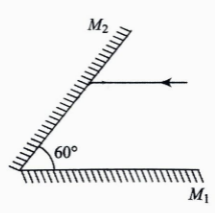
How many images will be formed when two mirrors are placed edge to edge at an angle of 60 degrees each?
Answer
 Verified
512.7k+ views
Hint: To answer this question, we need to understand the concept of formation of images by plane mirrors and the characteristics of the images formed. The reflected images in their typical proportions are reversed from left to right in the images created by a plane mirror. These are the mirrors that are most commonly used.
Complete step by step answer:
The picture generated by a plane mirror has the following characteristics:
-It's a virtual representation.
-It stands upright and is the same size as the target.
-The object's distance from the plane mirror is the same as the image's distance from the plane mirror.
-The image is laterally inverted, which is one of its most distinguishing features. It means that if you raise your left hand, the plane mirror will see you raise your right hand.
The number of images created by two adjacent plane mirrors is determined by their angle. If the angle between the plane mirrors is $\theta $ (in degrees), then the number of images equals will be,
$n = \dfrac{{360}}{\theta } - 1$
Here $n$is the number of images formed.
If $\theta = {60^o}$(as shown in the figure), then number of images formed is equal to,
$n = \dfrac{{360}}{{60}} - 1 \\
\Rightarrow n = 6 - 1 \\
\therefore n = 5 \\ $
Hence, 5 images will be formed for the arrangement shown in the figure.
Note:When a ray of light strikes a surface, it can have one of three effects: reflection, refraction, or absorption. When it hits a regular surface, the majority of the light is absorbed.As a result, mirrors are polished surfaces covered with mercury that reflect the majority of the light that falls on them. We may now classify mirrors as concave, convex, or plane mirrors based on the type of reflecting surface.
Complete step by step answer:
The picture generated by a plane mirror has the following characteristics:
-It's a virtual representation.
-It stands upright and is the same size as the target.
-The object's distance from the plane mirror is the same as the image's distance from the plane mirror.
-The image is laterally inverted, which is one of its most distinguishing features. It means that if you raise your left hand, the plane mirror will see you raise your right hand.
The number of images created by two adjacent plane mirrors is determined by their angle. If the angle between the plane mirrors is $\theta $ (in degrees), then the number of images equals will be,
$n = \dfrac{{360}}{\theta } - 1$
Here $n$is the number of images formed.
If $\theta = {60^o}$(as shown in the figure), then number of images formed is equal to,
$n = \dfrac{{360}}{{60}} - 1 \\
\Rightarrow n = 6 - 1 \\
\therefore n = 5 \\ $
Hence, 5 images will be formed for the arrangement shown in the figure.
Note:When a ray of light strikes a surface, it can have one of three effects: reflection, refraction, or absorption. When it hits a regular surface, the majority of the light is absorbed.As a result, mirrors are polished surfaces covered with mercury that reflect the majority of the light that falls on them. We may now classify mirrors as concave, convex, or plane mirrors based on the type of reflecting surface.
Recently Updated Pages
Master Class 10 Computer Science: Engaging Questions & Answers for Success

Master Class 10 General Knowledge: Engaging Questions & Answers for Success
Master Class 10 English: Engaging Questions & Answers for Success
Master Class 10 Social Science: Engaging Questions & Answers for Success
Master Class 10 Maths: Engaging Questions & Answers for Success
Master Class 10 Science: Engaging Questions & Answers for Success
Trending doubts
What is the median of the first 10 natural numbers class 10 maths CBSE
Which women's tennis player has 24 Grand Slam singles titles?
Who is the Brand Ambassador of Incredible India?
Why is there a time difference of about 5 hours between class 10 social science CBSE
Write a letter to the principal requesting him to grant class 10 english CBSE
A moving boat is observed from the top of a 150 m high class 10 maths CBSE