




List the differences between a square and a rhombus.
Answer
 Verified
646.2k+ views
Hint: Draw a square and a rhombus. Compare their different properties such as length of sides, the measure of angles, area and perimeter, length of diagonals to find the differences between them.
Complete step-by-step answer:
We have to list the differences between a square and a rhombus.
We will firstly draw a square and a rhombus and then compare their various properties.
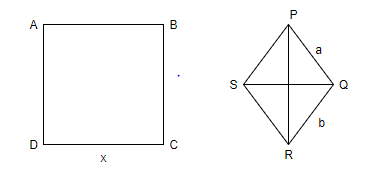
Here, ABCD is a square and PQRS is a rhombus.
We observe that a square is a parallelogram whose all sides are of equal length. While rhombus is a parallelogram whose opposite sides are of equal length.
All the four angles of a square are equal ${{90}^{\circ }}$. However, in a rhombus, the opposite angles are of equal measure. Thus, all the sides of a square are perpendicular to each other. However, the sides of a rhombus are not perpendicular to each other.
Both the diagonals of a square are of equal length. However, the length of diagonals of a rhombus is unequal.
The area of a square with a side of length ‘x’ is given by ${{x}^{2}}$. However, the area of a rhombus is half of the product of the length of the diagonals.
The perimeter of a square with a side of length ‘x’ is given by 4x. However, the perimeter of a rhombus whose sides are of length ‘a’ and ‘b’ is given by $2\left( a+b \right)$.
Hence, we have listed all the differences between a square and a rhombus.
Note: It’s necessary to draw both the figures to observe the differences between them. Otherwise, we might miss out on some differences, or we should memorize all the properties of both square and rhombus.
Complete step-by-step answer:
We have to list the differences between a square and a rhombus.
We will firstly draw a square and a rhombus and then compare their various properties.
Here, ABCD is a square and PQRS is a rhombus.
We observe that a square is a parallelogram whose all sides are of equal length. While rhombus is a parallelogram whose opposite sides are of equal length.
All the four angles of a square are equal ${{90}^{\circ }}$. However, in a rhombus, the opposite angles are of equal measure. Thus, all the sides of a square are perpendicular to each other. However, the sides of a rhombus are not perpendicular to each other.
Both the diagonals of a square are of equal length. However, the length of diagonals of a rhombus is unequal.
The area of a square with a side of length ‘x’ is given by ${{x}^{2}}$. However, the area of a rhombus is half of the product of the length of the diagonals.
The perimeter of a square with a side of length ‘x’ is given by 4x. However, the perimeter of a rhombus whose sides are of length ‘a’ and ‘b’ is given by $2\left( a+b \right)$.
Hence, we have listed all the differences between a square and a rhombus.
Note: It’s necessary to draw both the figures to observe the differences between them. Otherwise, we might miss out on some differences, or we should memorize all the properties of both square and rhombus.
Recently Updated Pages
Master Class 10 English: Engaging Questions & Answers for Success

Master Class 10 Social Science: Engaging Questions & Answers for Success
Master Class 10 Computer Science: Engaging Questions & Answers for Success
Class 10 Question and Answer - Your Ultimate Solutions Guide
Master Class 10 General Knowledge: Engaging Questions & Answers for Success
Master Class 10 Maths: Engaging Questions & Answers for Success
Trending doubts
Explain the Treaty of Vienna of 1815 class 10 social science CBSE
Who Won 36 Oscar Awards? Record Holder Revealed
What is the median of the first 10 natural numbers class 10 maths CBSE
Why is it 530 pm in india when it is 1200 afternoon class 10 social science CBSE
Make a sketch of the human nerve cell What function class 10 biology CBSE
Define Potential, Developed, Stock and Reserved resources