




Light ray entering the eye is controlled by
A) Pupil
B) Iris
C) Cornea
D) Lens
Answer
 Verified
618.9k+ views
Hint:The human eye is responsible for vision and it's one of the most complicated sense organs. The human eye is made up of tissues, muscles, nerves and blood which have an important role in its functioning.
Complete Answer:
Let us know a little bit about the structure of the eye before we find the correct answer.
The structure of eye can be divided into two parts,
->Internal structure - It includes retina, aqueous and vitreous humour and lens.
->External structure - It includes pupil, cornea, iris, conjunctiva, and sclera.
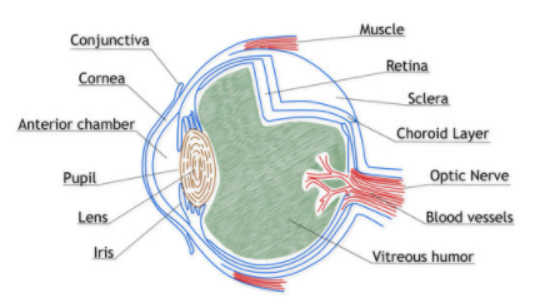
>Option A: Pupil is a small aperture which is located in the center of iris. The light enters via the iris into the pupil. Now, if the light is bright, the pupil gets constricted in order to decrease the amount of light which is entering into the eye. In presence of dim light, the pupil gets dilated in order to allow passage of more light. From this we can conclude that the pupil is the one that controls the entry of light. Therefore, this is the correct option.
>Option B: Iris is the pigmented portion of the eye which gives the eye its characteristic colour. The light enters via iris to the pupil. The main function of iris is to open and close in order to control the amount of light which is entering into the eye via pupil. Therefore, this is the incorrect option.
>Option C: Cornea is the transparent anterior part of the eye which covers the pupil and iris. The main function of cornea is to refract light i.e. bend the incoming light. Therefore, this is the incorrect option.
>Option D: Lens are transparent and biconcave shaped tissues which helps in focusing light to the retina. Therefore, this is the incorrect option.
Thus, the correct answer option is (A) Pupil.
Note:The eye is basically an opaque ball which is present in the eye socket of the skull. The front side of the eye is clear and transparent which helps in entering light. Whereas, in the back end, the optic nerves are connected to the brain to allow transmission of images which the brain processes as vision.
Complete Answer:
Let us know a little bit about the structure of the eye before we find the correct answer.
The structure of eye can be divided into two parts,
->Internal structure - It includes retina, aqueous and vitreous humour and lens.
->External structure - It includes pupil, cornea, iris, conjunctiva, and sclera.
>Option A: Pupil is a small aperture which is located in the center of iris. The light enters via the iris into the pupil. Now, if the light is bright, the pupil gets constricted in order to decrease the amount of light which is entering into the eye. In presence of dim light, the pupil gets dilated in order to allow passage of more light. From this we can conclude that the pupil is the one that controls the entry of light. Therefore, this is the correct option.
>Option B: Iris is the pigmented portion of the eye which gives the eye its characteristic colour. The light enters via iris to the pupil. The main function of iris is to open and close in order to control the amount of light which is entering into the eye via pupil. Therefore, this is the incorrect option.
>Option C: Cornea is the transparent anterior part of the eye which covers the pupil and iris. The main function of cornea is to refract light i.e. bend the incoming light. Therefore, this is the incorrect option.
>Option D: Lens are transparent and biconcave shaped tissues which helps in focusing light to the retina. Therefore, this is the incorrect option.
Thus, the correct answer option is (A) Pupil.
Note:The eye is basically an opaque ball which is present in the eye socket of the skull. The front side of the eye is clear and transparent which helps in entering light. Whereas, in the back end, the optic nerves are connected to the brain to allow transmission of images which the brain processes as vision.
Recently Updated Pages
Master Class 11 English: Engaging Questions & Answers for Success

Master Class 11 Social Science: Engaging Questions & Answers for Success
Master Class 11 Maths: Engaging Questions & Answers for Success
Master Class 11 Chemistry: Engaging Questions & Answers for Success
Master Class 11 Biology: Engaging Questions & Answers for Success
Master Class 11 Physics: Engaging Questions & Answers for Success
Trending doubts
One Metric ton is equal to kg A 10000 B 1000 C 100 class 11 physics CBSE
Difference Between Prokaryotic Cells and Eukaryotic Cells
Find the value of the expression given below sin 30circ class 11 maths CBSE
1 ton equals to A 100 kg B 1000 kg C 10 kg D 10000 class 11 physics CBSE
Two of the body parts which do not appear in MRI are class 11 biology CBSE
Draw a diagram of nephron and explain its structur class 11 biology CBSE