




Lewis structure for :
$ ClO_3^- $ (chlorate ion)
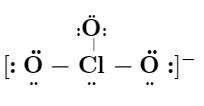
If the above Lewis structure is correct enter $ 1 $ else enter $ 0 $.
Answer
 Verified
596.4k+ views
Hint :For solving this problem, you should have the knowledge about polyatomic ion and oxidation number.Polyatomic ion is an ion containing more than one atom. Oxidation number is the number of electrons lost or gained by an element during a reaction.
Complete Step By Step Answer:
Step-1 :
To solve the given problem, let’s determine the valence electron of all the atoms present in the compound.
Step-2 :
Here, we have given chocolate ions. So, know that the total charge on the ion should be $ ClO_3^- $ . So, we know that the total charge on the ion should be $ -1 $ . We should first find the total valence electron. Here, chlorine has $ 1 $ atom and contains $ 7 $ electrons and oxygen atoms contain $ 18 $ valence electrons.
So, total valence electron is :
$ 7+18-(-1)=26 $
Step-3 :
Next we should find total electron pairs which is a sum of bond pairs and lone pairs. The total electron pairs can be calculated by dividing total valence electrons with $ 2 $ . Here, dividing $ 26 $ by $ 2 $ , we get total electron pairs as $ 13 $ .
Step-4 :
Here, chlorine is used as the central atom and oxygen as the surrounding atom. Here, maximum valency of chlorine is $ 7 $ while that of oxygen is $ 2 $ . So, oxygen can maximum from $ 2 $ bonds while chlorine can form $ 7 $ bonds. The charge on $ 1 $ oxygen is $ -1 $ .
Note :
While determining the Lewis structure of a compound, the valence electron should be remembered and determined correctly so as to avoid any mistakes and if possible the Lewis structures of some basic compounds can be learned to simplify the process.
Complete Step By Step Answer:
Step-1 :
To solve the given problem, let’s determine the valence electron of all the atoms present in the compound.
Step-2 :
Here, we have given chocolate ions. So, know that the total charge on the ion should be $ ClO_3^- $ . So, we know that the total charge on the ion should be $ -1 $ . We should first find the total valence electron. Here, chlorine has $ 1 $ atom and contains $ 7 $ electrons and oxygen atoms contain $ 18 $ valence electrons.
So, total valence electron is :
$ 7+18-(-1)=26 $
Step-3 :
Next we should find total electron pairs which is a sum of bond pairs and lone pairs. The total electron pairs can be calculated by dividing total valence electrons with $ 2 $ . Here, dividing $ 26 $ by $ 2 $ , we get total electron pairs as $ 13 $ .
Step-4 :
Here, chlorine is used as the central atom and oxygen as the surrounding atom. Here, maximum valency of chlorine is $ 7 $ while that of oxygen is $ 2 $ . So, oxygen can maximum from $ 2 $ bonds while chlorine can form $ 7 $ bonds. The charge on $ 1 $ oxygen is $ -1 $ .
Note :
While determining the Lewis structure of a compound, the valence electron should be remembered and determined correctly so as to avoid any mistakes and if possible the Lewis structures of some basic compounds can be learned to simplify the process.
Recently Updated Pages
Which will be the least stable resonating structure class 11 chemistry CBSE

How many 5 digit telephone numbers can be construc-class-11-maths-CBSE
How do you find the angle of the resultant vector class 11 physics CBSE
Draw labelled diagram of the following i Gram seed class 11 biology CBSE
1 Quintal is equal to a 110 kg b 10 kg c 100kg d 1000 class 11 physics CBSE
What is the need and importance of classification class 11 biology CBSE
Trending doubts
Find the value of the expression given below sin 30circ class 11 maths CBSE
One Metric ton is equal to kg A 10000 B 1000 C 100 class 11 physics CBSE
10 examples of friction in our daily life
Draw a diagram of a plant cell and label at least eight class 11 biology CBSE
Difference between physical and chemical change class 11 chemistry CBSE
Proton was discovered by A Thomson B Rutherford C Chadwick class 11 chemistry CBSE