




What is the Lewis structure for bicarbonate?
Answer
 Verified
594k+ views
Hint: To solve this question we first need to know what are Lewis dot structures. The valence electrons of the atoms of a molecule can be represented using the Lewis dot structure. They are a simplified version of the molecular geometry of a compound and can be used to depict the chemical bonding in the molecules.
Complete answer:
Bicarbonate, also known as hydrogen carbonate, is formed when carbonic acid is deprotonated. It is an anion having a formula $HCO_{3}^{-}$.
The Lewis dot structure of a compound can be drawn by the following steps.
1. We first need to know the valence electrons in the atoms of the molecule.
$_{6}C$ has 4 valence electrons, $_{8}O$ has 6 valence electrons, and $_{1}H$ has 1 valence electron.
And the molecule has a negative charge, i.e., 1 electron.
Hence the total number of valence electrons is $1+4+3\times 6+1=24$
2. Identify the least electronegative atom. This atom is the central atom of the molecule.
Carbon is the least electronegative atom in $HCO_{3}^{-}$.
3. Connect the atoms via single bonds to form a skeleton structure.
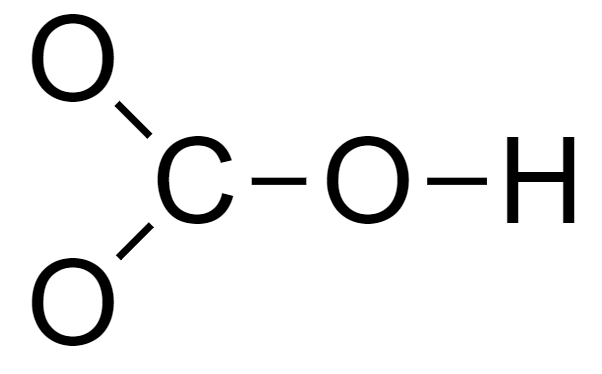
4. Complete the octet of each element.
The two O atoms bonded only to the C atom need 6 electrons each to complete their octet.
The C atom needs 2 electrons to complete its octet.
The O atom bonded to 1 C atom and 1 H atom needs 4 electrons to complete its octet.
The outermost shell of the H atom is complete.
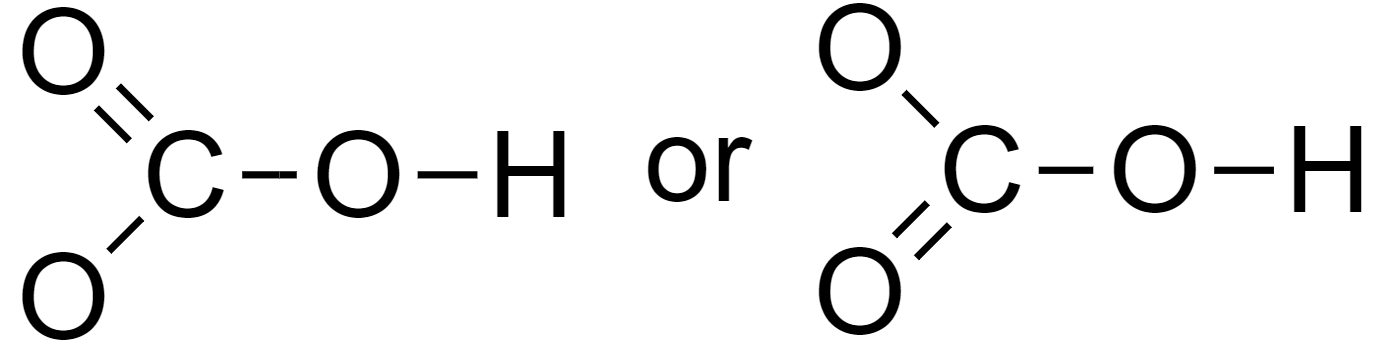
So the total number of electrons required is 18 whereas the available electrons are 16.
Octet can be completed by forming a double bond as follows
5. Assign lone pairs and the negative charge to the molecules.
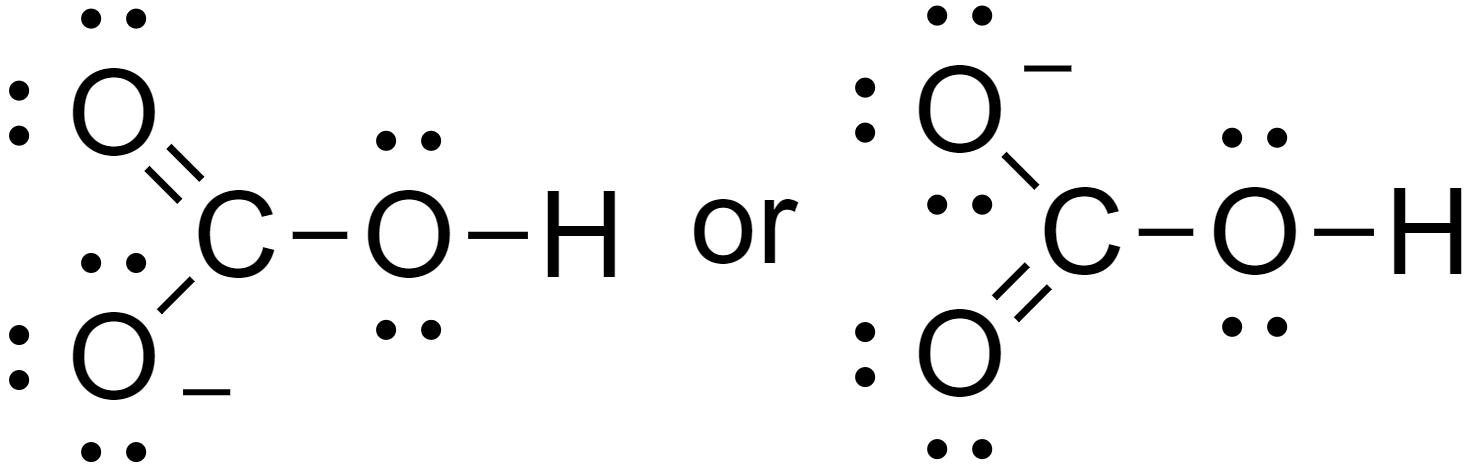
Hence the Lewis structure of bicarbonate is as above.
Note:
It should be noted that in sodium hydrogen carbonate, the hydrogen atom is attached to one of the oxygen atoms. Hence, we can assume that in hydrogen carbonate $HCO_{3}^{-}$, the hydrogen atom will also be bonded to the oxygen atom.
Complete answer:
Bicarbonate, also known as hydrogen carbonate, is formed when carbonic acid is deprotonated. It is an anion having a formula $HCO_{3}^{-}$.
The Lewis dot structure of a compound can be drawn by the following steps.
1. We first need to know the valence electrons in the atoms of the molecule.
$_{6}C$ has 4 valence electrons, $_{8}O$ has 6 valence electrons, and $_{1}H$ has 1 valence electron.
And the molecule has a negative charge, i.e., 1 electron.
Hence the total number of valence electrons is $1+4+3\times 6+1=24$
2. Identify the least electronegative atom. This atom is the central atom of the molecule.
Carbon is the least electronegative atom in $HCO_{3}^{-}$.
3. Connect the atoms via single bonds to form a skeleton structure.
4. Complete the octet of each element.
The two O atoms bonded only to the C atom need 6 electrons each to complete their octet.
The C atom needs 2 electrons to complete its octet.
The O atom bonded to 1 C atom and 1 H atom needs 4 electrons to complete its octet.
The outermost shell of the H atom is complete.
So the total number of electrons required is 18 whereas the available electrons are 16.
Octet can be completed by forming a double bond as follows
5. Assign lone pairs and the negative charge to the molecules.
Hence the Lewis structure of bicarbonate is as above.
Note:
It should be noted that in sodium hydrogen carbonate, the hydrogen atom is attached to one of the oxygen atoms. Hence, we can assume that in hydrogen carbonate $HCO_{3}^{-}$, the hydrogen atom will also be bonded to the oxygen atom.
Recently Updated Pages
Write structures of the following compounds i 2 Chloro3methylpentane class 11 chemistry CBSE

What is BLO What is the full form of BLO class 8 social science CBSE
Explain the Treaty of Vienna of 1815 class 10 social science CBSE
A Paragraph on Pollution in about 100-150 Words
XIX+XXX A 49 B 51 C 55 D 44 class 5 maths CBSE
If x a + bt + ct2 where x is in meters and t is in class 11 physics CBSE
Trending doubts
One Metric ton is equal to kg A 10000 B 1000 C 100 class 11 physics CBSE
Find the value of the expression given below sin 30circ class 11 maths CBSE
What do you mean by retardation What is its SI uni class 11 physics CBSE
Draw a diagram of nephron and explain its structur class 11 biology CBSE
10 examples of friction in our daily life
Difference between physical and chemical change class 11 chemistry CBSE