




Let ${{A}_{0}},{{A}_{1}},{{A}_{2}},{{A}_{3}},{{A}_{4}}\text{ and }{{A}_{5}}$ be a vertex of regular hexagon inscribed in a circle of unit radius. Then the product of the length of the line segment ${{A}_{0}}{{A}_{1}},{{A}_{0}}{{A}_{2}}\text{ and }{{A}_{0}}{{A}_{4}}$ is
\[\begin{align}
& A.\dfrac{3}{4} \\
& B.3\sqrt{3} \\
& C.3 \\
& D.\dfrac{3\sqrt{3}}{2} \\
\end{align}\]
Answer
 Verified
574.8k+ views
Hint: We are given that, we have a unit circle with a circle inscribed in a hexagon. Circle is of unit radius. We have to find length of ${{A}_{0}},{{A}_{1}},{{A}_{2}},{{A}_{3}},{{A}_{4}}\text{ and }{{A}_{5}}$. To do so we will use the circle to find the coordinate of those vertices, we use that hexagon subtend ${{60}^{\circ }}$ at the center from each side. Once we have coordinates, we will use $\cos {{60}^{\circ }}=\dfrac{1}{{2}}\text{ and }\sin {{60}^{\circ }}=\dfrac{\sqrt{3}}{2}$ and lastly we need distance formula $\sqrt{{{\left( {{x}_{2}}-{{x}_{1}} \right)}^{2}}+{{\left( {{y}_{2}}-{{y}_{1}} \right)}^{2}}}$ to find distance. Then, at last we will find the product.
Complete step-by-step solution:
We are given that ${{A}_{0}},{{A}_{1}},{{A}_{2}},{{A}_{3}},{{A}_{4}}\text{ and }{{A}_{5}}$ are vertex of a regular hexagon that is inscribed in a circle.
Let the circle have O as center. As we are given, the circle has unit radius, so we have $O{{A}_{0}}=1$.
$O{{A}_{0}}$ is radius as ${{A}_{0}}$ lies on the circle and O is the center.
So as ${{A}_{1}},{{A}_{2}},{{A}_{3}},{{A}_{4}}\text{ and }{{A}_{5}}$ also lies on circle. So, $O{{A}_{1}},O{{A}_{2}},O{{A}_{3}},O{{A}_{4}}\text{ and O}{{A}_{5}}$ are also radius. Hence,
$O{{A}_{1}}=O{{A}_{2}}=O{{A}_{3}}=O{{A}_{4}}=\text{O}{{A}_{5}}=1$.
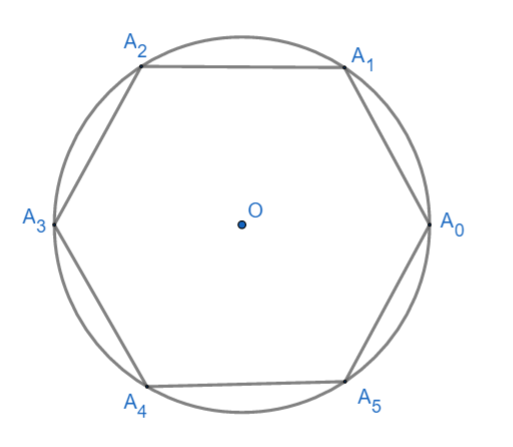
Now we know regular hexagon has each side equal and angle subtended by them at the center is of ${{60}^{\circ }}$ so,
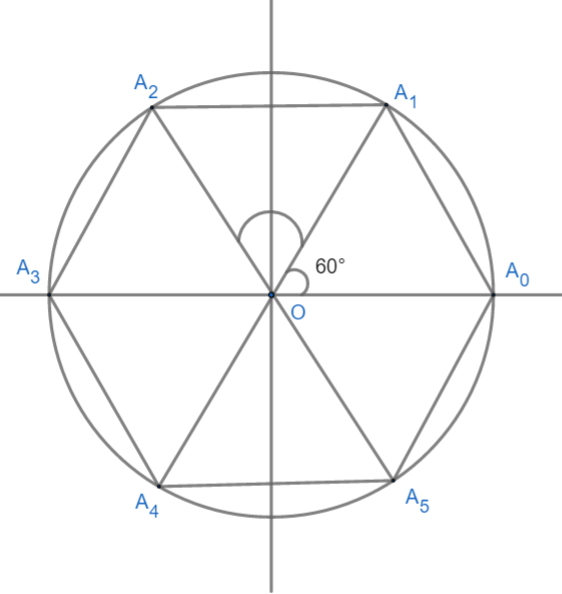
Now we will have to find the coordinate of the vertex of the hexagon.
As we have to find distance of ${{A}_{0}}{{A}_{1}},{{A}_{0}}{{A}_{2}}\text{ and }{{A}_{0}}{{A}_{4}}$ so we need coordinate of ${{A}_{0}},{{A}_{1}},{{A}_{2}}\text{ and }{{A}_{4}}$.
As angle subtends by each side, so we can see that, ${{A}_{0}}=\left( 1,0 \right)$ (as radius of circle is 1).
Now, coordinate of ${{A}_{1}}=\left( \cos {{60}^{\circ }},\sin {{60}^{\circ }} \right)$.
Similarly, we have ${{A}_{2}}=\left( \cos {{120}^{\circ }},\sin {{120}^{\circ }} \right)$.
Similarly, we have ${{A}_{4}}=\left( \cos {{240}^{\circ }},\sin {{240}^{\circ }} \right)$.
Now simplifying we get,
$\begin{align}
& {{A}_{1}}=\left( \cos {{60}^{\circ }},\sin {{60}^{\circ }} \right)={{A}_{1}}\left( \dfrac{1}{2},\dfrac{\sqrt{3}}{2} \right) \\
& {{A}_{2}}=\left( \cos {{120}^{\circ }},\sin {{120}^{\circ }} \right)={{A}_{2}}\left( \dfrac{-1}{2},\dfrac{\sqrt{3}}{2} \right) \\
\end{align}$
We can write it as we know that $\cos {{120}^{\circ }}=\cos \left( {{180}^{\circ }}-{{60}^{\circ }} \right)=-\cos {{60}^{\circ }}=-\dfrac{1}{2}$ and $\sin {{120}^{\circ }}=\sin \left( {{180}^{\circ }}-{{60}^{\circ }} \right)=\sin {{60}^{\circ }}=\dfrac{\sqrt{3}}{2}$.
${{A}_{4}}=\left( \cos {{240}^{\circ }},\sin {{240}^{\circ }} \right)=\left( -\dfrac{1}{2},\dfrac{-\sqrt{3}}{2} \right)$.
We can write it as we know that $\cos {{240}^{\circ }}=\cos \left( {{180}^{\circ }}+{{60}^{\circ }} \right)=-\cos {{60}^{\circ }}=-\dfrac{1}{2}$ and $\sin {{240}^{\circ }}=\sin \left( {{180}^{\circ }}+{{60}^{\circ }} \right)=-\sin {{60}^{\circ }}=\dfrac{-\sqrt{3}}{2}$.
Now we will find the distance, we know that for points \[A\left( {{x}_{1}},{{y}_{1}} \right)\text{ and }B\left( {{x}_{2}},{{y}_{2}} \right)\], the distance AB is given as $AB=\sqrt{{{\left( {{x}_{2}}-{{x}_{1}} \right)}^{2}}+{{\left( {{y}_{2}}-{{y}_{1}} \right)}^{2}}}$.
So for
\[\begin{align}
& {{A}_{0}}\left( 1,0 \right)\text{ and }{{A}_{1}}\left( \dfrac{1}{2},\dfrac{\sqrt{3}}{2} \right) \\
& {{A}_{0}}{{A}_{1}}=\sqrt{{{\left( \dfrac{1}{2}-1 \right)}^{2}}+{{\left( \dfrac{\sqrt{3}}{2}-0 \right)}^{2}}} \\
\end{align}\].
Simplifying we get \[{{A}_{0}}{{A}_{1}}=\sqrt{{{\left( -\dfrac{1}{2} \right)}^{2}}+{{\left( \dfrac{\sqrt{3}}{2} \right)}^{2}}}=\sqrt{\dfrac{4}{4}}=1\].
Similarly, for
\[\begin{align}
& {{A}_{0}}\left( 1,0 \right)\text{ and }{{A}_{2}}\left( \dfrac{-1}{2},\dfrac{\sqrt{3}}{2} \right) \\
& {{A}_{0}}{{A}_{2}}=\sqrt{{{\left( \dfrac{-1}{2}-1 \right)}^{2}}+{{\left( \dfrac{\sqrt{3}}{2}-0 \right)}^{2}}} \\
\end{align}\]
Simplifying we get \[{{A}_{0}}{{A}_{2}}=\sqrt{{{\left( -\dfrac{3}{2} \right)}^{2}}+{{\left( \dfrac{\sqrt{3}}{2} \right)}^{2}}}=\sqrt{\dfrac{9}{4}+\dfrac{3}{4}}=\sqrt{\dfrac{12}{4}}=\sqrt{3}\].
Now for
\[\begin{align}
& {{A}_{0}}\left( 1,0 \right)\text{ and }{{A}_{4}}\left( \dfrac{-1}{2},\dfrac{-\sqrt{3}}{2} \right) \\
& {{A}_{0}}{{A}_{2}}=\sqrt{{{\left( \dfrac{-1}{2}-1 \right)}^{2}}+{{\left( \dfrac{-\sqrt{3}}{2}-0 \right)}^{2}}} \\
\end{align}\]
Simplifying we get, \[{{A}_{0}}{{A}_{4}}=\sqrt{{{\left( -\dfrac{3}{2} \right)}^{2}}+{{\left( \dfrac{-\sqrt{3}}{2} \right)}^{2}}}\].
Solving we get, \[{{A}_{0}}{{A}_{4}}=\sqrt{\dfrac{9}{4}+\dfrac{3}{4}}=\sqrt{\dfrac{12}{4}}=\sqrt{3}\].
So we get \[{{A}_{0}}{{A}_{4}}=\sqrt{3}\].
Now, we are asked to find the product of ${{A}_{0}}{{A}_{1}},{{A}_{0}}{{A}_{2}}\text{ and }{{A}_{0}}{{A}_{4}}$. So, ${{A}_{0}}{{A}_{1}}\times {{A}_{0}}{{A}_{2}}\times {{A}_{0}}{{A}_{4}}=1\times \sqrt{3}\times \sqrt{3}=3$.
So the required product is 3.
Hence option C is the correct answer.
Note: While solving distance we need to be much focused. As mistakes like ${{\left( \dfrac{-3}{2} \right)}^{2}}=\dfrac{-9}{4},\dfrac{-1}{2}-1=\dfrac{-2}{2}$ may happen. Students must remember that, while doing square, sign always comes out as positive and for addition of fraction, we take LCM before adding.
Complete step-by-step solution:
We are given that ${{A}_{0}},{{A}_{1}},{{A}_{2}},{{A}_{3}},{{A}_{4}}\text{ and }{{A}_{5}}$ are vertex of a regular hexagon that is inscribed in a circle.
Let the circle have O as center. As we are given, the circle has unit radius, so we have $O{{A}_{0}}=1$.
$O{{A}_{0}}$ is radius as ${{A}_{0}}$ lies on the circle and O is the center.
So as ${{A}_{1}},{{A}_{2}},{{A}_{3}},{{A}_{4}}\text{ and }{{A}_{5}}$ also lies on circle. So, $O{{A}_{1}},O{{A}_{2}},O{{A}_{3}},O{{A}_{4}}\text{ and O}{{A}_{5}}$ are also radius. Hence,
$O{{A}_{1}}=O{{A}_{2}}=O{{A}_{3}}=O{{A}_{4}}=\text{O}{{A}_{5}}=1$.
Now we know regular hexagon has each side equal and angle subtended by them at the center is of ${{60}^{\circ }}$ so,
Now we will have to find the coordinate of the vertex of the hexagon.
As we have to find distance of ${{A}_{0}}{{A}_{1}},{{A}_{0}}{{A}_{2}}\text{ and }{{A}_{0}}{{A}_{4}}$ so we need coordinate of ${{A}_{0}},{{A}_{1}},{{A}_{2}}\text{ and }{{A}_{4}}$.
As angle subtends by each side, so we can see that, ${{A}_{0}}=\left( 1,0 \right)$ (as radius of circle is 1).
Now, coordinate of ${{A}_{1}}=\left( \cos {{60}^{\circ }},\sin {{60}^{\circ }} \right)$.
Similarly, we have ${{A}_{2}}=\left( \cos {{120}^{\circ }},\sin {{120}^{\circ }} \right)$.
Similarly, we have ${{A}_{4}}=\left( \cos {{240}^{\circ }},\sin {{240}^{\circ }} \right)$.
Now simplifying we get,
$\begin{align}
& {{A}_{1}}=\left( \cos {{60}^{\circ }},\sin {{60}^{\circ }} \right)={{A}_{1}}\left( \dfrac{1}{2},\dfrac{\sqrt{3}}{2} \right) \\
& {{A}_{2}}=\left( \cos {{120}^{\circ }},\sin {{120}^{\circ }} \right)={{A}_{2}}\left( \dfrac{-1}{2},\dfrac{\sqrt{3}}{2} \right) \\
\end{align}$
We can write it as we know that $\cos {{120}^{\circ }}=\cos \left( {{180}^{\circ }}-{{60}^{\circ }} \right)=-\cos {{60}^{\circ }}=-\dfrac{1}{2}$ and $\sin {{120}^{\circ }}=\sin \left( {{180}^{\circ }}-{{60}^{\circ }} \right)=\sin {{60}^{\circ }}=\dfrac{\sqrt{3}}{2}$.
${{A}_{4}}=\left( \cos {{240}^{\circ }},\sin {{240}^{\circ }} \right)=\left( -\dfrac{1}{2},\dfrac{-\sqrt{3}}{2} \right)$.
We can write it as we know that $\cos {{240}^{\circ }}=\cos \left( {{180}^{\circ }}+{{60}^{\circ }} \right)=-\cos {{60}^{\circ }}=-\dfrac{1}{2}$ and $\sin {{240}^{\circ }}=\sin \left( {{180}^{\circ }}+{{60}^{\circ }} \right)=-\sin {{60}^{\circ }}=\dfrac{-\sqrt{3}}{2}$.
Now we will find the distance, we know that for points \[A\left( {{x}_{1}},{{y}_{1}} \right)\text{ and }B\left( {{x}_{2}},{{y}_{2}} \right)\], the distance AB is given as $AB=\sqrt{{{\left( {{x}_{2}}-{{x}_{1}} \right)}^{2}}+{{\left( {{y}_{2}}-{{y}_{1}} \right)}^{2}}}$.
So for
\[\begin{align}
& {{A}_{0}}\left( 1,0 \right)\text{ and }{{A}_{1}}\left( \dfrac{1}{2},\dfrac{\sqrt{3}}{2} \right) \\
& {{A}_{0}}{{A}_{1}}=\sqrt{{{\left( \dfrac{1}{2}-1 \right)}^{2}}+{{\left( \dfrac{\sqrt{3}}{2}-0 \right)}^{2}}} \\
\end{align}\].
Simplifying we get \[{{A}_{0}}{{A}_{1}}=\sqrt{{{\left( -\dfrac{1}{2} \right)}^{2}}+{{\left( \dfrac{\sqrt{3}}{2} \right)}^{2}}}=\sqrt{\dfrac{4}{4}}=1\].
Similarly, for
\[\begin{align}
& {{A}_{0}}\left( 1,0 \right)\text{ and }{{A}_{2}}\left( \dfrac{-1}{2},\dfrac{\sqrt{3}}{2} \right) \\
& {{A}_{0}}{{A}_{2}}=\sqrt{{{\left( \dfrac{-1}{2}-1 \right)}^{2}}+{{\left( \dfrac{\sqrt{3}}{2}-0 \right)}^{2}}} \\
\end{align}\]
Simplifying we get \[{{A}_{0}}{{A}_{2}}=\sqrt{{{\left( -\dfrac{3}{2} \right)}^{2}}+{{\left( \dfrac{\sqrt{3}}{2} \right)}^{2}}}=\sqrt{\dfrac{9}{4}+\dfrac{3}{4}}=\sqrt{\dfrac{12}{4}}=\sqrt{3}\].
Now for
\[\begin{align}
& {{A}_{0}}\left( 1,0 \right)\text{ and }{{A}_{4}}\left( \dfrac{-1}{2},\dfrac{-\sqrt{3}}{2} \right) \\
& {{A}_{0}}{{A}_{2}}=\sqrt{{{\left( \dfrac{-1}{2}-1 \right)}^{2}}+{{\left( \dfrac{-\sqrt{3}}{2}-0 \right)}^{2}}} \\
\end{align}\]
Simplifying we get, \[{{A}_{0}}{{A}_{4}}=\sqrt{{{\left( -\dfrac{3}{2} \right)}^{2}}+{{\left( \dfrac{-\sqrt{3}}{2} \right)}^{2}}}\].
Solving we get, \[{{A}_{0}}{{A}_{4}}=\sqrt{\dfrac{9}{4}+\dfrac{3}{4}}=\sqrt{\dfrac{12}{4}}=\sqrt{3}\].
So we get \[{{A}_{0}}{{A}_{4}}=\sqrt{3}\].
Now, we are asked to find the product of ${{A}_{0}}{{A}_{1}},{{A}_{0}}{{A}_{2}}\text{ and }{{A}_{0}}{{A}_{4}}$. So, ${{A}_{0}}{{A}_{1}}\times {{A}_{0}}{{A}_{2}}\times {{A}_{0}}{{A}_{4}}=1\times \sqrt{3}\times \sqrt{3}=3$.
So the required product is 3.
Hence option C is the correct answer.
Note: While solving distance we need to be much focused. As mistakes like ${{\left( \dfrac{-3}{2} \right)}^{2}}=\dfrac{-9}{4},\dfrac{-1}{2}-1=\dfrac{-2}{2}$ may happen. Students must remember that, while doing square, sign always comes out as positive and for addition of fraction, we take LCM before adding.
Recently Updated Pages
Basicity of sulphurous acid and sulphuric acid are

Master Class 10 English: Engaging Questions & Answers for Success
Master Class 10 Social Science: Engaging Questions & Answers for Success
Master Class 10 Computer Science: Engaging Questions & Answers for Success
Class 10 Question and Answer - Your Ultimate Solutions Guide
Master Class 10 General Knowledge: Engaging Questions & Answers for Success
Trending doubts
Who is known as the "Little Master" in Indian cricket history?
Explain the Treaty of Vienna of 1815 class 10 social science CBSE
A boat goes 24 km upstream and 28 km downstream in class 10 maths CBSE
Which are the three major ports of Tamil Nadu A Chennai class 10 social science CBSE
The highest dam in India is A Bhakra dam B Tehri dam class 10 social science CBSE
Describe the process of Unification of Italy class 10 social science CBSE