




Let A = {1, 3, 5, 7, 9} & B = {2, 3, 5, 7, 11, 13}. Find A∩B?
Answer
 Verified
625.5k+ views
Hint: For finding A∩B, we need to know what A∩B is. It is the number of elements common in both the sets A and B. In the above problem, look through set A and set B and segregate the number of elements common in both the sets and write these segregated elements under A∩B.
Complete step-by-step answer:
From the chapter of sets, we know that:
A∩B is the intersection of the two sets A and B.
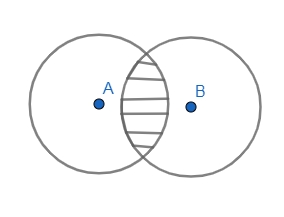
In the above figure, 2 sets A and B are given and the shaded region is the area common in both the sets and it is also called as A∩B.
Number of elements given in the set A is as follows:
A = {1, 3, 5, 7, 9}
Number of elements given in the set B is as follows:
B = {2, 3, 5, 7, 11, 13}
As you can see from both the sets that 3, 5, 7 are the common elements among both the sets.
So, A∩B is equal to 3, 5 and 7.
Hence, A∩B = {3, 5, 7}.
Note: You might think that in the intersection of sets A and B, the set size of both the sets should be equal. It is not necessary that the size of the sets be similar. And don’t confuse with the symbols like “∪” stands for Union and “∩” stands for intersection. To eliminate confusion as “Union” starts with “U” so you can remember “U” for “Union” and the remaining will be intersection.
Complete step-by-step answer:
From the chapter of sets, we know that:
A∩B is the intersection of the two sets A and B.
In the above figure, 2 sets A and B are given and the shaded region is the area common in both the sets and it is also called as A∩B.
Number of elements given in the set A is as follows:
A = {1, 3, 5, 7, 9}
Number of elements given in the set B is as follows:
B = {2, 3, 5, 7, 11, 13}
As you can see from both the sets that 3, 5, 7 are the common elements among both the sets.
So, A∩B is equal to 3, 5 and 7.
Hence, A∩B = {3, 5, 7}.
Note: You might think that in the intersection of sets A and B, the set size of both the sets should be equal. It is not necessary that the size of the sets be similar. And don’t confuse with the symbols like “∪” stands for Union and “∩” stands for intersection. To eliminate confusion as “Union” starts with “U” so you can remember “U” for “Union” and the remaining will be intersection.
Recently Updated Pages
Master Class 10 Social Science: Engaging Questions & Answers for Success

Master Class 10 Science: Engaging Questions & Answers for Success
Master Class 10 Maths: Engaging Questions & Answers for Success
Master Class 10 General Knowledge: Engaging Questions & Answers for Success
Master Class 10 Computer Science: Engaging Questions & Answers for Success
Class 10 Question and Answer - Your Ultimate Solutions Guide
Trending doubts
What is the full form of PNG A Petrol Natural Gas B class 10 chemistry CBSE
Explain the Treaty of Vienna of 1815 class 10 social science CBSE
In cricket, how many legal balls are there in a standard over?
Why is there a time difference of about 5 hours between class 10 social science CBSE
Who Won 36 Oscar Awards? Record Holder Revealed
What is the median of the first 10 natural numbers class 10 maths CBSE