




What is the length of the alimentary canal in human beings? List out the parts of the gastrointestinal tract in the correct sequential order based on the passage of food.
Answer
 Verified
599.1k+ views
Hint:Along with those associated glands, the food canal is the entire digestive system of our body. The arrangement and size of the different organs of the food canal depend on the role of the organ.
Complete answer:
In humans, the food canal stretches from the mouth to the anus. It is between 8 to 10 meters long in humans. The basic organs of the food canal are the mouth, the esophagus, the stomach, the small intestine, and the large intestine. The food canal has two openings. The opening at the anterior end is the mouth, and the anus at the posterior end.
The various organs of the food canal can be described as:
The first part of the food canal where partial digestion of food takes place with the help of saliva include the teeth and tongue. Food falls from the mouth to the food pipe or to the esophagus.
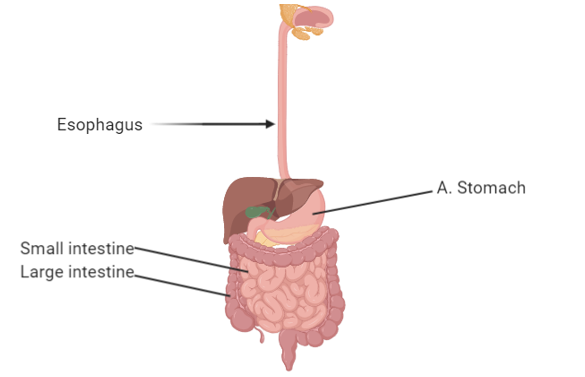
The gastrointestinal tract may be separated into the upper and lower tracts. The oral cavity, pharynx, esophagus, stomach, and duodenum are part of the upper gastrointestinal tract, while the small intestine and large intestine are part of the lower tract.
The small intestine is further divided into duodenum, jejunum, and ileum, while the ascending colon, transverse colon, descending colon, and rectum is located in the large intestine.
Food travels in series through the following organs: oral cavity or mouth, pharynx, esophagus, stomach, small intestine (duodenum, jejunum, and ileum), large intestine (cecum, colon, rectum), and anus.
Note: The primary function of the small intestine is the absorption of nutrients and a maximum amount of surface area is needed for this function. In order to increase its surface area, it also bears several finger-like projections called villi and microvilli on its internal surface. That's why small intestines are too long. Unlike the act of feeding, the nutrients are absorbed very slowly, since the length of the small intestine causes the process to take time (in hours).
Complete answer:
In humans, the food canal stretches from the mouth to the anus. It is between 8 to 10 meters long in humans. The basic organs of the food canal are the mouth, the esophagus, the stomach, the small intestine, and the large intestine. The food canal has two openings. The opening at the anterior end is the mouth, and the anus at the posterior end.
The various organs of the food canal can be described as:
The first part of the food canal where partial digestion of food takes place with the help of saliva include the teeth and tongue. Food falls from the mouth to the food pipe or to the esophagus.
The gastrointestinal tract may be separated into the upper and lower tracts. The oral cavity, pharynx, esophagus, stomach, and duodenum are part of the upper gastrointestinal tract, while the small intestine and large intestine are part of the lower tract.
The small intestine is further divided into duodenum, jejunum, and ileum, while the ascending colon, transverse colon, descending colon, and rectum is located in the large intestine.
Food travels in series through the following organs: oral cavity or mouth, pharynx, esophagus, stomach, small intestine (duodenum, jejunum, and ileum), large intestine (cecum, colon, rectum), and anus.
Note: The primary function of the small intestine is the absorption of nutrients and a maximum amount of surface area is needed for this function. In order to increase its surface area, it also bears several finger-like projections called villi and microvilli on its internal surface. That's why small intestines are too long. Unlike the act of feeding, the nutrients are absorbed very slowly, since the length of the small intestine causes the process to take time (in hours).
Recently Updated Pages
Master Class 11 English: Engaging Questions & Answers for Success

Master Class 11 Social Science: Engaging Questions & Answers for Success
Master Class 11 Maths: Engaging Questions & Answers for Success
Master Class 11 Biology: Engaging Questions & Answers for Success
Master Class 11 Physics: Engaging Questions & Answers for Success
Master Class 11 Chemistry: Engaging Questions & Answers for Success
Trending doubts
Difference between physical and chemical change class 11 chemistry CBSE
How do I convert ms to kmh Give an example class 11 physics CBSE
What is the atomic mass of Sodium a 22 gmol b 23 gmol class 11 chemistry CBSE
In which country Lascaux cave is located A India B class 11 social science CBSE
Proton was discovered by A Thomson B Rutherford C Chadwick class 11 chemistry CBSE
The skull of the frog is a Tricondylic b Monocondylic class 11 biology CBSE