




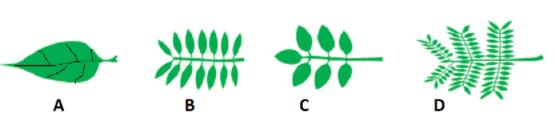
Leaves may be simple or compound. Which of the given figures show(s) compound leaves?
A) A only
B) B, C, D only
C) A and D only
D0 All of these.
Answer
 Verified
536.4k+ views
Hint: Leaf is the aerial part of the plant. It is attached to the plant stem by the help of petiole. The lamina is called the leaf blade. The leaves are classified as simple or compound on the basis of the division of the lamina.
Complete answer:
From the above figure, it is evident that the leaves are of various types simple and compound. Let us discuss the structure of the leaf. The leaf contains a lamina or leaf blade. The stalk of the leaf which attaches the stem is called the petiole. The leaf has a midrib from which the veins and veinlets arise.
On the basis of the division of the lamina or leaf blade, leaves are of two types-
I) Simple leaf- It is the leaf in which the lamina or the blade is undivided. Each leaf has a midrib, from which the veins and veinlets are arising. Example- Leaves of Ficus is a simple leaf. The figure A represents a simple leaf.
II) Compound leaf- A compound leaf is a leaf in which the lamina is divided and subdivided to form leaflets. Each leaflet is separated along the vein or the secondary veins. Examples of compound leaves are neem, rose, tamarind etc. Figure B, C, D are the compound leaf Figure B and C are pinnately compound leaves where the leaflets are arranged around the main vein whereas figure D is bipinnately compound where the division of the leaf is twice and the leaflets are arranged along the secondary vein.
Thus, the correct answer is option ‘B’.
Note: Leaf are the integral part of the plants. They contain chlorophyll which are useful for photosynthesis. The exchange of gases and transpiration occurs through the stomata of the leaf. The leaves are modified according to the habitat for better adaptation of the plant.
Complete answer:
From the above figure, it is evident that the leaves are of various types simple and compound. Let us discuss the structure of the leaf. The leaf contains a lamina or leaf blade. The stalk of the leaf which attaches the stem is called the petiole. The leaf has a midrib from which the veins and veinlets arise.
On the basis of the division of the lamina or leaf blade, leaves are of two types-
I) Simple leaf- It is the leaf in which the lamina or the blade is undivided. Each leaf has a midrib, from which the veins and veinlets are arising. Example- Leaves of Ficus is a simple leaf. The figure A represents a simple leaf.
II) Compound leaf- A compound leaf is a leaf in which the lamina is divided and subdivided to form leaflets. Each leaflet is separated along the vein or the secondary veins. Examples of compound leaves are neem, rose, tamarind etc. Figure B, C, D are the compound leaf Figure B and C are pinnately compound leaves where the leaflets are arranged around the main vein whereas figure D is bipinnately compound where the division of the leaf is twice and the leaflets are arranged along the secondary vein.
Thus, the correct answer is option ‘B’.
Note: Leaf are the integral part of the plants. They contain chlorophyll which are useful for photosynthesis. The exchange of gases and transpiration occurs through the stomata of the leaf. The leaves are modified according to the habitat for better adaptation of the plant.
Recently Updated Pages
Master Class 11 English: Engaging Questions & Answers for Success

Master Class 11 Maths: Engaging Questions & Answers for Success
Class 11 Question and Answer - Your Ultimate Solutions Guide
Master Class 11 Biology: Engaging Questions & Answers for Success
Master Class 11 Physics: Engaging Questions & Answers for Success
Master Class 11 Accountancy: Engaging Questions & Answers for Success
Trending doubts
Differentiate between an exothermic and an endothermic class 11 chemistry CBSE
One Metric ton is equal to kg A 10000 B 1000 C 100 class 11 physics CBSE
In what year Guru Nanak Dev ji was born A15 April 1469 class 11 social science CBSE
Difference Between Prokaryotic Cells and Eukaryotic Cells
There are 720 permutations of the digits 1 2 3 4 5 class 11 maths CBSE
Draw a diagram of a plant cell and label at least eight class 11 biology CBSE